用語 Reference
Glossary of Nihontō Terminology
281 terms used across the site — blade parts, the activities of the steel (hada, hamon, nie and nioi), geometry, construction, flaws, mountings, schools, and authentication papers. Filter by category or search; the visual terms gain photographs as we shoot them.
281 terms shown
No terms match. Try a different word or “All”.
Blade parts
- Kissaki
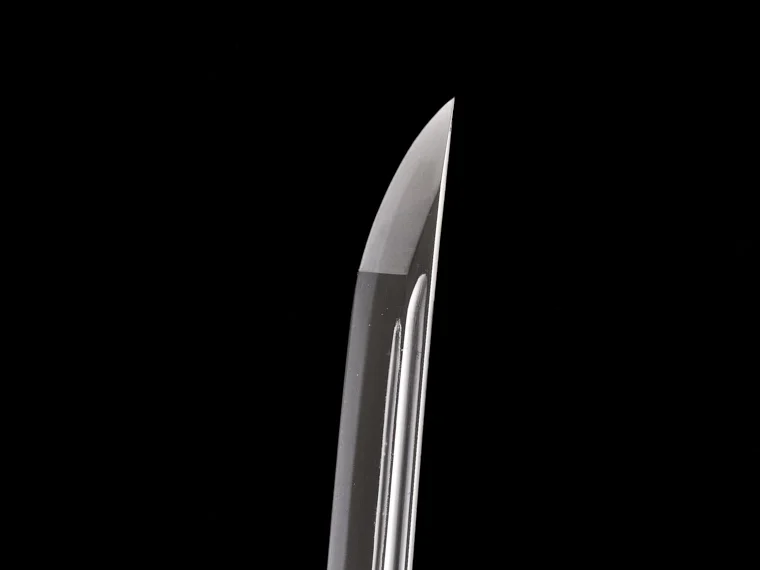
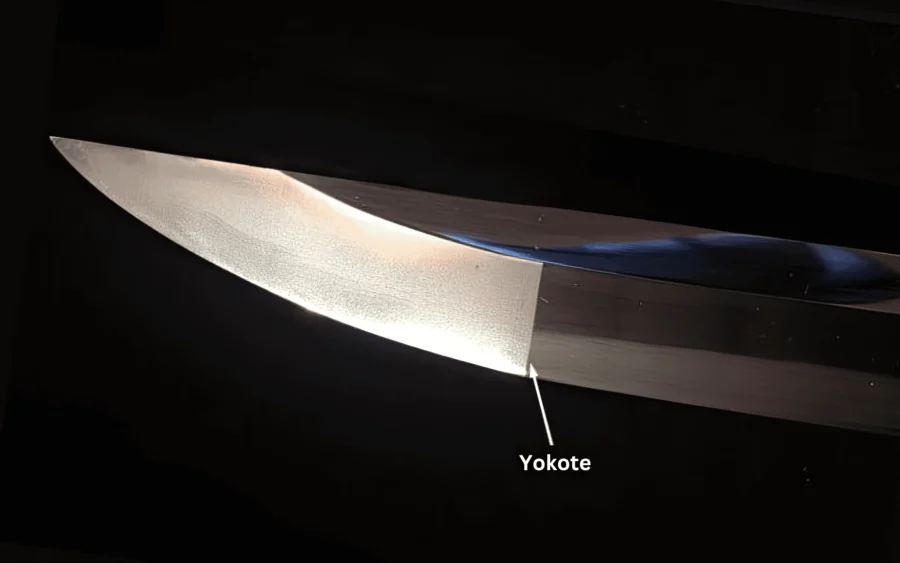
- The point section of the blade, bounded by the yokote line. Classified by size — ko-kissaki (small), chu-kissaki (medium), or o-kissaki (large) — and a primary indicator of period and school in kantei.
- Yokote
- The line that delineates the kissaki from the rest of the blade. Its angle and sharpness are important kantei details.
- Shinogi
- The longitudinal ridge running along the blade that divides the flat ji from the upper bevel (shinogi-ji). Its height and placement affect both cutting geometry and visual character.
- Ji
- The flat surface of the blade between the shinogi and the hamon. The ji displays the hada (grain) and is where activities such as utsuri appear. See also: hada, utsuri.
- Mune
- The spine (back) of the blade. Common forms are iori-mune (ridged), maru-mune (rounded), and kaku-mune (square); the profile is a useful indicator of school and period.
- Hi
- A groove or channel cut into the blade, usually on the shinogi-ji. Beyond aesthetics, hi reduce weight and improve balance. Also called bo-hi when a single full-length groove is present.
- Hamachi
- The notch at the base of the cutting edge that marks the boundary between the blade proper and the nakago. See also: munemachi.
- Munemachi
- The corresponding notch on the spine side, paired with the hamachi to seat the habaki. The distance between munemachi and hamachi can indicate whether a blade has been shortened (o-suriage).
- Habaki
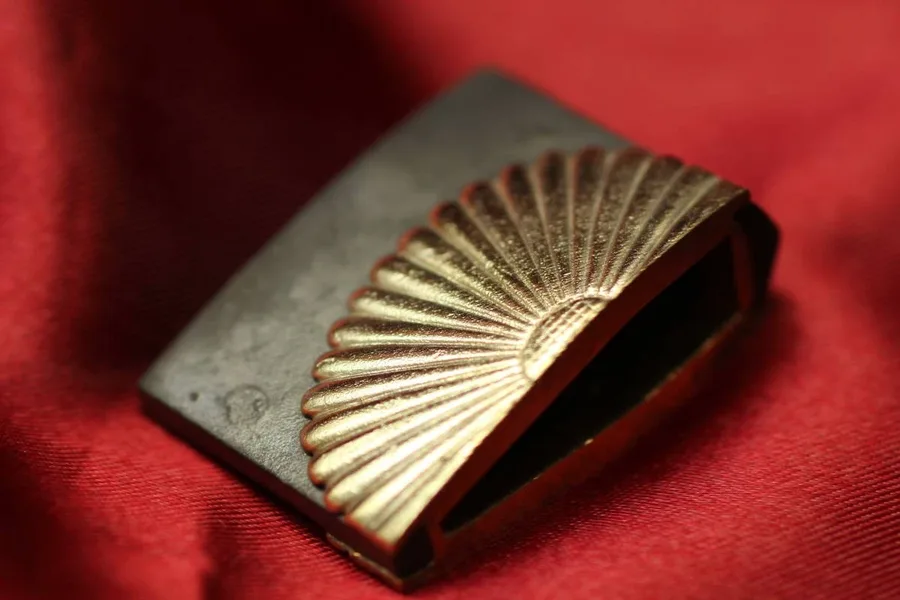
- The metal collar that seats over the hamachi and munemachi, locking the blade snugly in the saya and providing a stop for the koiguchi. Usually copper or silver; quality and age of the habaki are secondary authentication details.
- Nakago
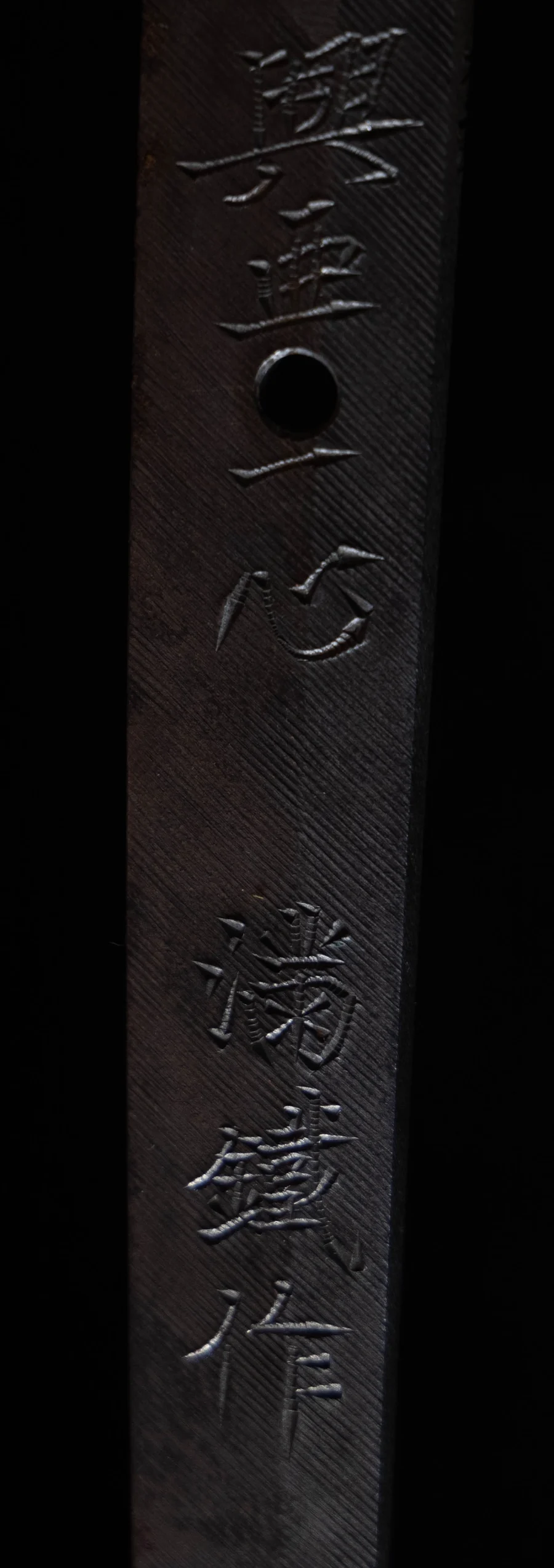
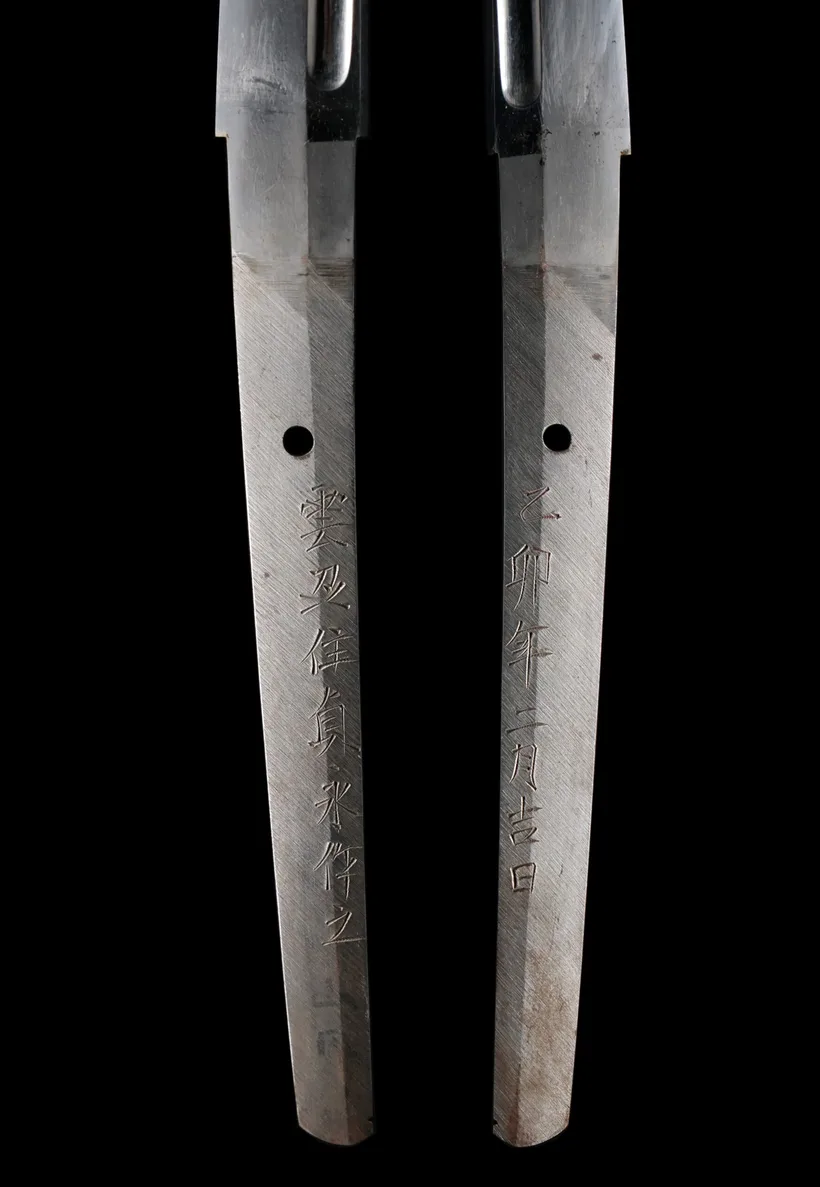
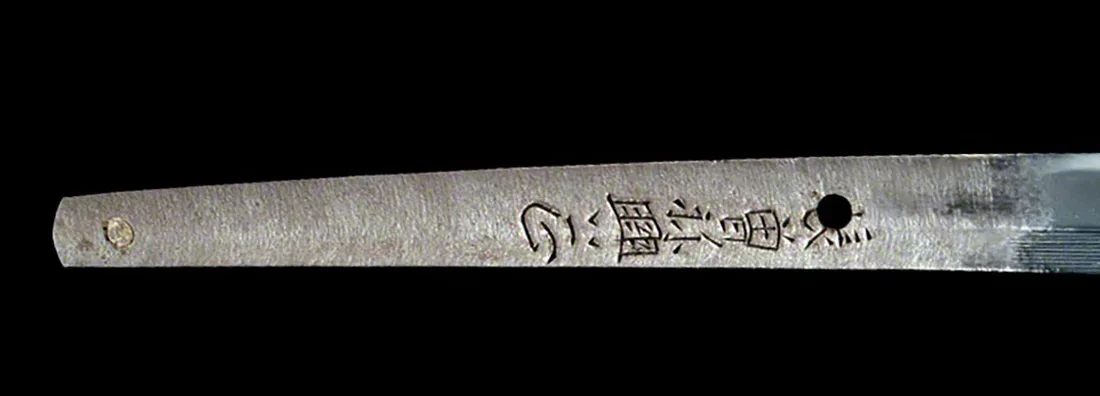
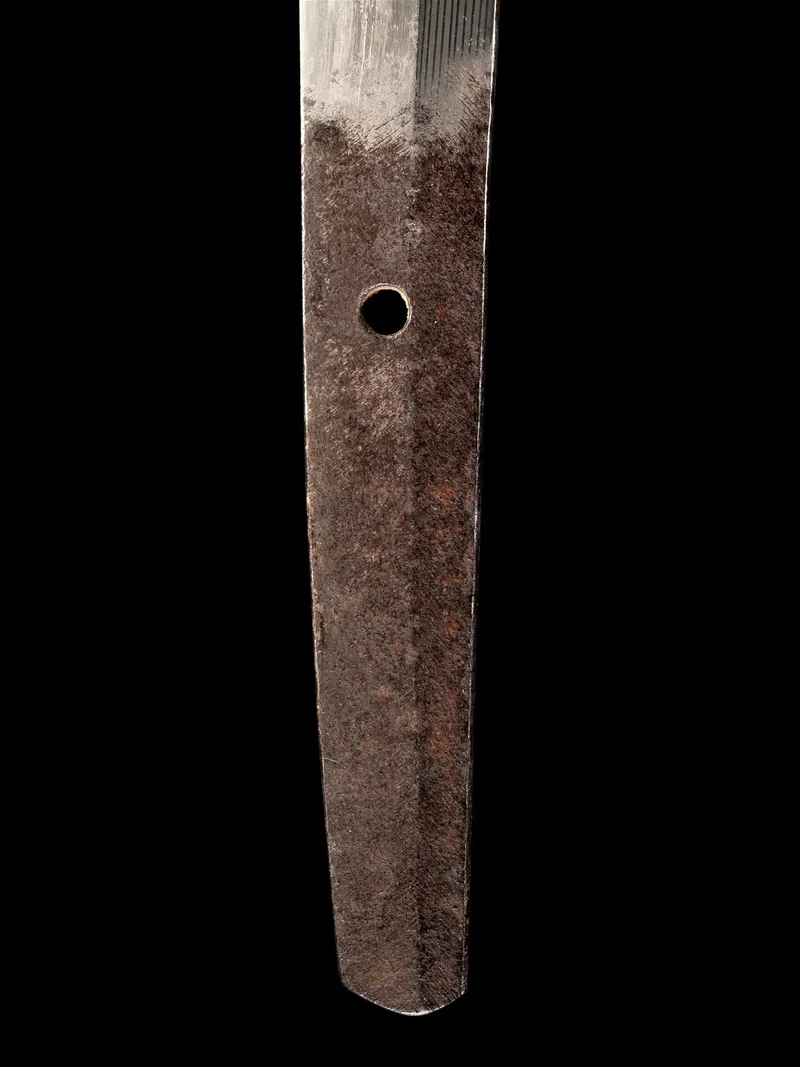
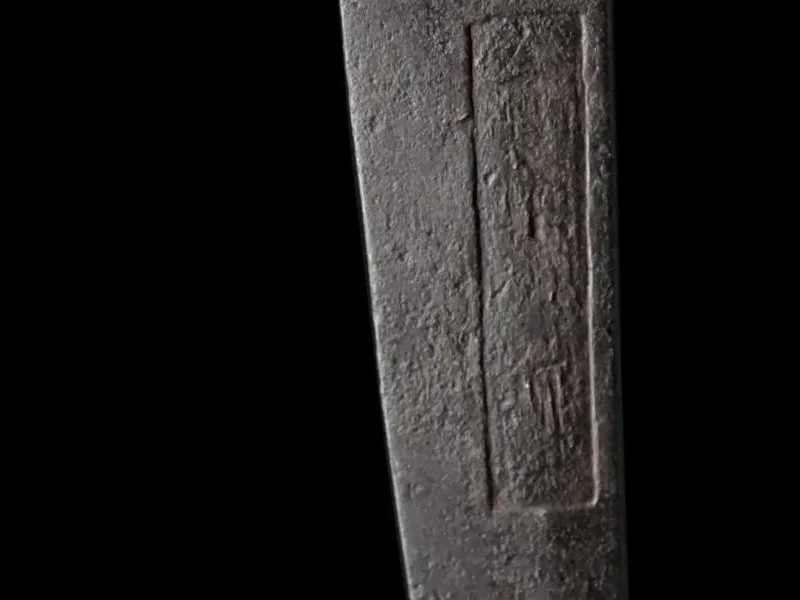
- The tang — the unsharpened portion concealed within the tsuka. The nakago carries the smith's signature (mei), file marks (yasurime), and on WW2-era blades often a punched arsenal stamp. See also: mei, yasurime.
- Mei
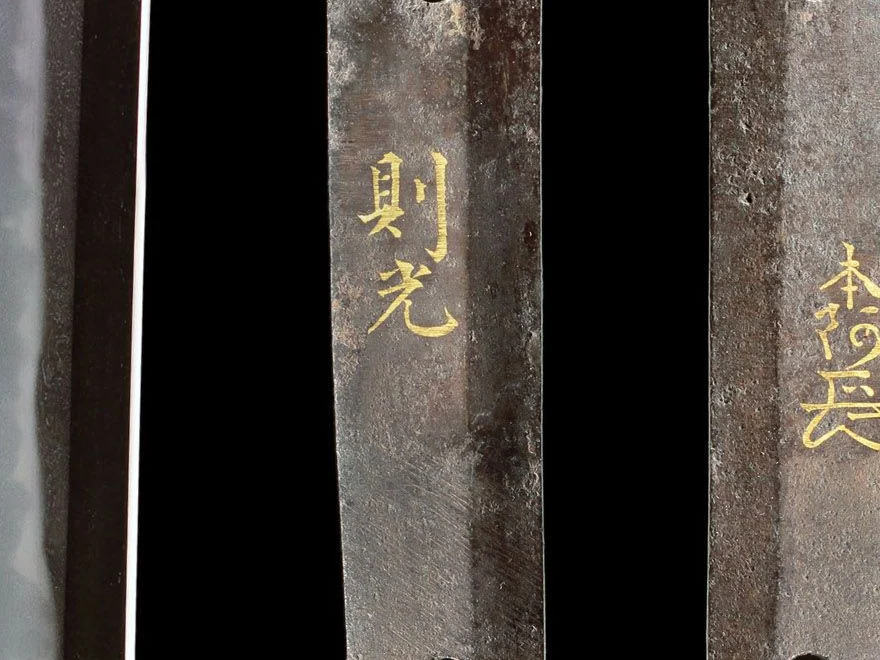
- The signature inscribed on the nakago, typically giving the smith's name on the omote (outward-facing side) and sometimes province, date, or dedication on the ura. Authenticity of the mei is the central concern of kantei and shinsa.
- Yasurime
- The file-mark pattern on the nakago surface, applied to prevent slipping in the handle and to identify a smith or school. Common patterns include katte-sagari (slanting toward the edge), o-sujikai (steep diagonal), and kiri (horizontal).
- Shinogi-ji
- The upper bevel of the blade between the shinogi ridge and the mune. In kantei its hada is examined separately from the ji; in the Yamato tradition it often shows masame even when the ji is itame.
- Fukura
- The curved edge of the kissaki, from the yokote to the point. Described as fukura-tsuku (full) or fukura-kareru (sparse); a period indicator, as Nanbokuchō kissaki tend to a thinner fukura.
- Monouchi
- The portion of the edge about a hand's-breadth below the kissaki that delivers most cutting blows. Hardening and any damage here carry particular weight in assessing a blade.
- Mitsu-mune
- A three-faceted spine, flat on top and bevelled both sides. Common in Yamashiro and Shintō work; distinct from iori-mune (two-faceted) and maru-mune (rounded).
- Koshibi
- A short groove cut only in the lower part of the blade near the nakago, rather than the full length. Its form and termination are school details.
- Ubu
- A nakago in its original, unaltered state, retaining the original length and signature. Desirable on an old blade, as it preserves the full mei.
- Mumei
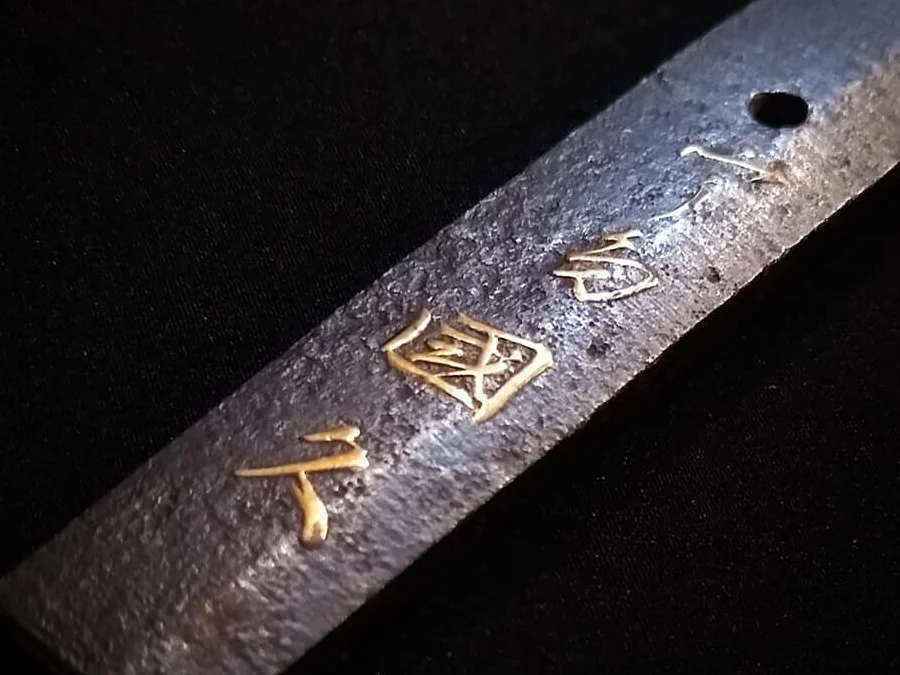
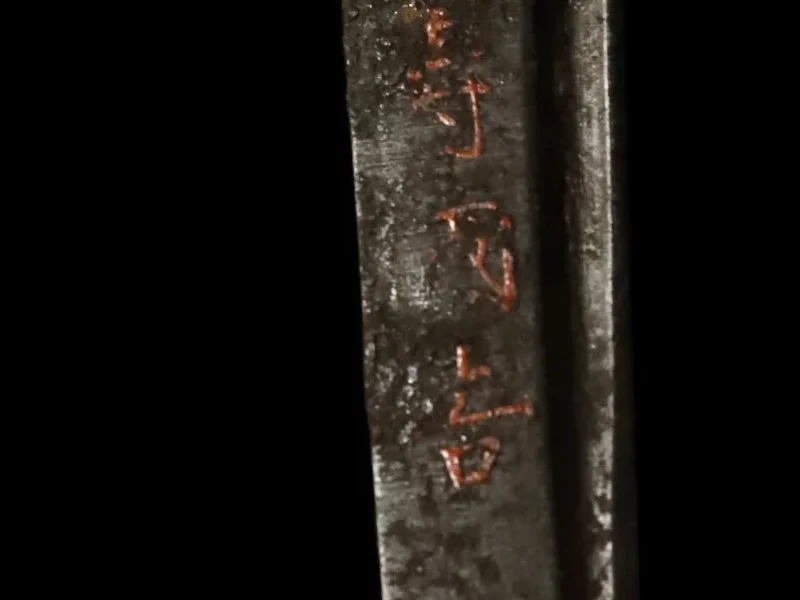
- An unsigned blade. The signature may have been lost when the blade was shortened by ō-suriage, or it was never cut in the first place. A mumei blade is judged on its workmanship alone, and a good one often carries a later gold-inlay or lacquer attribution to a smith or school.
- Suriage
- A blade shortened from the nakago end, common as fashions shifted from tachi to katana; preserves at least part of the mei.
- Ō-suriage
- Heavily shortened at both ends — the hamachi moved up and the nakago-jiri re-cut — to the point the original signature is lost, leaving the blade mumei. Common among long Kamakura and Nanbokuchō tachi.
- Machi-okuri
- Moving the hamachi and munemachi up the blade to shorten it slightly without cutting the nakago. A milder alteration than suriage.
- Orikaeshi-mei
- A signature preserved during shortening by folding the signed end of the old nakago back and re-attaching it.
- Gakumei
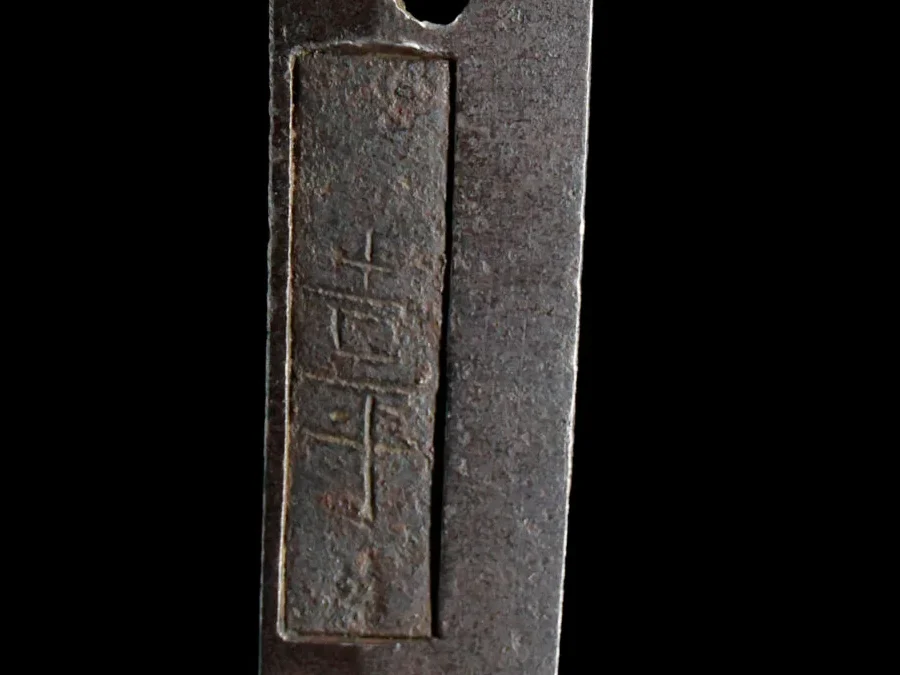
- A signature preserved during shortening by cutting out the signed panel and inlaying it into the shortened tang.
- Kinzōgan-mei
- An attribution inscribed in gold inlay set into the nakago. Used by the Hon'ami appraisers on mumei blades; among the most authoritative old attributions.
- Kinpun-mei
- An attribution written in gold-powder lacquer rather than inlaid. Records a connoisseur's attribution but, being lacquer, is not permanent.
- Shumei
- An attribution written in red lacquer on the nakago; the same purpose as kinpun-mei, in vermilion.
- Keshō-yasuri
- "Decorative" file marks combining a main direction with short marks along the edges of the nakago. Common from the Shintō period on.
- Takanoha
- "Hawk's-feather" yasurime slanting from a central spine toward both edges in a chevron. Strongly associated with the Mino tradition.
- Kurijiri
- A rounded, chestnut-shaped nakago-jiri (tang end). The most common form.
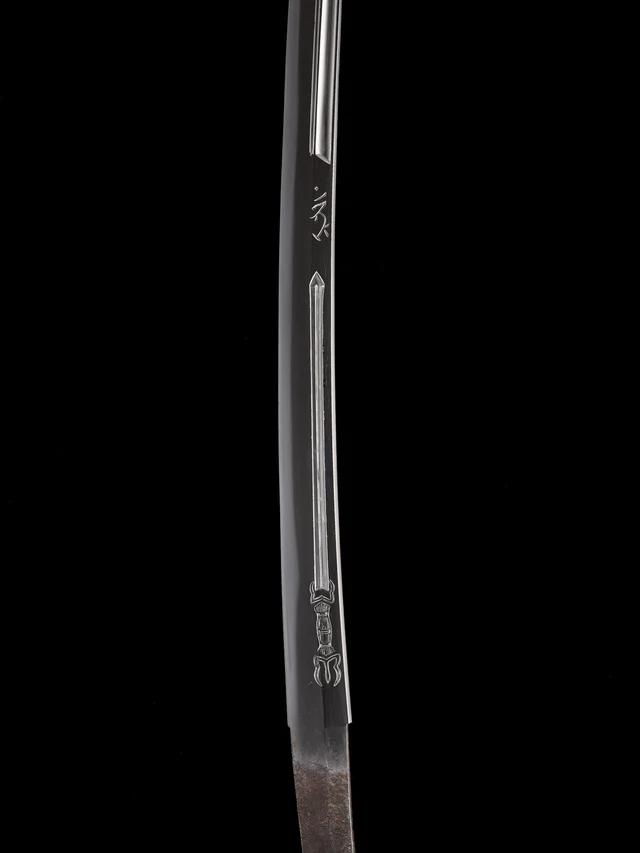
- Horimono
- Decorative or religious carvings cut into the blade face — bonji (Sanskrit), ken, or kurikara (dragon); their style and quality bear on attribution and value.
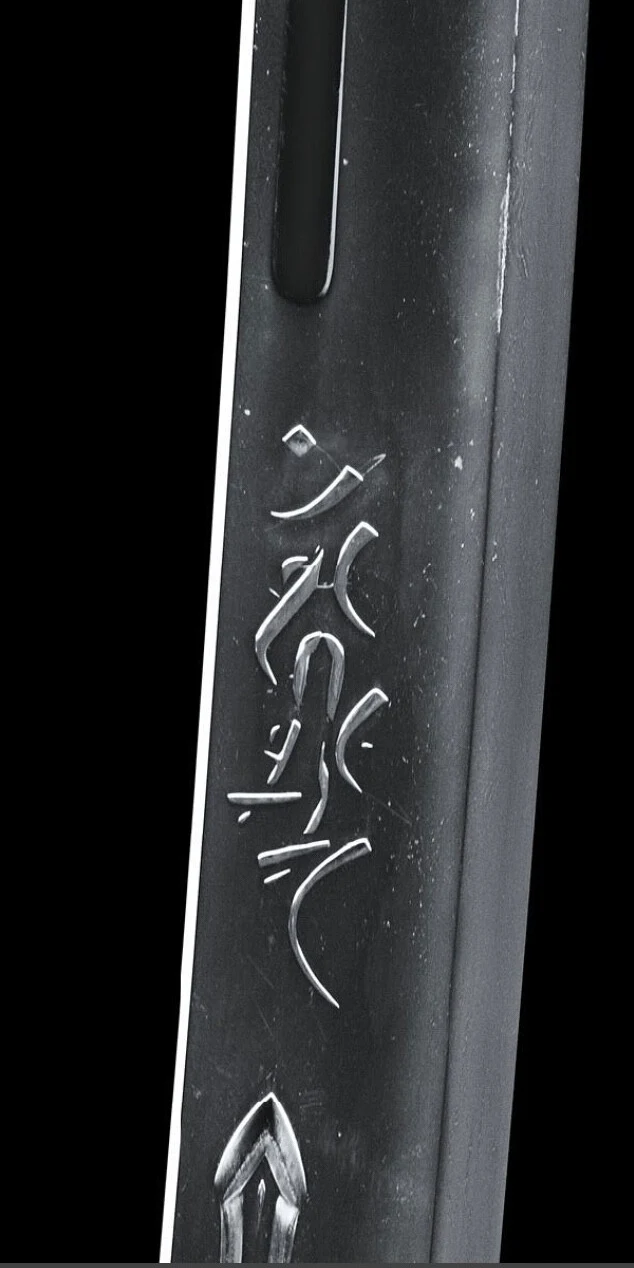
- Bonji
- Sanskrit "seed-syllable" characters carved into a blade as a Buddhist invocation, a common form of horimono.
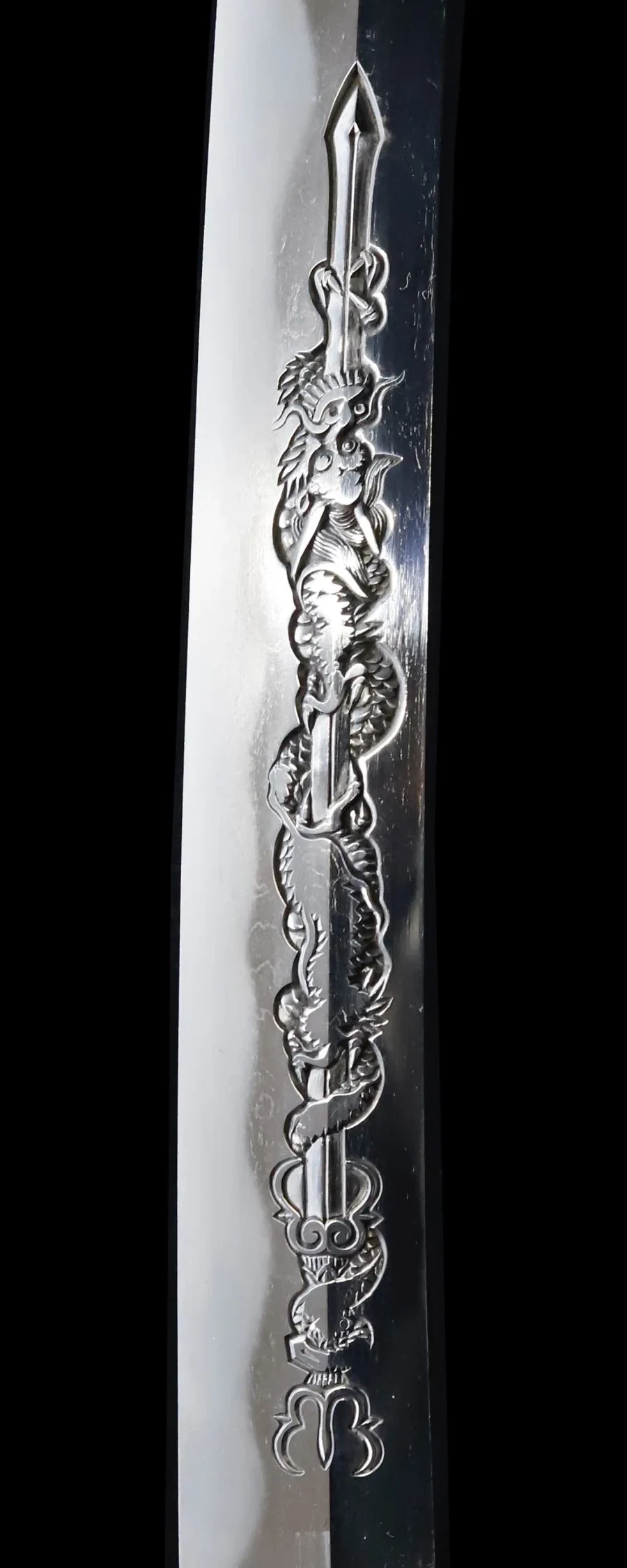
- Kurikara
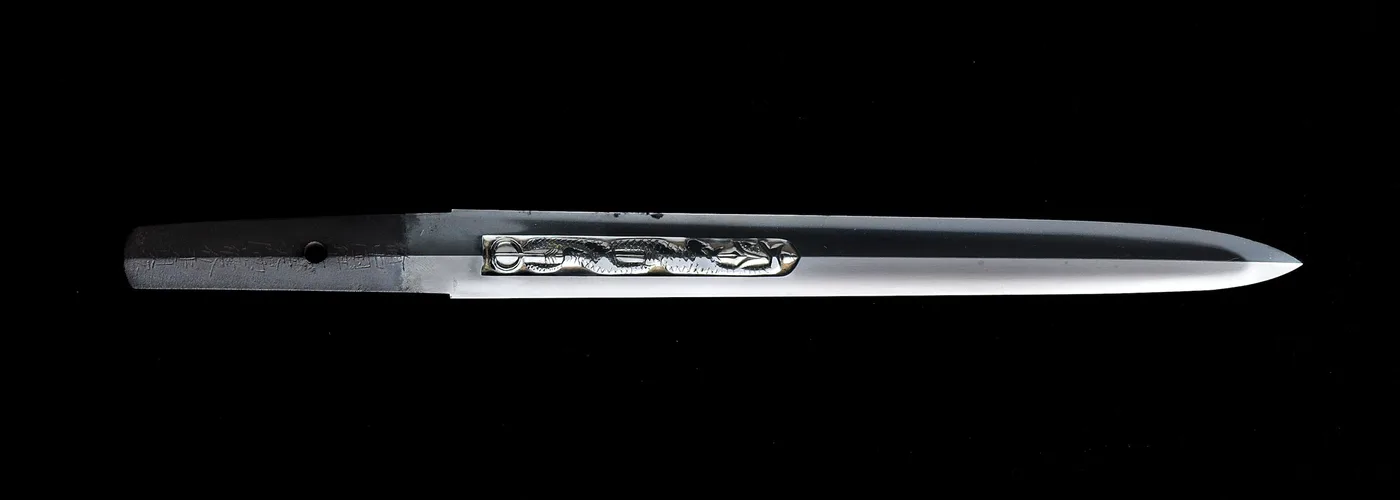
- A horimono of a dragon entwined about a sword, representing the Buddhist deity Fudō Myōō; among the most common blade carvings.
- Mekugi-ana
- The hole pierced through the nakago for the mekugi peg; the number and placement of holes can indicate shortening and help date a blade.
- Nakago-jiri
- The shape of the tang's end (kurijiri, kengyō, ha-agari, kiri); a recognised school and period indicator.
- Kengyō
- A pointed, triangular nakago-jiri; one of the standard tang-end shapes read in kantei.
Hada and hamon
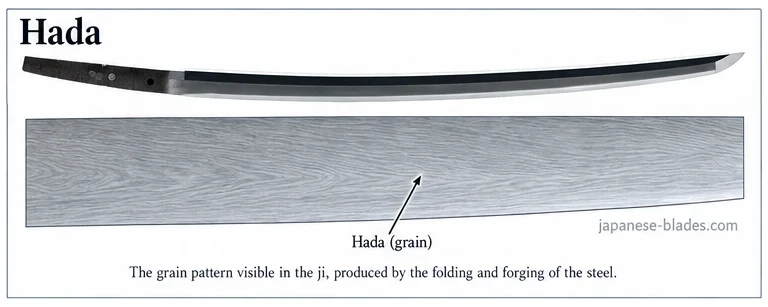
- Hada
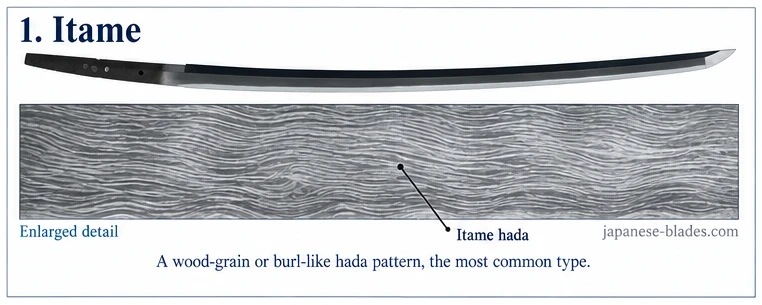
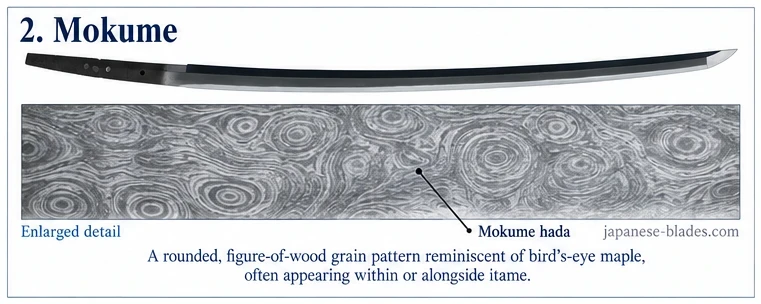
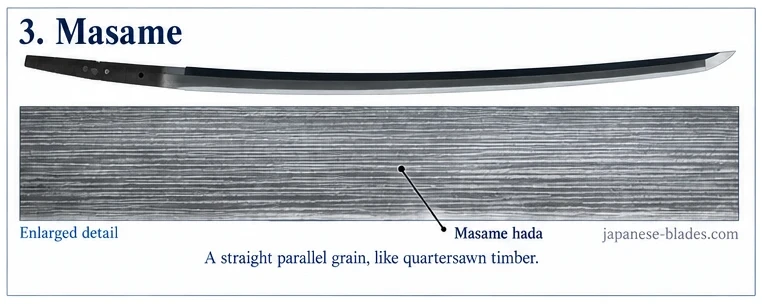
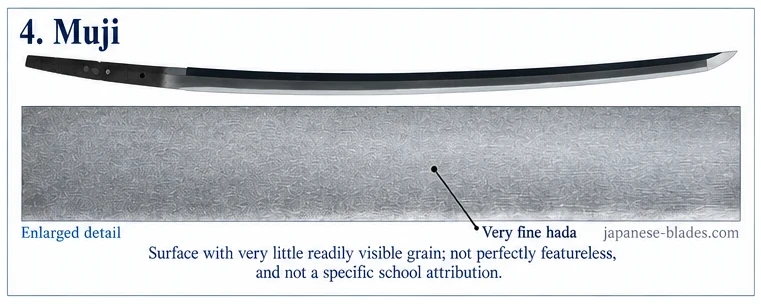
- The grain pattern visible in the ji, produced by the folding and forging of the steel. Hada type is a primary characteristic used in school attribution. See also: itame, mokume, masame, muji.
- Itame
- A wood-grain or burl-like hada pattern, the most common type. Ranges from fine (ko-itame) to coarse; associated with Bizen and Sōshū traditions among others.
- Mokume
- A rounded, figure-of-wood grain pattern reminiscent of bird's-eye maple, often appearing within or alongside itame. Associated with Yamashiro and some Bizen work.
- Masame
- A straight parallel grain, like quartersawn timber. Characteristic of the Yamato tradition and some Sōshū works; often confined to the shinogi-ji even when the ji shows another hada.
- Muji
- An indistinct or nearly grain-free surface, typical of densely worked Sōshū steel and many Shintō-period blades. Not a flaw — in fine Sōshū work it accompanies rich nie activity.
- Hamon
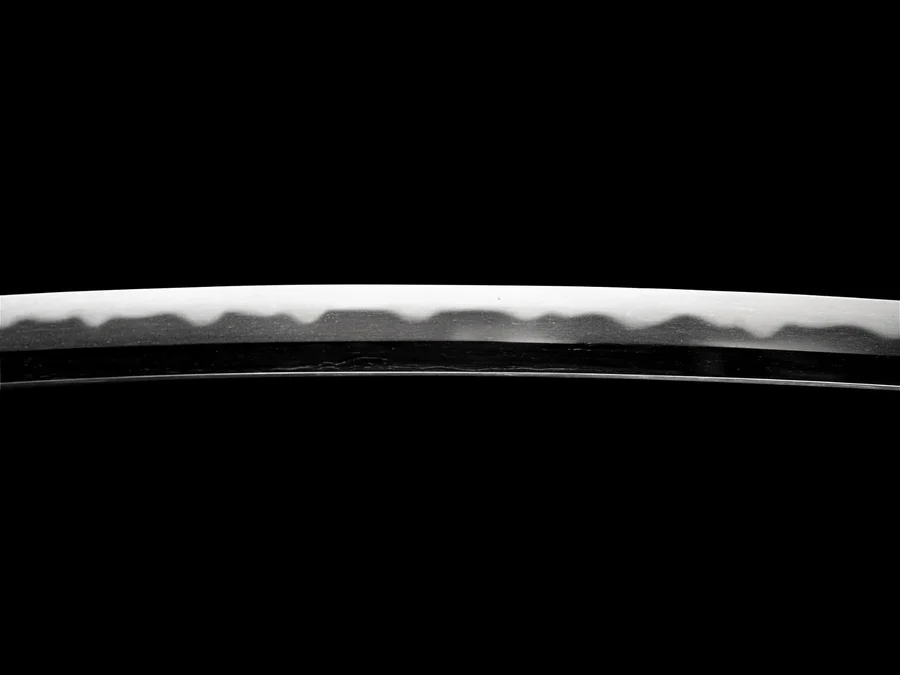
- The temper line — the visible boundary between the hardened yakiba and the softer ji, produced by differential clay quenching (tsuchioki). Its shape, texture, and activities are the single most informative feature in kantei.
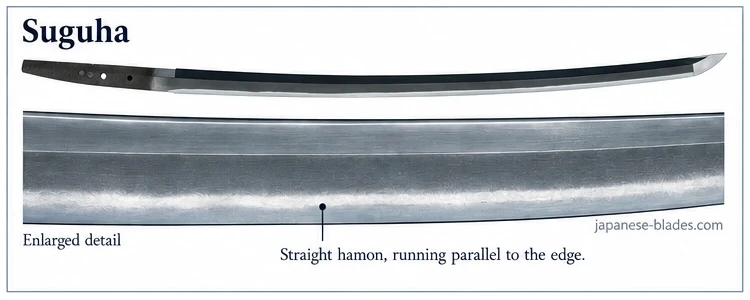
- Suguha
- A straight hamon, running parallel to the edge. The hallmark of the Yamato tradition and Rai smiths; ranges from narrow (hoso-suguha) to wide, with varying nie or nioi texture.
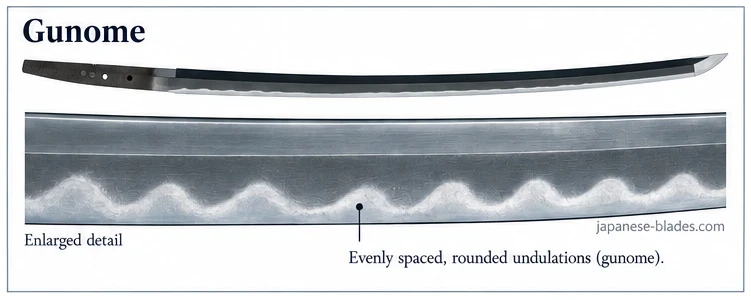
- Gunome
- A repeating, evenly spaced undulating hamon with rounded peaks. Common in Bizen work from the mid-Kotō period onward; often combined with choji or notare elements.
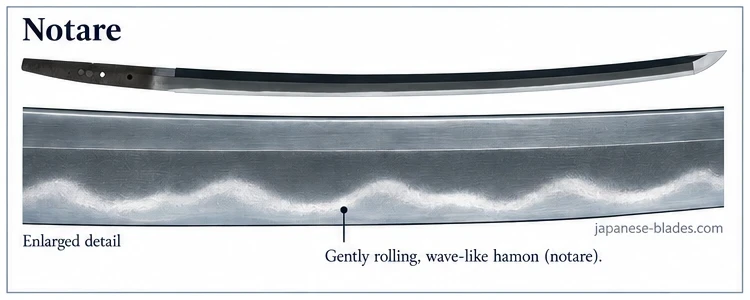
- Notare
- A gently rolling, wave-like hamon. Associated with Sōshū and Shintō traditions; frequently appears in combination with other elements such as gunome (gunome-notare).
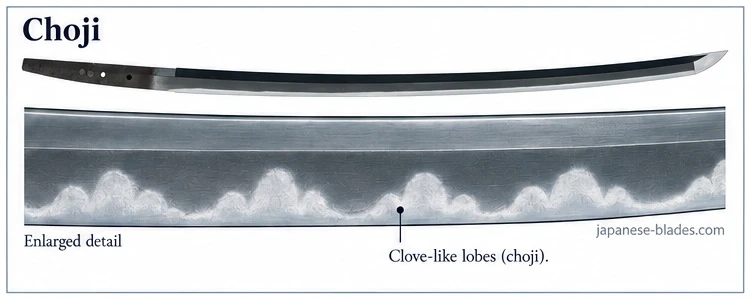
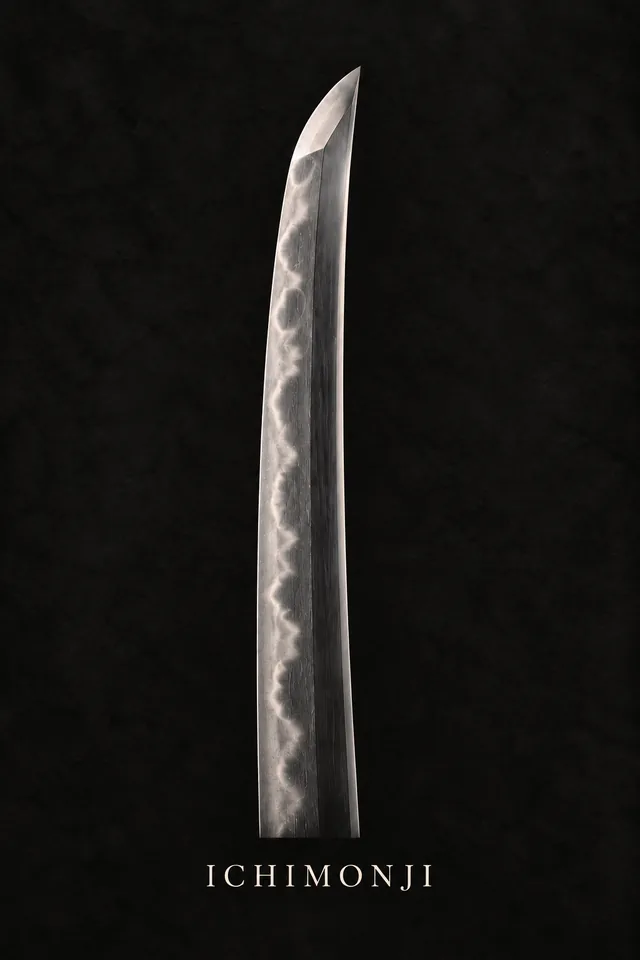
- Choji
- A hamon shaped in clove-like lobes, the signature of classic Ichimonji and Osafune Bizen work. Koshi-no-hiraita choji (open-waisted choji) is particularly prized and closely associated with the Fukuoka Ichimonji school.
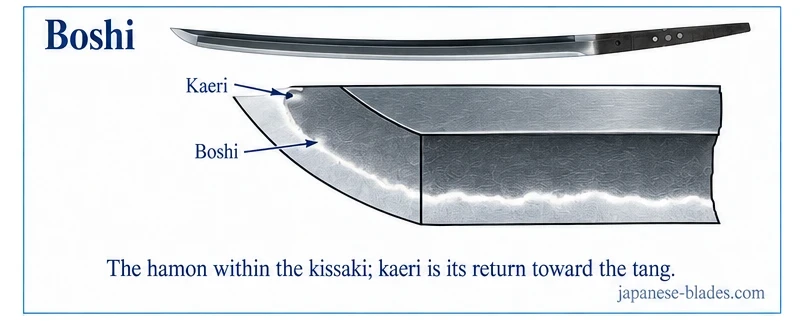
- Boshi
- The continuation of the hamon within the kissaki, turning back toward the spine. Boshi form — ko-maru (small round turn), jizo, kaen (flame), or yakizume (running to the tip) — is a key school indicator.
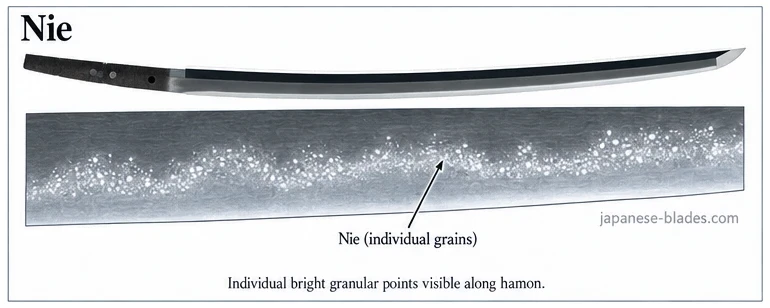
- Nie
- Individually visible martensite crystals in the hamon, appearing as bright, sandy or starry points. Heavy nie is the defining texture of Sōshū work and the smiths in its lineage. See also: nioi.
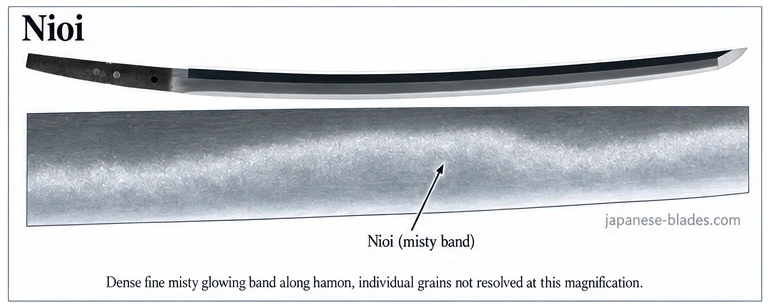
- Nioi
- A fine, misty band of martensite visible as a diffuse glow rather than individual points — the characteristic texture of Bizen hamon. The distinction between nie and nioi is fundamental to period and school attribution.
- Yakiba
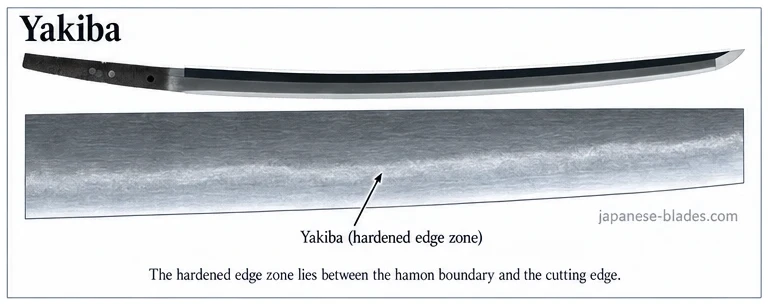
- The hardened zone of the blade encompassing and surrounding the hamon. Its width, activities (ashi, yo, sunagashi, kinsuji, etc.), and boundary character are all read in kantei.
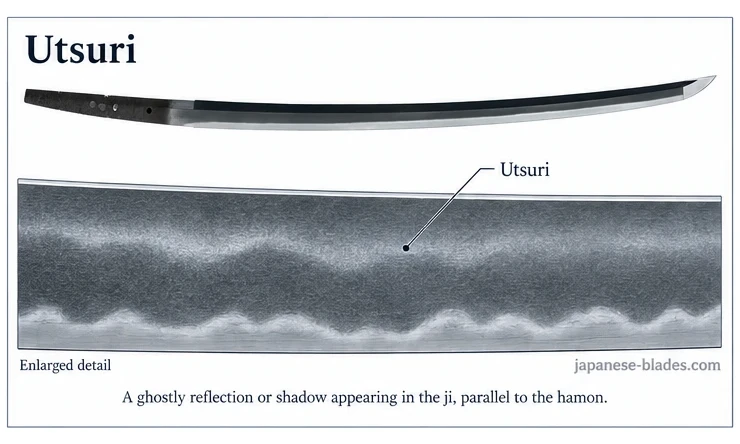
- Utsuri
- A ghostly reflection or shadow appearing in the ji, parallel to the hamon. Most closely associated with Bizen blades — especially Ko-Bizen and Ichimonji — and its presence (or absence) is a significant authenticity and attribution indicator.
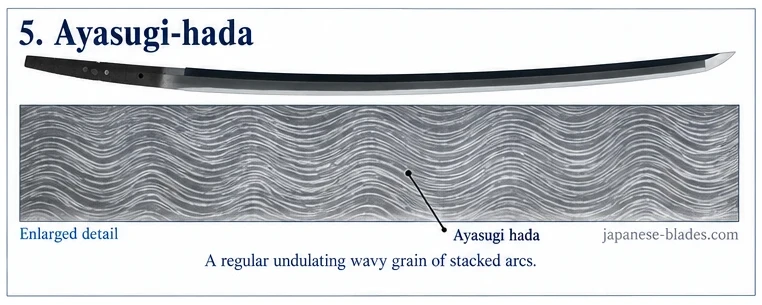
- Ayasugi-hada
- A regular undulating wavy grain of stacked arcs. The signature of the Gassan school (also called Gassan-hada); rarely seen elsewhere.
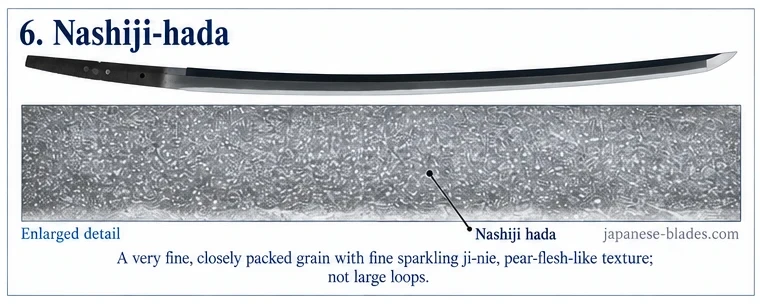
- Nashiji-hada
- A very fine, dense, even itame likened to a cut pear surface. Associated with the Rai school and refined Yamashiro work.
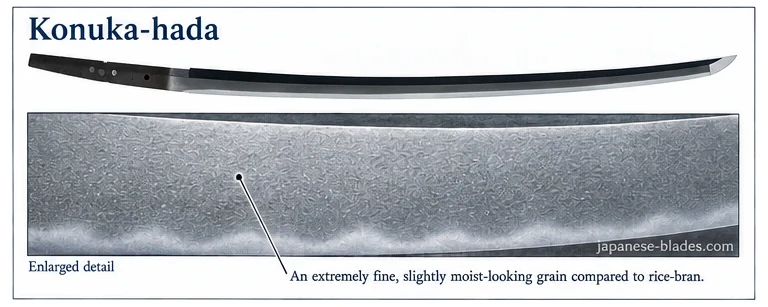
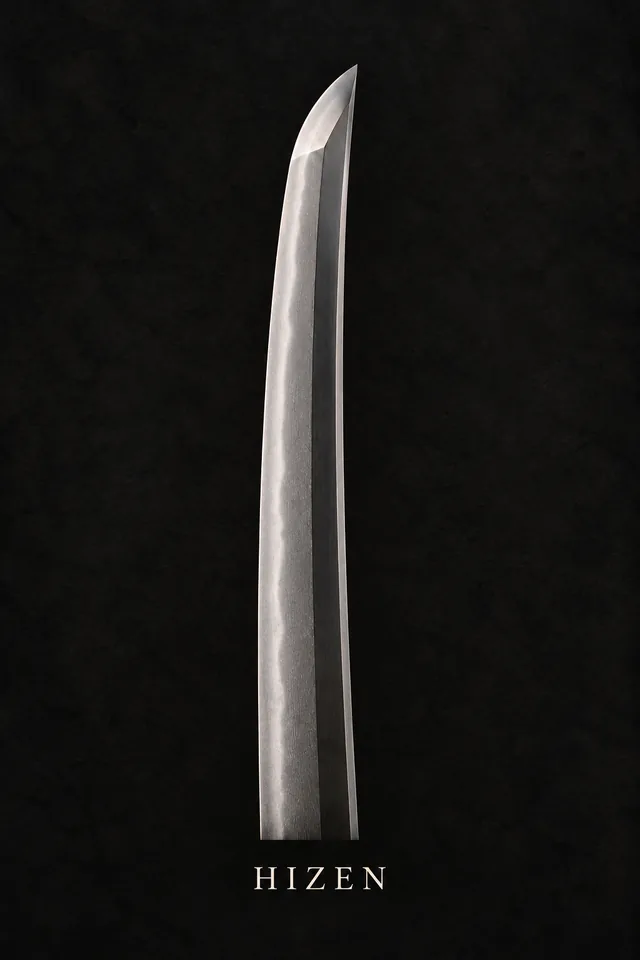
- Konuka-hada
- An extremely fine, slightly moist-looking grain compared to rice-bran. The hallmark of the Hizen (Tadayoshi) school.
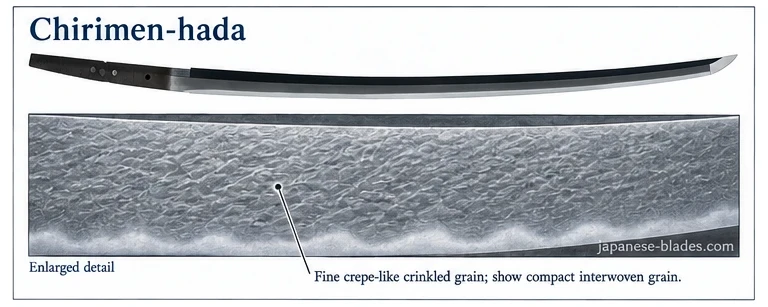
- Chirimen-hada
- A fine, crinkled itame likened to crêpe silk; often applied to high-quality Yamashiro forging.
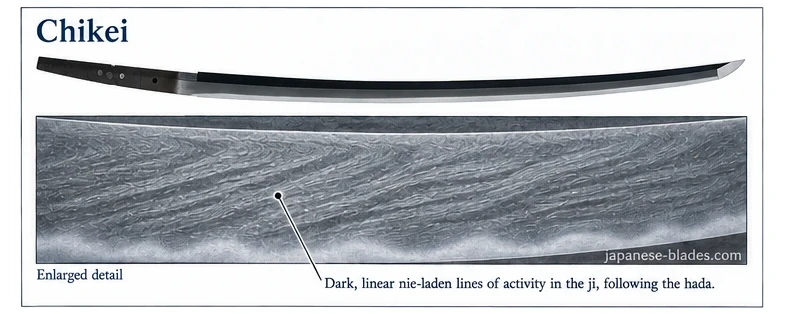
- Chikei
- Dark, linear nie-laden lines of activity in the ji, following the hada. Heavy chikei marks fine Sōshū work; distinct from kinsuji, which lies in the hamon.
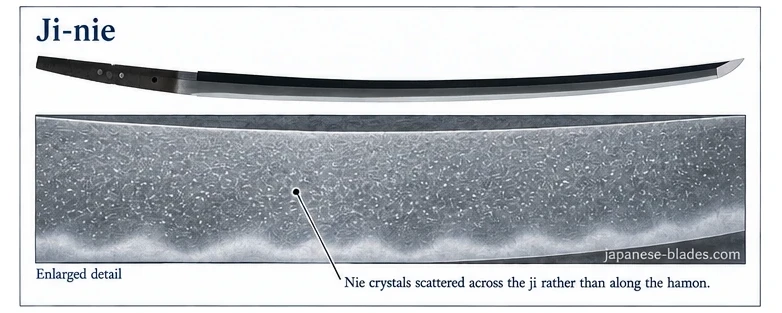
- Ji-nie
- Nie crystals scattered across the ji rather than along the hamon. Abundant, bright ji-nie is characteristic of Sōshū-den.
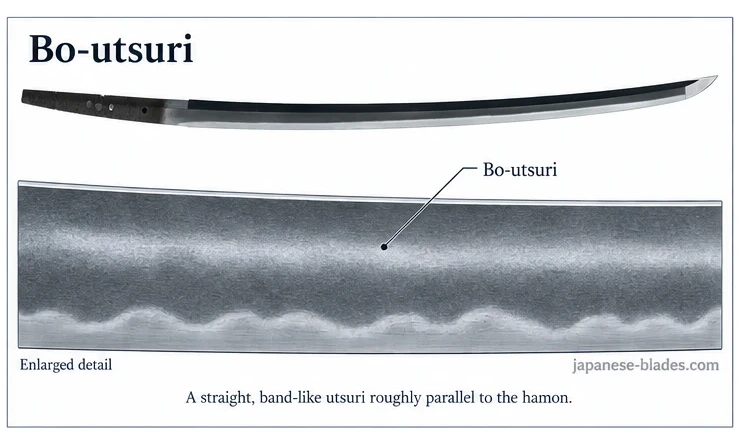
- Bo-utsuri
- A straight, band-like utsuri roughly parallel to the hamon. Associated with Ōei-era and later (Sue-) Bizen work.
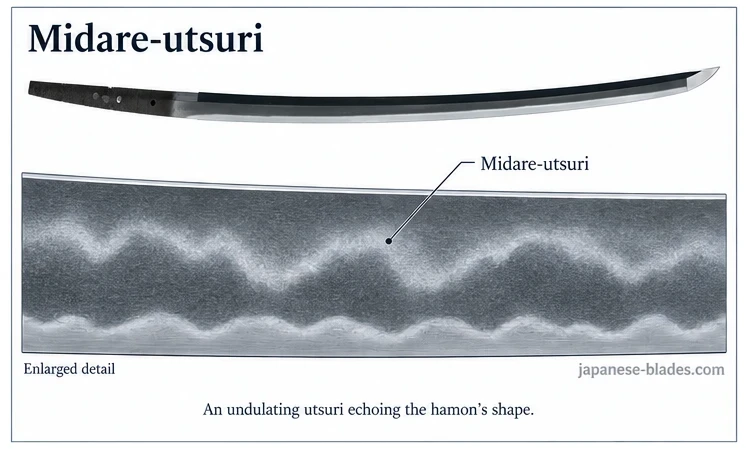
- Midare-utsuri
- An undulating utsuri echoing the hamon's shape. The classic utsuri of mainline Osafune Bizen; its revival is a feature of the Ishidō school.
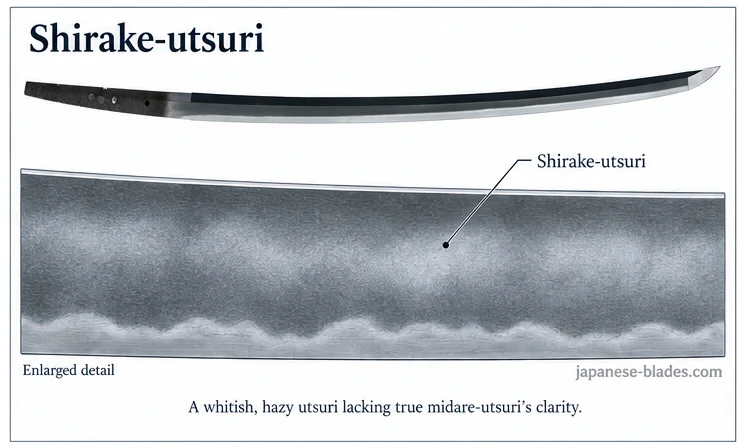
- Shirake-utsuri
- A whitish, hazy utsuri lacking true midare-utsuri's clarity. Common in Mino work and late, declining Bizen.
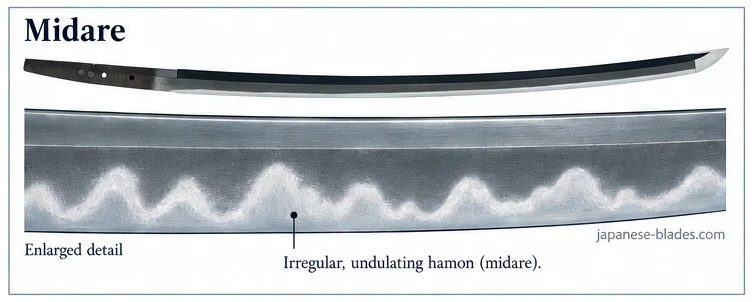
- Midare
- The general term for any irregular, undulating hamon, as opposed to suguha. The umbrella for gunome, chōji, notare, and their combinations.
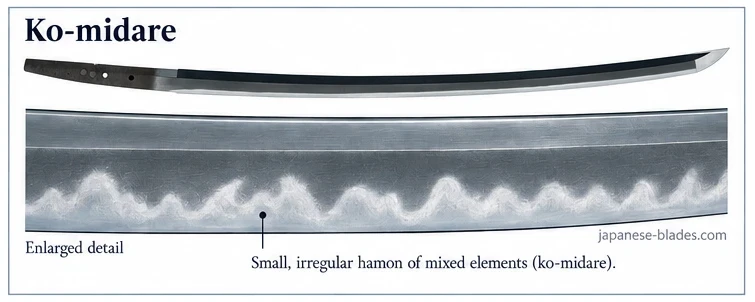
- Ko-midare
- A small, irregular hamon of mixed elements. Characteristic of Ko-Bizen and early tachi, appearing in nie with utsuri.
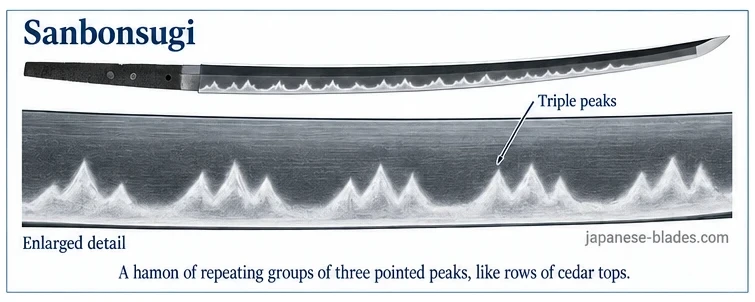
- Sanbonsugi
- A hamon of repeating groups of three pointed peaks, like rows of cedar tops. Originated by Magoroku Kanemoto of Mino and a defining feature of the Kanemoto line.
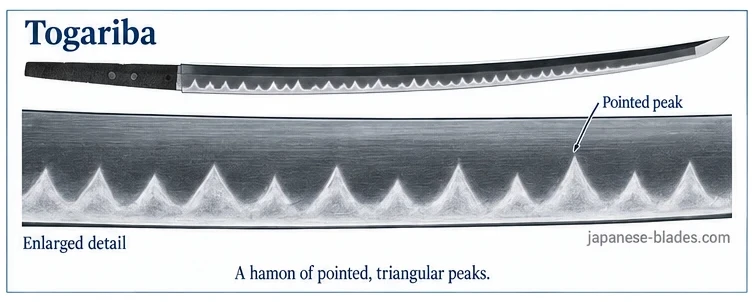
- Togariba
- A hamon of pointed, triangular peaks. A hallmark of the Mino tradition, often combined with gunome.
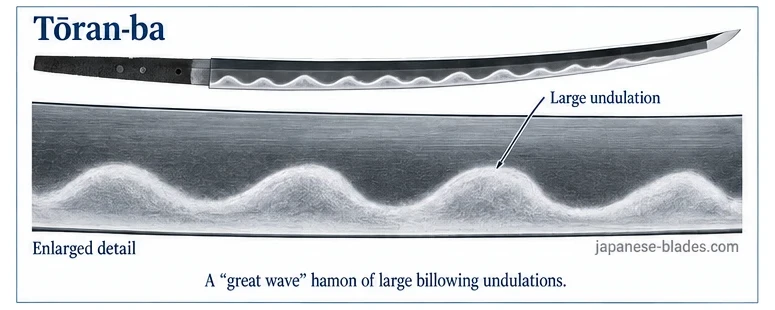
- Tōran-ba
- A "great wave" hamon of large billowing undulations. Created by Tsuda Sukehiro in Osaka in the Shintō period and widely imitated; a strong clue to the Sukehiro line.
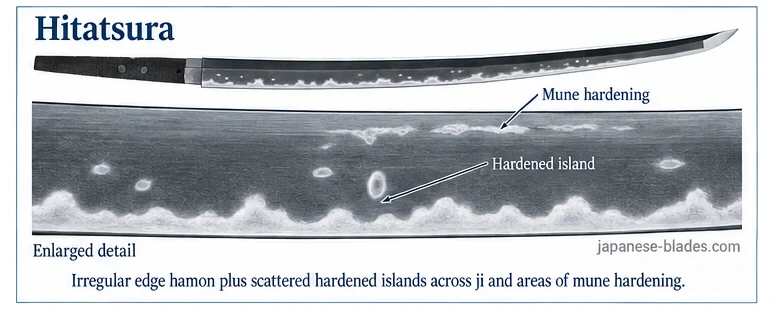
- Hitatsura
- A "full temper" in which hardening covers not only the edge but spreads across the ji to the mune in patches. Associated with Sōshū smiths Hiromitsu and Akihiro and with Muromachi work.
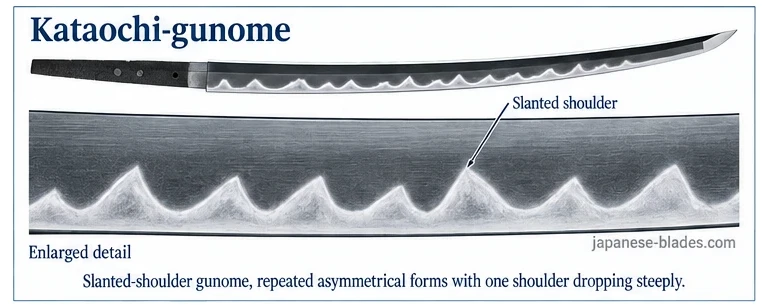
- Kataochi-gunome
- A gunome whose peaks lean uniformly to one side, giving a saw-tooth look. Associated with Kanemitsu and mainline Osafune Bizen of the Nanbokuchō period.
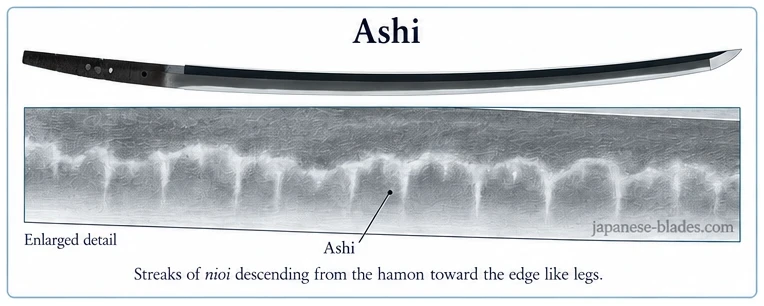
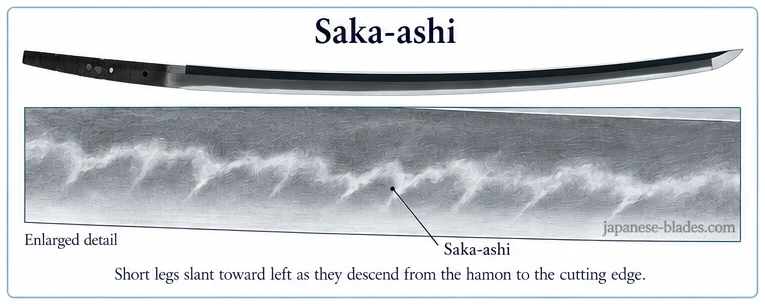
- Ashi
- Streaks of nioi descending from the hamon toward the edge like legs. Profuse ashi is characteristic of Bizen chōji work.
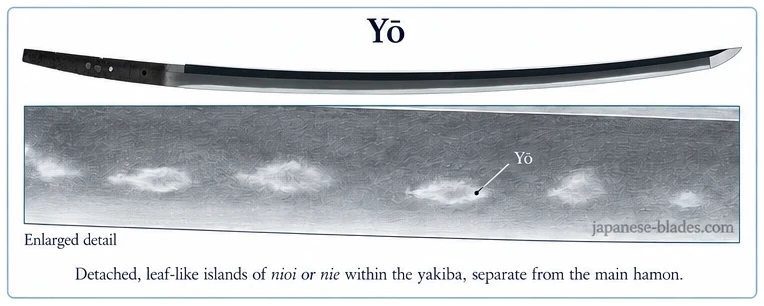
- Yō
- Detached, leaf-like islands of nioi or nie within the yakiba, separate from the main hamon. Often seen with ashi.
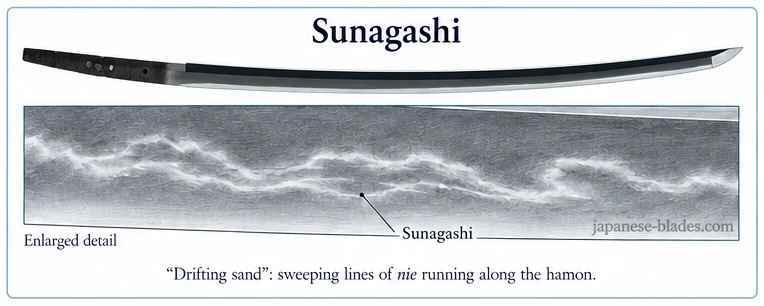
- Sunagashi
- "Drifting sand": sweeping lines of nie running along the hamon. A feature of Sōshū and Mino work.
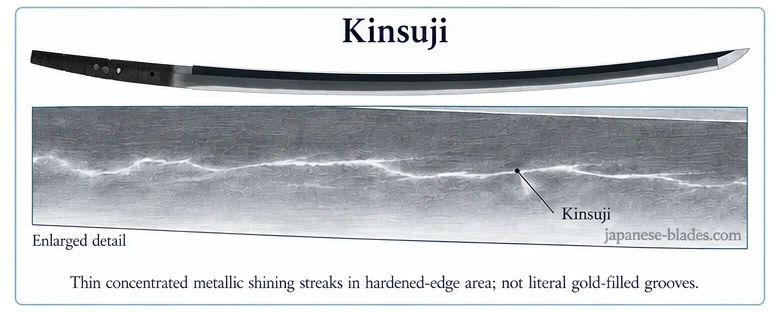
- Kinsuji
- Bright, thin lines of concentrated nie within the hamon, as if drawn in gold. Prized in nie-deki blades, especially Sōshū; distinct from chikei, which lies in the ji.
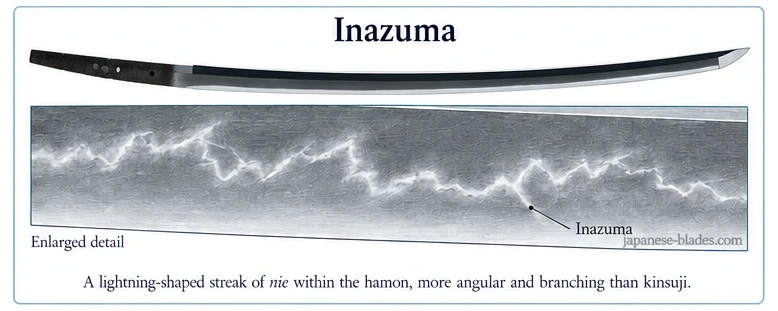
- Inazuma
- A lightning-shaped streak of nie within the hamon, more angular and branching than kinsuji. A sign of vigorous nie activity.
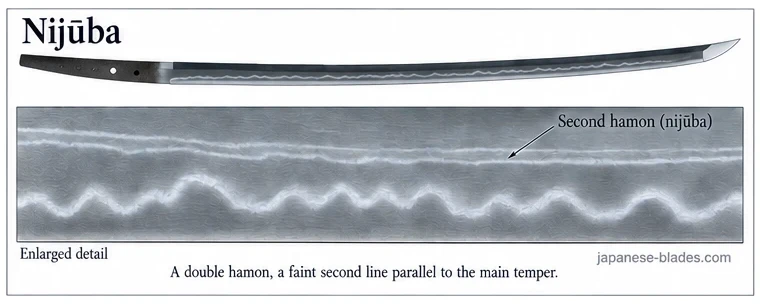
- Nijūba
- A "double hamon," a faint second line parallel to the main temper. Seen in Yamato work and some Hizen and Rai blades.
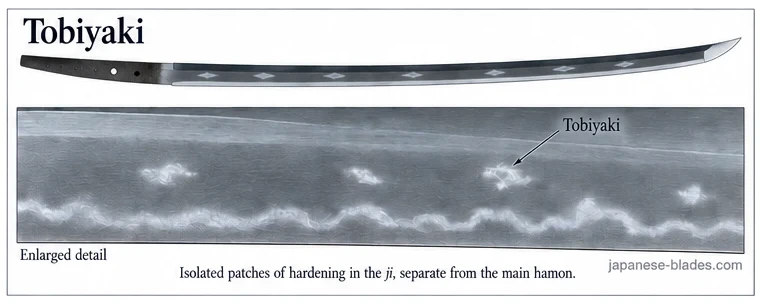
- Tobiyaki
- Isolated patches of hardening in the ji, separate from the main hamon. When extensive they grade into hitatsura.
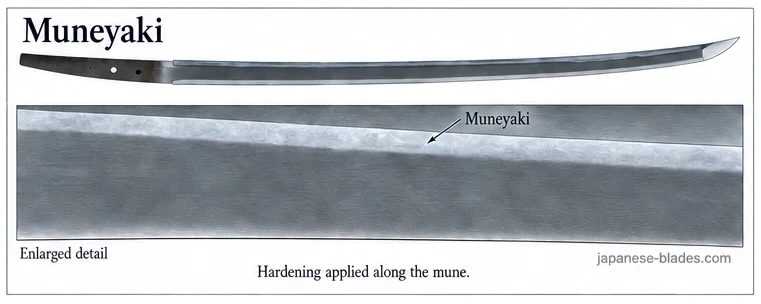
- Muneyaki
- Hardening applied along the mune. A feature of Sōshū-influenced work and a component of hitatsura.
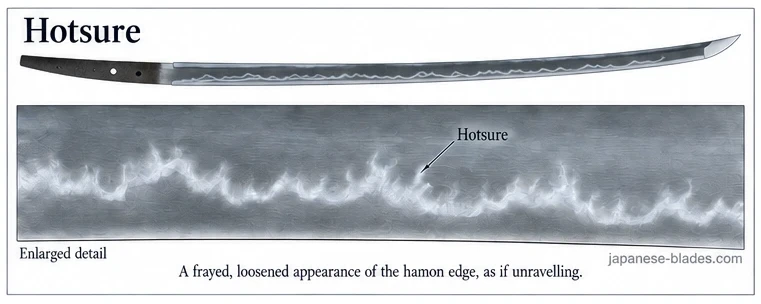
- Hotsure
- A frayed, loosened appearance of the hamon edge, as if unravelling. Common in Yamato and Hoshō work.
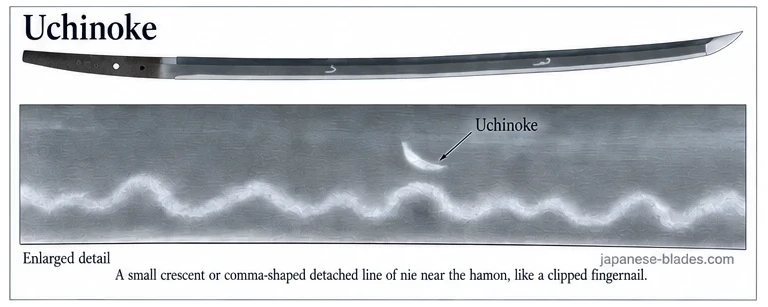
- Uchinoke
- A small crescent or comma-shaped detached line of nie near the hamon, like a clipped fingernail. A Yamato and Hoshō feature.
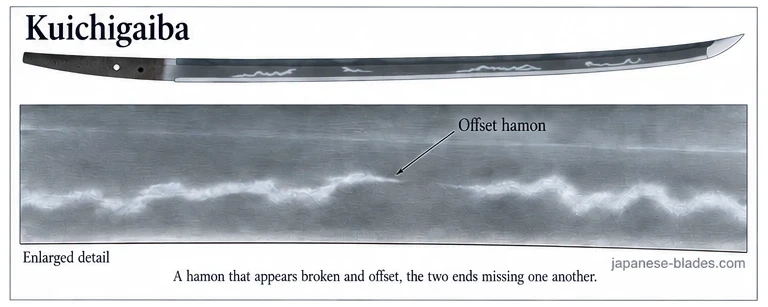
- Kuichigaiba
- A hamon that appears broken and offset, the two ends missing one another. Associated with the Yamato (especially Hoshō) tradition.
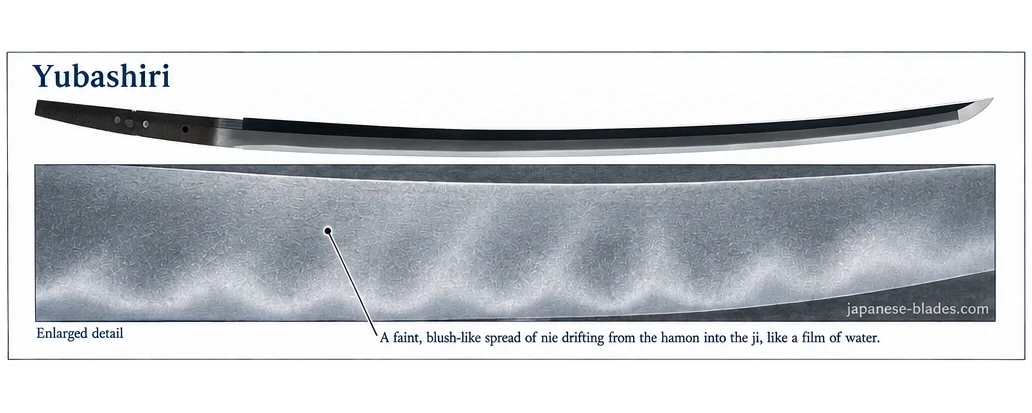
- Yubashiri
- A faint, blush-like spread of nie drifting from the hamon into the ji, like a film of water. Often accompanies tobiyaki.
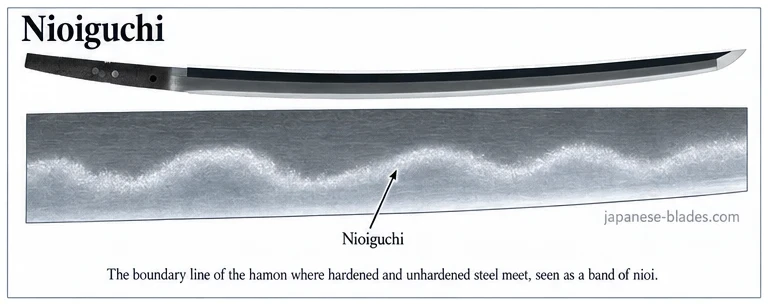
- Nioiguchi
- The boundary line of the hamon where hardened and unhardened steel meet, seen as a band of nioi. Whether tight or soft, bright or subdued, it is among the most telling features in attribution.
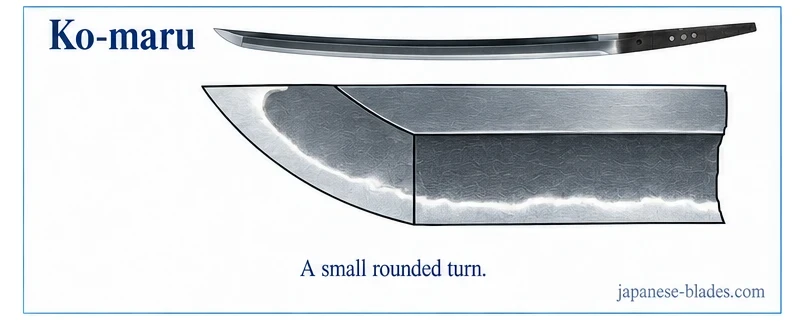
- Ko-maru
- A small, round turn-back of the boshi. A common form; a tidy ko-maru is associated with the Rai school and Yamashiro work.
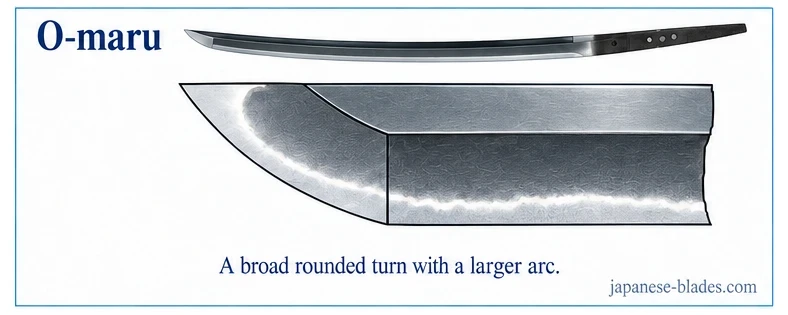
- Ō-maru
- A large, broad rounded turn-back of the boshi, distinguished from ko-maru by the breadth of the arc.
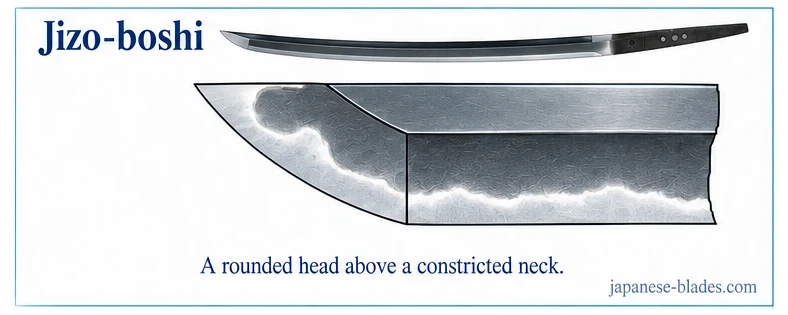
- Jizō-bōshi
- A boshi shaped like the profiled head of the bodhisattva Jizō. A feature of certain Mino smiths, notably the Kanemoto line.
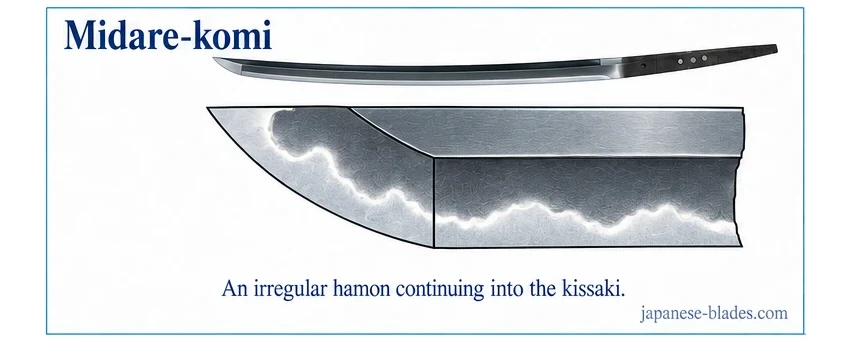
- Midare-komi
- A boshi continuing the irregular hamon up into the kissaki rather than settling into a simple turn. Common where the body shows gunome or chōji.
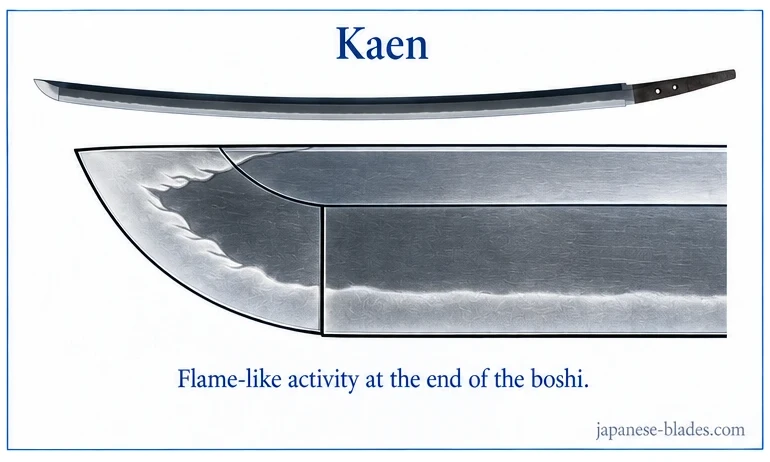
- Kaen
- A "flame" boshi rising in irregular, flame-like tongues. A vigorous Sōshū-style boshi.
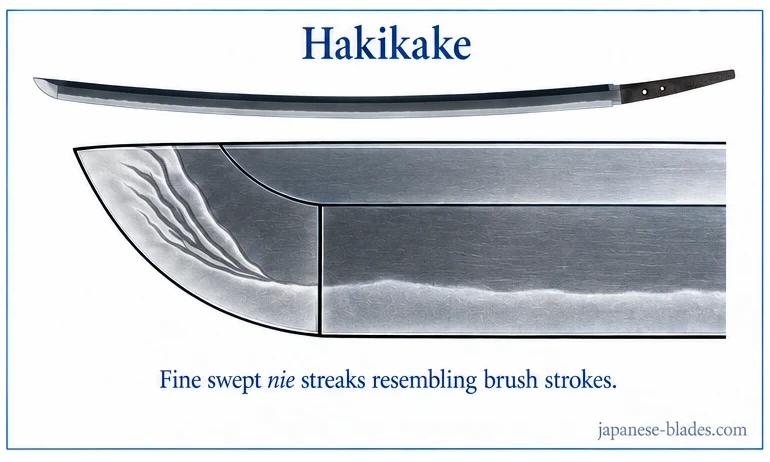
- Hakikake
- A boshi finished with brushed, swept lines of nie like broom-strokes. A Sōshū and Yamato feature.
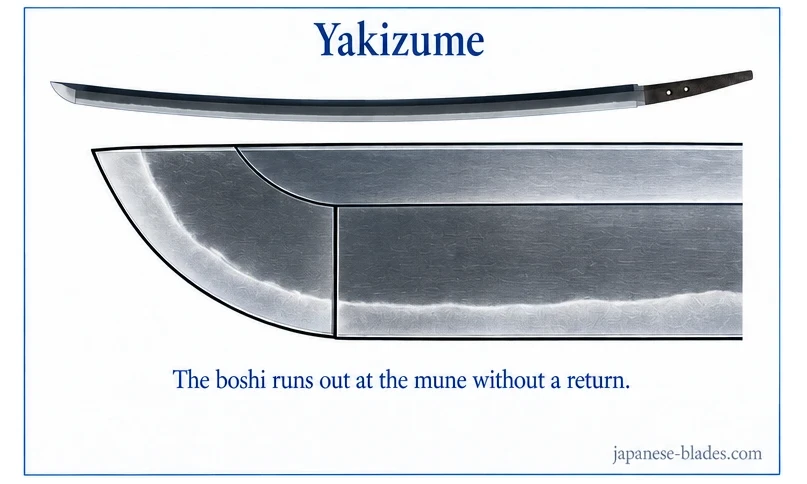
- Yakizume
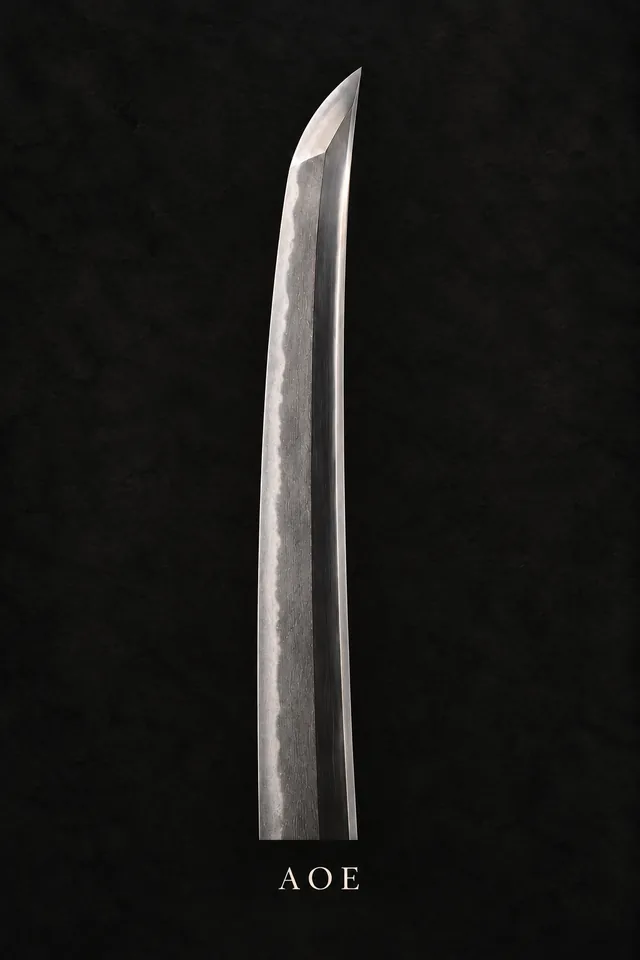
- A boshi that runs to the tip with no turn-back. Characteristic of the Yamato tradition and some Aoe work.
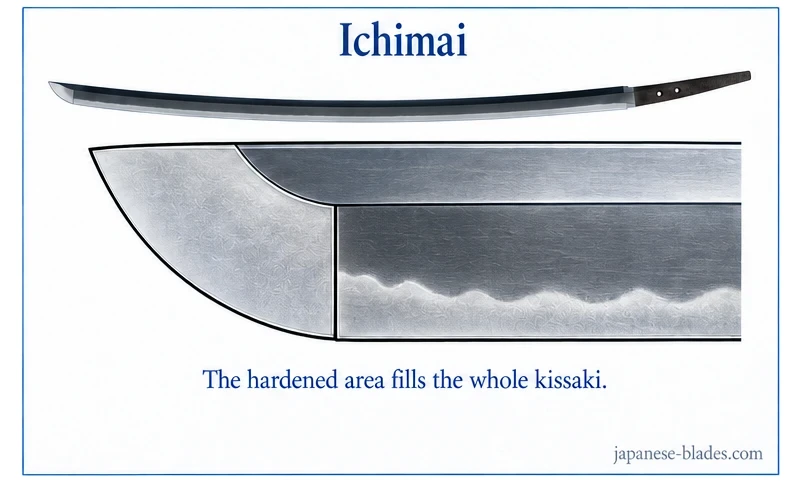
- Ichimai
- A boshi in which the whole kissaki is hardened, the temper occupying the entire point. A vigorous form seen in some Sōshū blades.
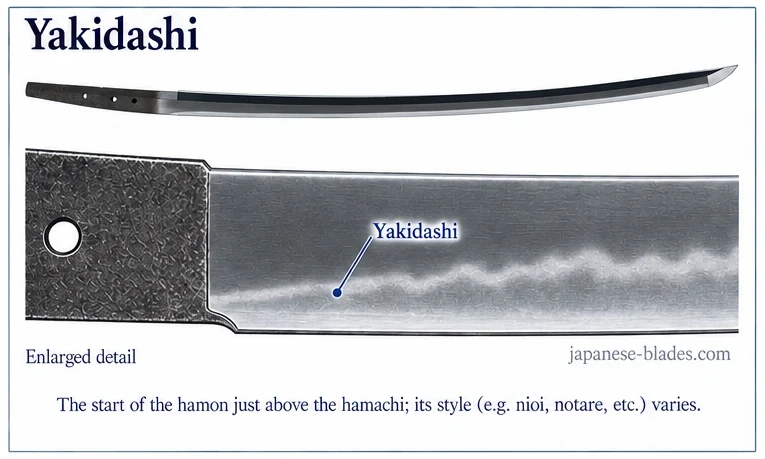
- Yakidashi
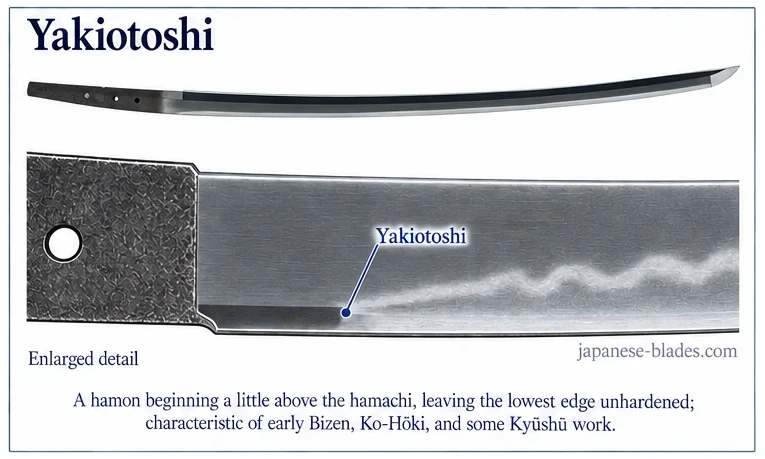
- The start of the hamon just above the hamachi; its style (e.g. the rising "Osaka yakidashi") is a strong clue to Shintō schools and individual smiths.
- Yakiotoshi
- A hamon beginning a little above the hamachi, leaving the lowest edge unhardened; characteristic of early Bizen, Ko-Hōki, and some Kyūshū work.
- Saka-ashi
- Ashi that slant backward toward the nakago rather than straight down; a Mino and Aoe trait.
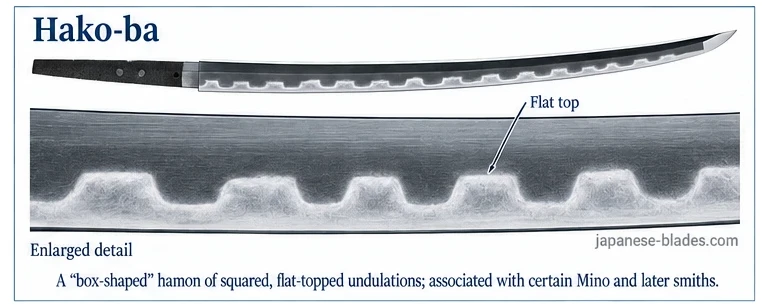
- Hako-ba
- A "box-shaped" hamon of squared, flat-topped undulations; associated with certain Mino and later smiths.
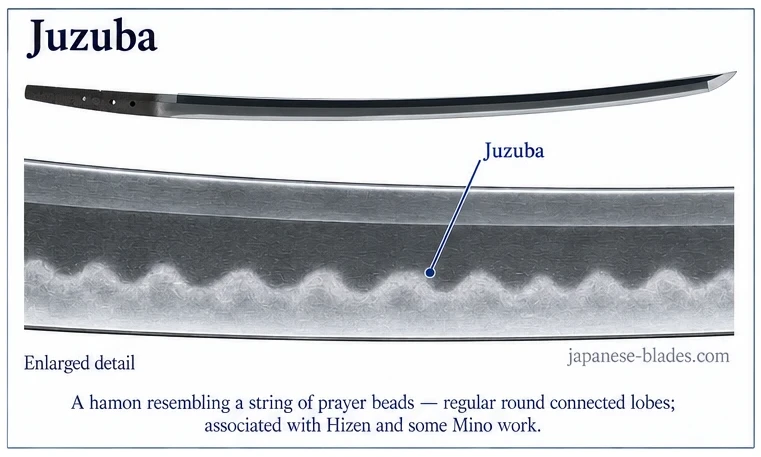
- Juzuba
- A hamon resembling a string of prayer beads — regular round connected lobes; associated with Hizen and some Mino work.
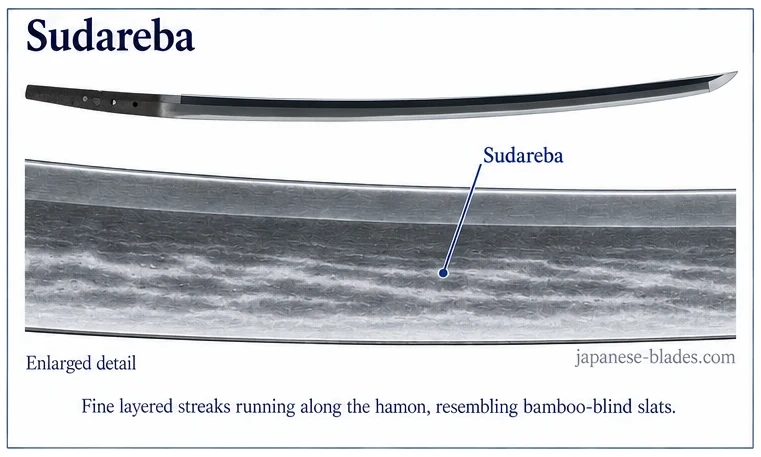
- Sudareba
- A "bamboo-blind" hamon of fine parallel lines; the signature of the Mishina/Tanba no Kami Yoshimichi line.
Construction & forging
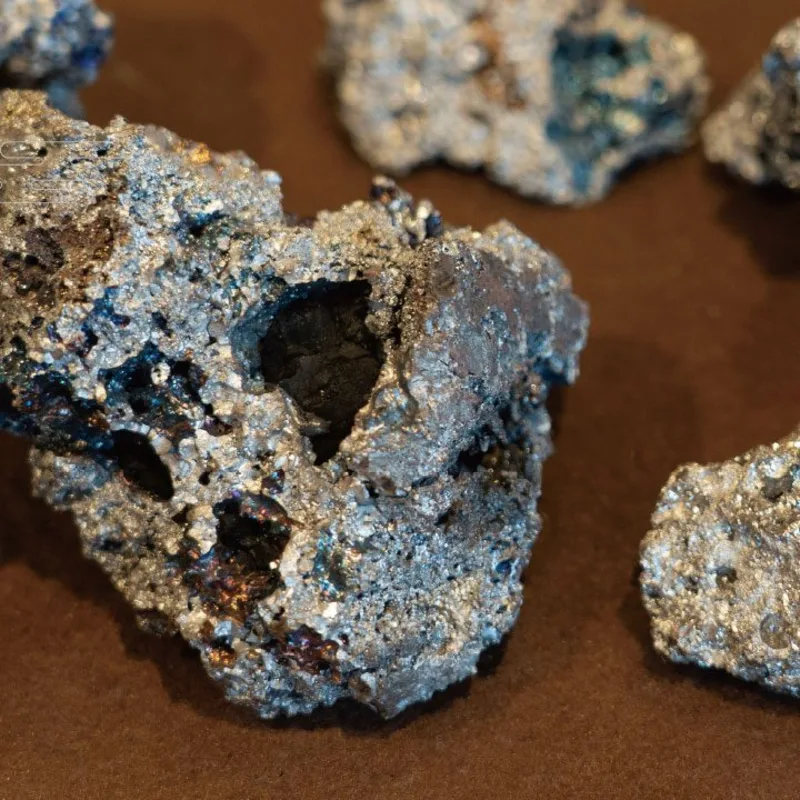
- Tamahagane
- Steel produced in the tatara smelter from iron sand and charcoal — the traditional raw material for nihonto forging. Quality varies by smelter and run; the smith selects and combines tamahagane pieces during the kawagane and shingane construction of the blade.
- Kobuse
- A construction wrapping a soft low-carbon core (shingane) in a U-shaped jacket of harder steel (kawagane). The most common method, balancing a resilient core against a hard exterior.
- Honsanmai
- A three-piece lamination of soft core, harder sides, and a high-carbon edge, so edge, flanks, and core each suit their role.
- Shihōzume
- "Four-sides packed": honsanmai plus a back steel along the mune, enclosing the core on four sides. Labour-intensive and uncommon.
- Maru-kitae
- A blade forged from a single steel, without a soft core or laminated jacket. The simplest construction.
- Kawagane
- The hard outer "skin steel" forming the exterior and edge of a laminated blade, folded and refined to develop the hada.
- Shingane
- The softer low-carbon "core steel" enclosed within the kawagane, giving the blade resilience.
- Orikaeshi
- The folding-and-forge-welding process by which steel is repeatedly cut, doubled, and hammered to homogenise carbon and expel slag; the folding produces the visible hada.
- Tsuchioki
- The application of clay slurry to the blade before quenching, thick over the spine and thin along the edge. The pattern laid down determines the shape of the hamon.
- Yakiire
- The hardening step: the clay-coated blade is heated and quenched, hardening the thinly coated edge (producing the hamon and the sori) while the spine stays softer.
- Sashikomi-togi
- A traditional polish that brings out hamon and hada through the steel's natural colour, without a whitened hadori finish.
- Hadori
- A finishing polish enhancing the hamon with a whitish, even highlight along the temper line. The standard modern presentation polish.
- Gomai-kitae
- A five-piece lamination (core, two flanking steels, two outer skins); a more elaborate cousin of honsanmai.
- Kitae
- The forging and folding of the steel, and the resulting forged structure; kitae-ware (forging cracks) are judged against it.
Flaws (kizu)
- Hagire
- A crack crossing the hardened edge. A fatal flaw: it makes a blade structurally unsound and effectively worthless as a sword, however fine it otherwise looks.
- Fukure
- A blister where a void from incomplete forge-welding has risen toward the surface. A serious flaw, especially if it opens.
- Ware
- An open crack or seam in the surface steel, often along the hada. Severity depends on location and depth.
- Kirikomi
- A nick in the mune or edge from another blade in combat. Sometimes valued as honest evidence of a blade's history rather than a fault.
- Shinae
- Fine wrinkle-like compressions from bending stress in the soft steel. Usually superficial.
- Hakobore
- Chipping of the hardened edge. Small chips may polish out; deep ones near the hamon may not.
- Mizukage
- A cloudy, often diagonal line near the hamachi. Most often a sign that a blade has been retempered (saiha); warrants caution.
- Saiha
- A retempered blade — one whose original hamon was lost (often through fire) and a new hamon quenched in. Generally regarded as severely diminished in value, even by a great smith.
- Umegane
- A patch of steel forged or plugged into a void or flaw during manufacture. A repair rather than a flaw, but disclosed in honest description.
- Kitae-ware
- An open seam following the hada, opened during forging; distinguished from general ware by its forging origin.
- Tsukare
- "Tired" steel — worn thin by repeated polishing over centuries, so the hardened edge runs shallow or the core steel shows through; a key condition concern in old blades.
Geometry and dimensions
- Nagasa
- The cutting-edge length measured in a straight line from the hamachi to the tip of the kissaki. The standard reference measurement for classification: under approximately 30 cm for tantō, 30–60 cm for wakizashi, and over 60 cm for katana or tachi.
- Sori
- The curvature of the blade, measured as the greatest perpendicular distance between the mune and a straight line from munemachi to tip. The position of deepest curve defines the sori type — see: tori-zori, koshi-zori, saki-zori.
- Tori-zori
- An even, full-length curvature with the deepest point near the centre of the blade. Typical of Kamakura-period tachi and the Bizen tradition.
- Koshi-zori
- Curvature with the deepest point in the lower (koshi) third of the blade, near the hamachi. Characteristic of early Heian and Ko-Bizen tachi.
- Saki-zori
- Curvature concentrated toward the kissaki. Associated with naginata and some late-Kamakura/Nanbokuchō blades; appears again in the Shinshintō revival period.
- Motohaba
- The width of the blade measured at the hamachi. Together with sakihaba, motohaba determines the degree of fumbari and the visual taper of the blade.
- Sakihaba
- The width measured at the yokote, just below the kissaki. A narrow sakihaba relative to motohaba indicates strong fumbari; a wide sakihaba is associated with Nanbokuchō-period blades and some Shintō work.
- Kasane
- The thickness of the blade, usually measured at the mune above the hamachi (moto-kasane) and again near the yokote (saki-kasane). Kasane narrows considerably in Nanbokuchō-era works.
- Fumbari
- The pronounced taper from a wide motohaba to a narrower sakihaba, creating a characteristic flare at the base. Strong fumbari is a mark of Kotō tachi and an important indicator of age.
- Mihaba
- The general term for blade width; for precise work it is split into motohaba (at the hamachi) and sakihaba (at the yokote).
- Ikubi-kissaki
- A short, stubby point likened to a boar's neck. Strongly associated with the mid-Kamakura period and a key dating feature.
- Ō-kissaki
- An elongated, large point. Characteristic of Nanbokuchō blades and revived in Shinshintō; on an ō-suriage blade a long kissaki is often the surviving clue to a Nanbokuchō origin.
- Chū-kissaki
- A medium-length point, the most common form across most periods.
- Kaeri
- The turn-back of the boshi where the hamon reverses in the kissaki and runs toward the mune. Its depth and form are read closely in kantei; no turn-back at all is yakizume.
- Uchizori
- A slight curvature toward the edge (mune curving toward the point); characteristic of Kamakura-period tantō and an age indicator on daggers.
- Mu-sori
- A blade with no curvature; expected on tantō and archaic straight forms.
Blade shapes (zukuri)
- Shinogi-zukuri
- The standard sword construction, with a shinogi ridge dividing ji from shinogi-ji and a defined yokote at the kissaki. Dominant for tachi, katana, and wakizashi from the late Heian period on.
- Hira-zukuri
- A flat construction with no shinogi ridge and no yokote, the whole face one plane to the point. The usual form for tantō and many wakizashi.
- Shōbu-zukuri
- A shinogi construction lacking a yokote, so the edge sweeps unbroken into the point like an iris leaf. Common in Muromachi wakizashi and tantō.
- Kanmuri-otoshi-zukuri
- A construction in which the shinogi-ji is bevelled away from low on the blade up to the tip, reducing weight toward the point. Favoured by Yamato smiths.
- Unokubi-zukuri
- "Cormorant's neck": like kanmuri-otoshi but with only the middle of the shinogi-ji thinned, base full and tip widening again. A weight-saving form in tantō and ko-wakizashi.
- Kiriha-zukuri
- An archaic construction with the shinogi very close to the edge, giving a wide flat bevel. Associated with very early (jōkotō and early Heian) blades.
- Moroha-zukuri
- A double-edged construction with a central ridge, both edges sharpened. Rare; chiefly Muromachi tantō.
- Kissaki-moroha-zukuri
- A distinctive double-edged-at-the-tip form with reversing curvature — the construction of the famous Kogarasu-maru. Also called kogarasu-zukuri.
- Sunnobi-zukuri
- A "stretched" hira-zukuri tantō exceeding the normal ~30 cm; a Nanbokuchō and Ōei form (sunnobi-tantō).
- Osoraku-zukuri
- A rare form with the yokote set near the middle of the blade, giving an enormous kissaki; associated with Shimada Sukemune and revived in Shinshintō.
Types of swords
- Nihonto
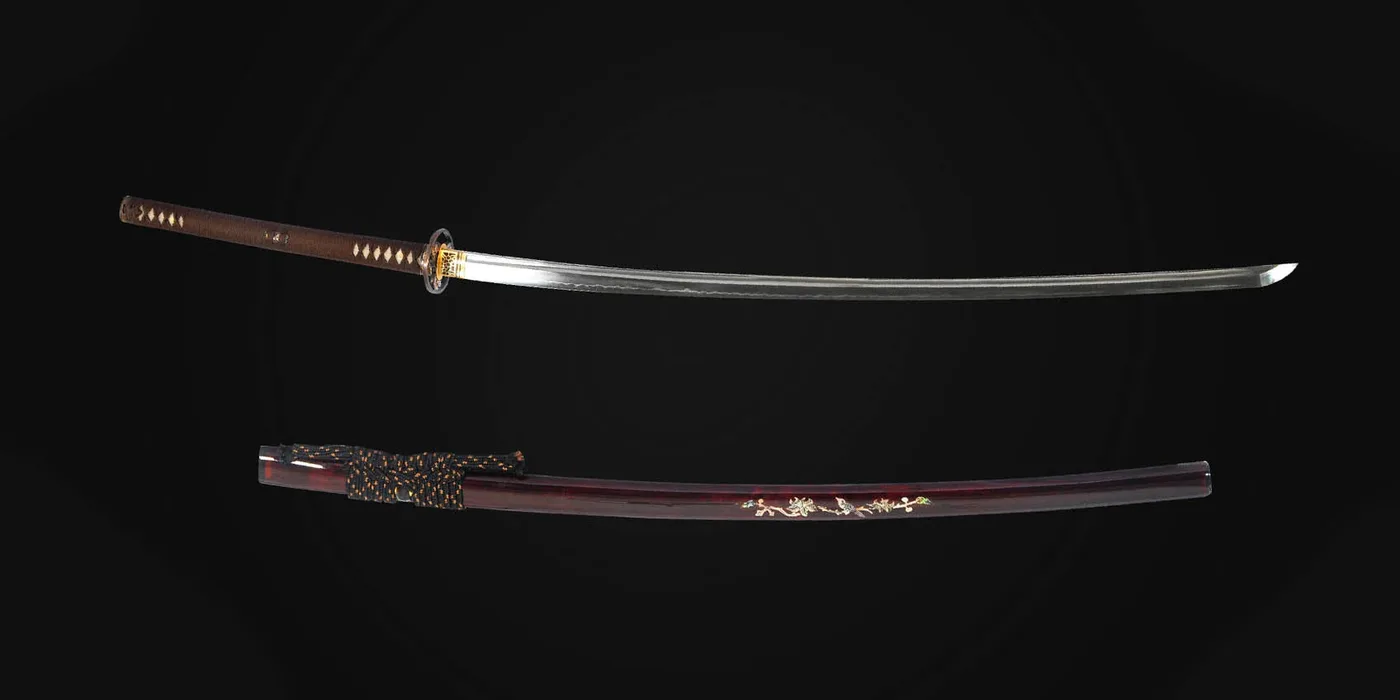
- Japanese sword in the strict sense — a blade forged by traditional methods from tamahagane, with a differentially hardened hamon produced by clay-coating and water quenching. Distinguished from shōwatō (machine-made WW2 swords); nihonto of all periods, from Heian tachi through modern gendaitō, share this fundamental method.
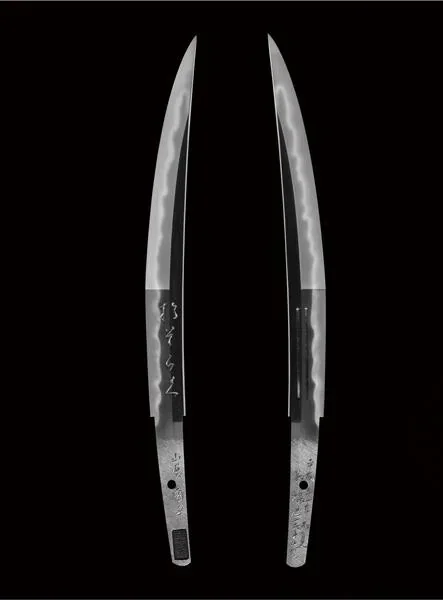
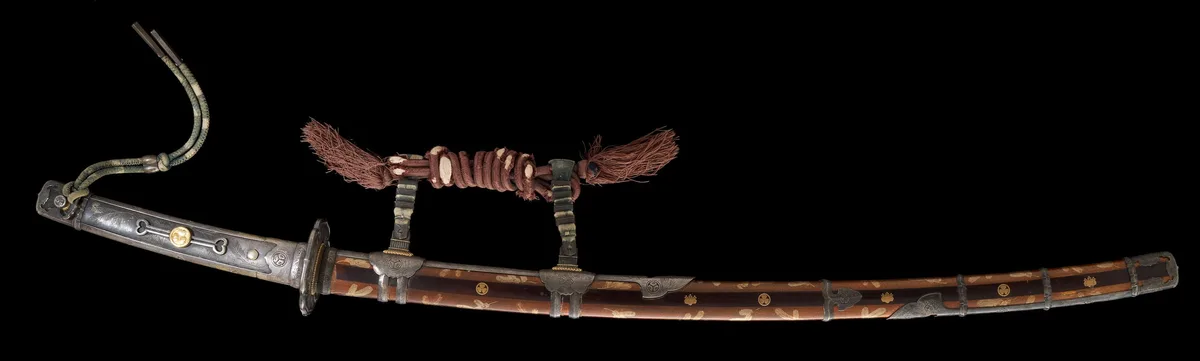
- Tachi
- A long curved sword worn suspended edge-downward from the belt (obi), prevalent from the Heian through Muromachi periods. Generally longer and with more curvature than the katana; signed on the side that faces outward when worn (ura).
- Katana
- The classic long sword of the samurai, worn edge-upward through the obi, dominant from the Muromachi period onward. Nagasa typically 60–75 cm; the omote (outward face when worn) is the opposite side to tachi convention.
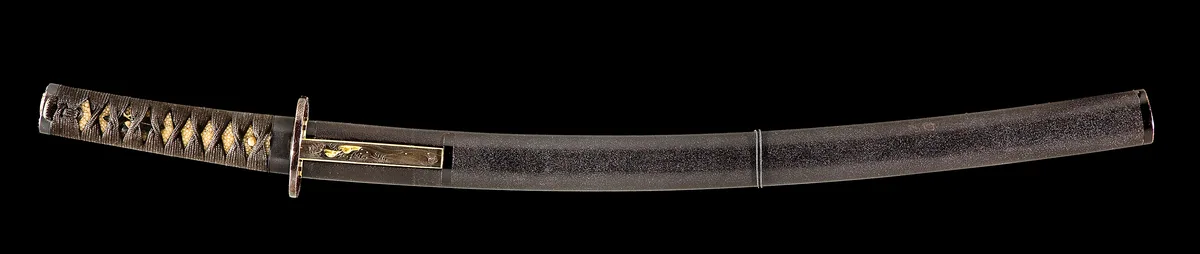
- Wakizashi
- The shorter companion sword of the daisho pairing, with nagasa broadly between 30 and 60 cm. Worn alongside the katana by samurai from the Edo period; independently useful in confined spaces and for the ritual of seppuku.
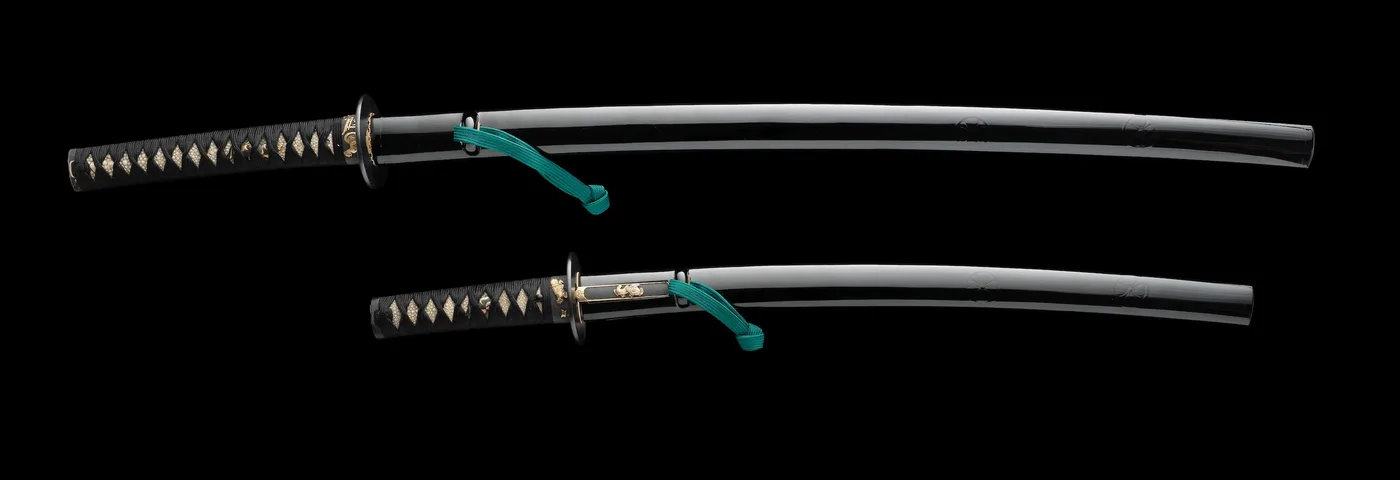
- Daishō
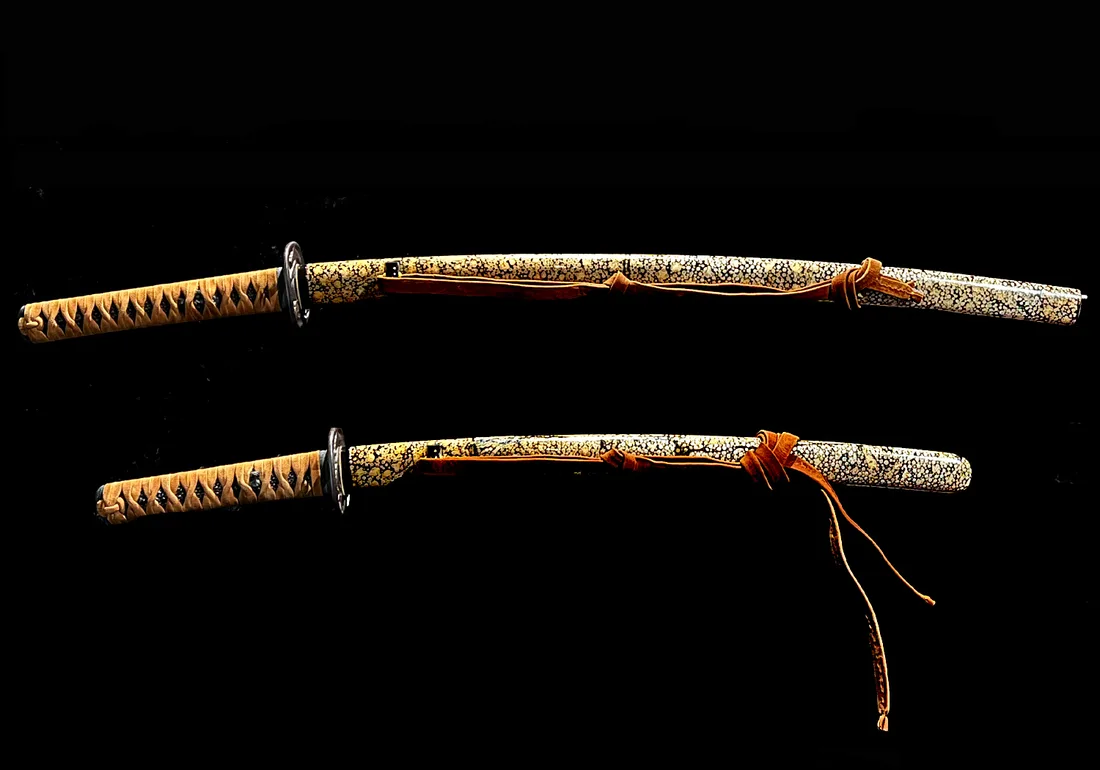
- The matched pair of a long sword and a short sword, the daitō (katana) and shōtō (wakizashi), worn together as the mark of the samurai class in the Edo period. A true daishō shares a coordinated koshirae, the fittings made to match, and the pair is valued as a set rather than as two separate swords.
- Tantō
- A single-edged blade under approximately 30 cm nagasa. Made from the Heian period onward; Kamakura-period tantō by Masamune, Yoshimitsu, and their contemporaries represent some of the highest achievements in the form.
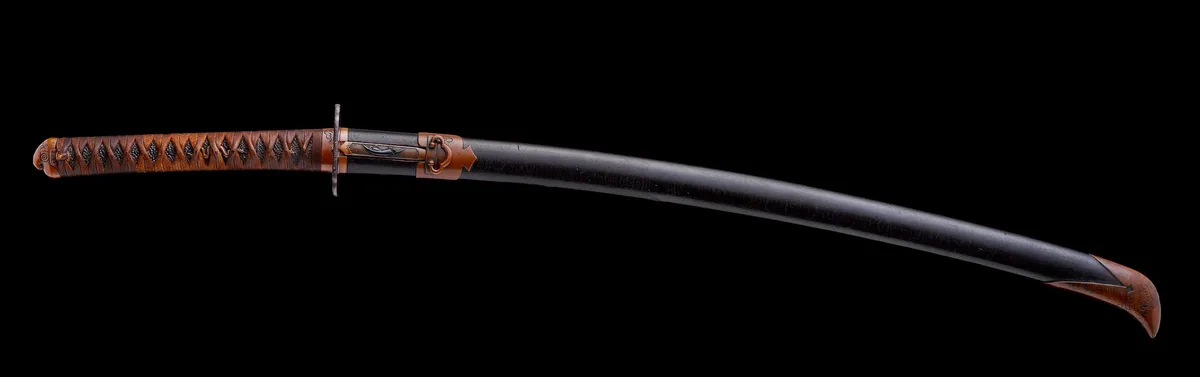
- Ōdachi
- An exceptionally long tachi, sometimes exceeding 90 cm or considerably more, associated with the Nanbokuchō period (14th century). Many surviving ōdachi were later shortened (o-suriage) to more practical lengths.
- Naginata
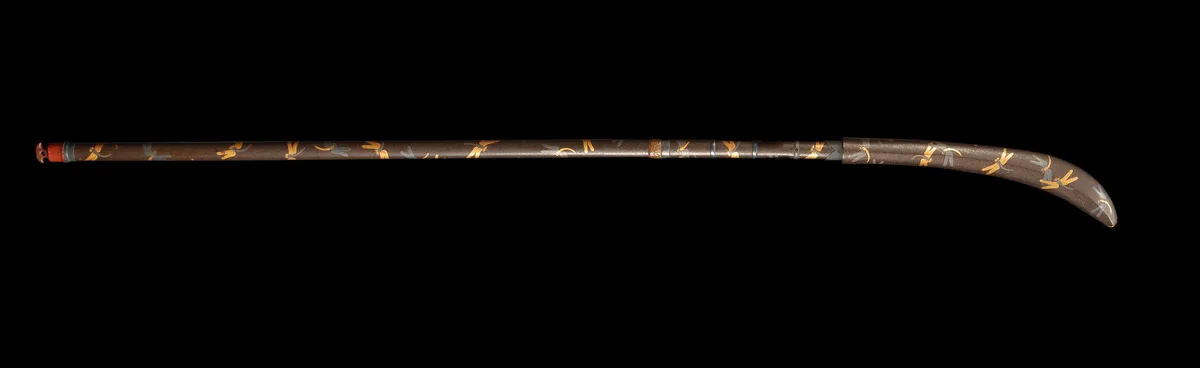
- A polearm with a curved single-edged blade mounted on a long shaft. Widely used by infantry and warrior monks; naginata-naoshi refers to blades shortened and remounted as conventional swords, identifiable by their distinctive saki-zori and wide body.
- Yari
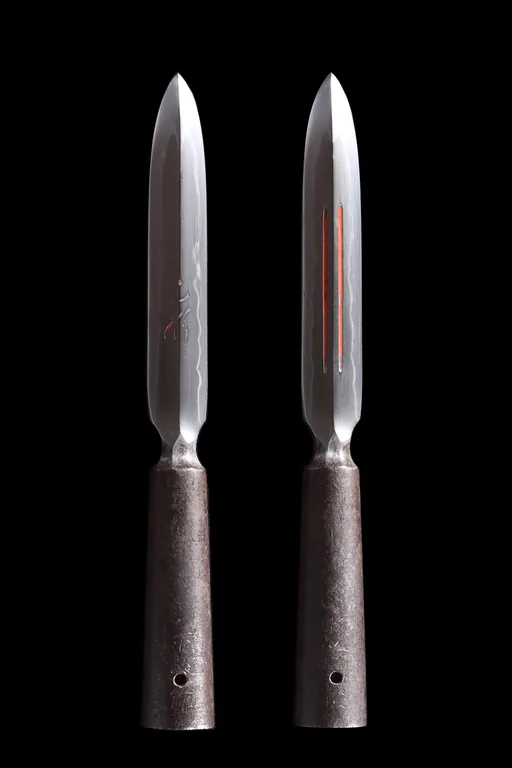
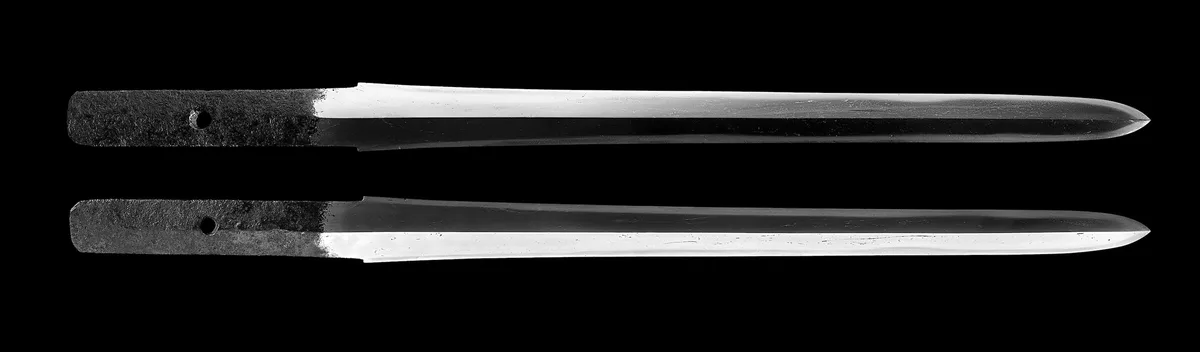
- A spear blade, double-edged and typically diamond-section, mounted on a long pole. Unlike naginata, yari blades are straight; they are signed on the nakago and collected as nihonto in their own right.
- Su-yari
- The plain straight spear: a simple double-edged, straight-bladed yari with no branches or hooks, usually of diamond (ryō-shinogi) or triangular section. By far the most common form, it was the standard thrusting spear of the samurai and foot soldier alike.
- Jūmonji-yari
- A cruciform spear with a central blade and two side blades set at right angles, forming the shape of the character 十 (ten). The side prongs allow parrying, hooking and cutting as well as thrusting. Also called magari-yari when the side blades curve.
- Kama-yari
- A spear with one or two sickle-like branches projecting from the base of the main blade. The hooks were used to catch an opponent's weapon, unhorse a rider, or grapple. A single-branch example is a kata-kama-yari; a symmetrical pair is a rare form.
- Magari-yari
- A general term for spears with curved or branching side blades, embracing the jūmonji and kama forms. The word ("bent spear") is often used interchangeably with jūmonji-yari, distinguishing these hooked types from the plain su-yari.
- Sankaku-yari
- A spear of triangular cross-section, having three faces rather than the flat diamond of a su-yari. The stiff triangular section gives a rigid, armour-piercing point at the cost of cutting ability; such blades are typically without a distinct shinogi on one face.
- Ōmi-yari
- A large-bladed spear, the term denoting an unusually long blade (often well over 30 cm, sometimes exceeding a shaku) on a straight su-yari form. Prized as a display of a smith's skill and a warrior's status; also read ōyari. Not to be confused with the province of Ōmi.
- Mochi-yari
- A short hand spear ("held spear") with a comparatively short haft, carried and wielded by a single warrior at close quarters rather than in massed formation. The counterpart to the long pike used by foot-soldiers.
- Nagae-yari
- A long pike, its name referring to the long haft (nagae) rather than the blade. Wielded in disciplined ranks by ashigaru foot-soldiers of the Sengoku period, some hafts reached four to six metres. The blade itself is usually a modest su-yari.
- Kikuchi-yari
- An early single-edged spear resembling a small tantō blade mounted point-forward on a long haft. Named for the Kikuchi clan of Higo, who are said to have improvised them; regarded as a transitional form between the tantō and the true double-edged yari.
- Fukuro-yari
- A socketed spear, in which the nakago is formed as a hollow socket (fukuro, "bag") that fits over the end of the haft, rather than a solid tang inserted into it. A simple, economical mounting; the signature, when present, is on the socket.
- Tanpo-yari
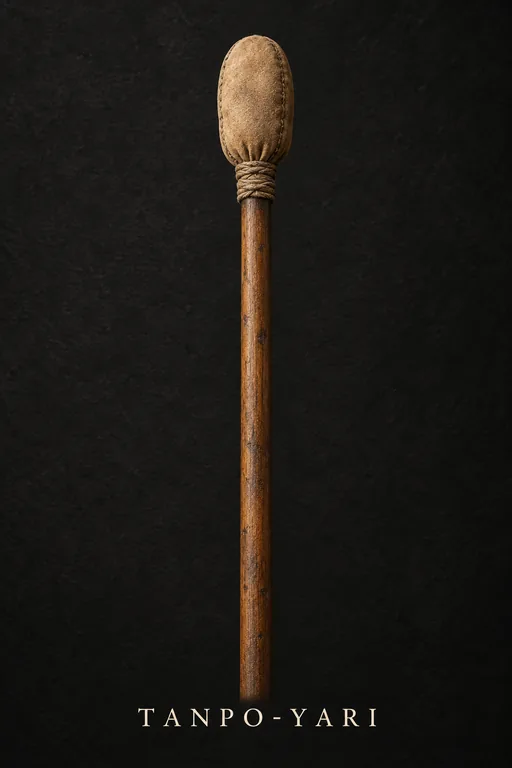
- A practice spear whose point is capped with a padded ball (tanpo), used for training so that thrusts could be delivered safely. A training implement rather than a collectible blade, though the term appears in discussions of spear technique.
- Kaiken
- A small dagger worn concealed in the breast of the kimono, typically by women of samurai class. Usually mounted in elegant koshirae with matching lacquerwork; nagasa rarely exceeds 20 cm.
- Ken
- A straight, double-edged sword of the earliest and ceremonial/Buddhist tradition, predating the curved nihontō; also survives as a carving motif (su-ken). Also read tsurugi.
- Nagamaki
- A polearm with a long blade and an equally long sword-wrapped handle, between naginata and ōdachi; nagamaki-naoshi blades remounted as swords are encountered by collectors.
- Uchigatana
- The earlier, less formal mounted katana worn edge-up that became the standard katana.
- Kodachi
- A short tachi of genuine tachi proportions but under ~60 cm; a distinct Kamakura form, not a wakizashi.



Periods
- Jōkotō
- Blades predating the curved nihonto form, broadly before the late Heian period (pre-c. 900 AD). Straight double-edged forms; survivals are extremely rare and largely held in shrines or museums.
- Kotō
- The "old sword" period, c. 900–1596. Encompasses the great classical schools — Ko-Bizen, Yamashiro, Sōshū, Mino — and the full arc from early tachi through the Sengoku era. Generally considered the peak of Japanese swordsmithing.
- Shintō
- The "new sword" period, c. 1596–1780. Swordsmiths relocated to castle towns; production became more commercial. Technically accomplished but scholarly opinion generally ranks shintō below the finest kotō work.
- Shinshintō
- The "new-new sword" period, c. 1780–1876, marked by a deliberate revival of Kotō techniques led by smiths such as Suishinshi Masahide and Taikei Naotane. Ended with the Haitōrei edict of 1876, which prohibited the wearing of swords.
- Gendaitō
- Modern swords made from 1876 to the present by traditionally trained smiths using tamahagane and classical methods. The NBTHK recognises gendaitō as legitimate nihonto eligible for shinsa and preservation papers.
- Shōwatō
- Military blades of the Shōwa era (1926–1945) produced by machine or semi-industrial methods, not by licensed traditional smiths. Shōwatō are ineligible for NBTHK papers and are not classified as nihonto, though they are collectable as militaria in their own right.
- Heian period
- c. 794–1185. The era in which the curved tachi emerged from earlier straight forms — the birth of the nihontō. Ko-Bizen and early Yamashiro work date here.
- Kamakura period
- 1185–1333. Widely regarded as the high point of swordmaking — Ichimonji and Osafune Bizen, Rai Yamashiro, the founding of Sōshū.
- Nanbokuchō period
- 1333–1392. The era of the Northern and Southern Courts, known for grand, wide blades and long ō-dachi; most surviving examples are now ō-suriage.
- Muromachi period
- 1392–1573. War demand shifted production to shorter, practical katana and large workshop output (Sue-Bizen, Sue-Seki).
- Shinsakutō
- "Newly made swords": blades by living, licensed smiths today, by fully traditional methods — contemporary new work, as distinct from older (pre-1945) gendaitō.
- Bakumatsu
- The late Edo / end-of-shogunate years (roughly 1853–1868), overlapping the Shinshintō revival and the run-up to the Meiji Restoration.
- Sengoku
- The "Warring States" era (roughly 1467–1600) within the Muromachi/Momoyama span, whose mass demand drove the huge Sue-Bizen and Sue-Seki output.
Schools & traditions
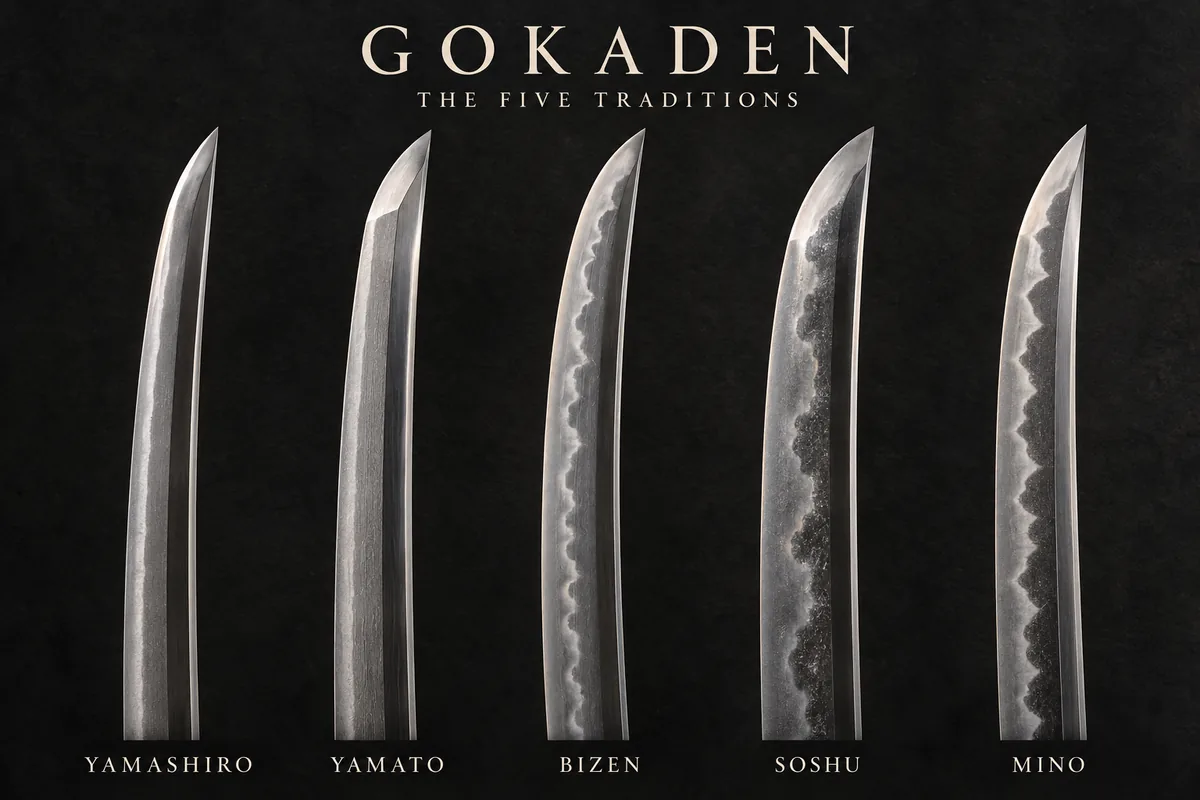
- Gokaden
- The "Five Traditions": the principal regional schools of the kotō period — Yamashiro, Yamato, Bizen, Sōshū, and Mino — each with characteristic steel, hamon, and forging. The framework underpinning most kantei.
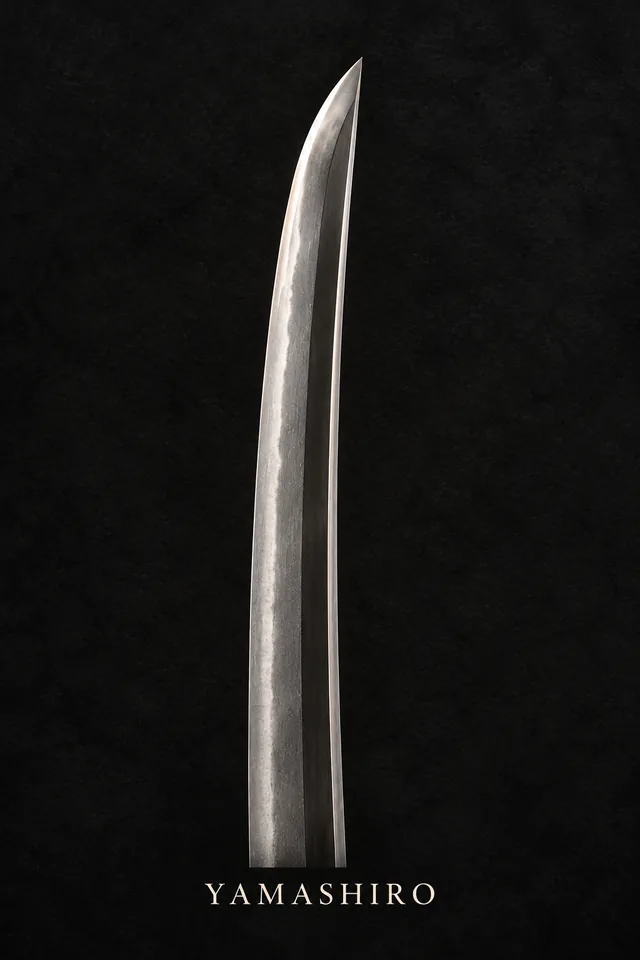
- Yamashiro
- The refined Kyoto tradition: tight ko-itame, ji-nie, quiet suguha or gentle midare. Home of the Sanjō, Awataguchi, and Rai schools.
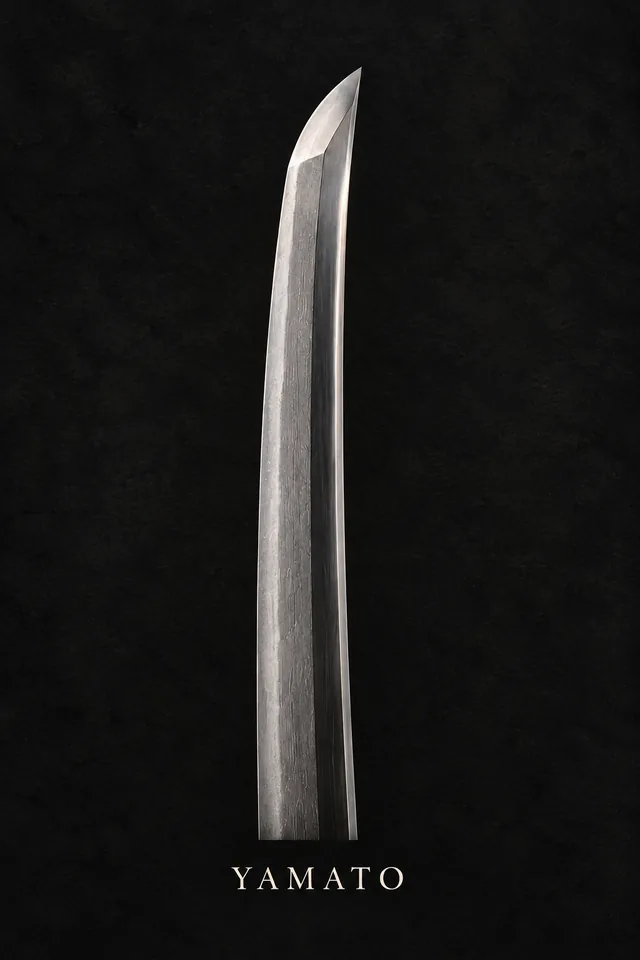
- Yamato
- The oldest tradition, tied to temple patronage: prominent masame in the shinogi-ji, suguha with hotsure and uchinoke, frequent yakizume boshi.
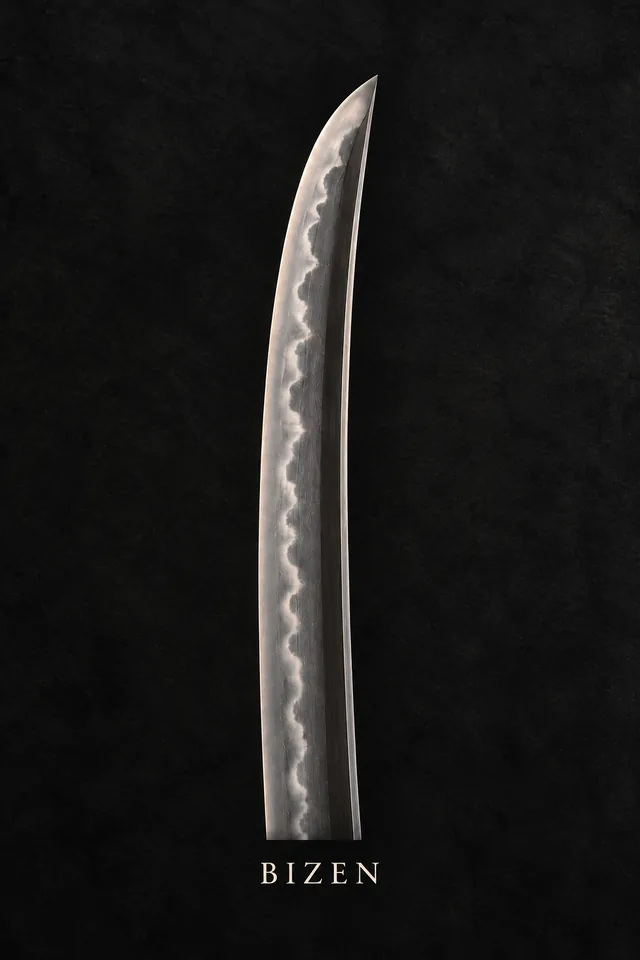
- Bizen
- The most prolific tradition: itame with utsuri, nioi-based hamon, and the chōji of Ichimonji and Osafune. The longest-running of the gokaden.
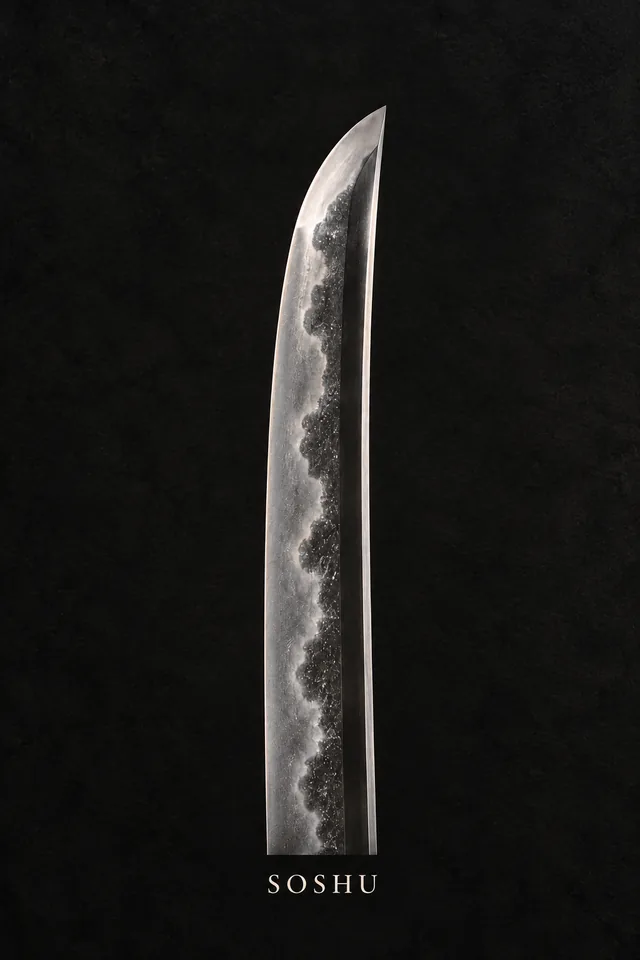
- Sōshū
- The Sagami tradition founded in Kamakura, at its height with Masamune: dense steel with abundant ji-nie and chikei, vigorous nie-deki hamon with kinsuji and inazuma.
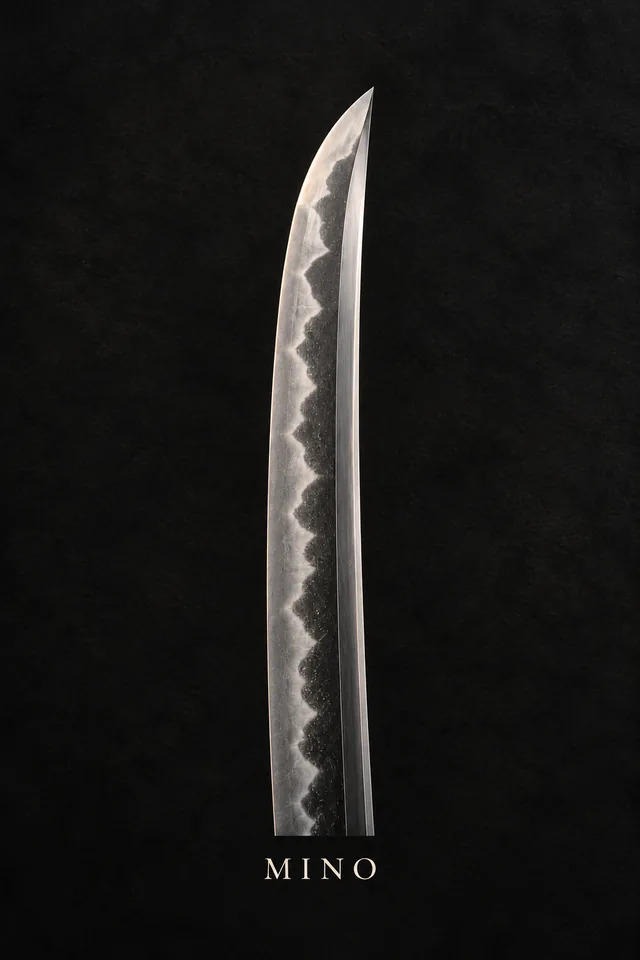
- Mino
- The youngest gokaden tradition, centred on Seki: togariba and gunome, often pointed, with shirake-utsuri and a practical character. Huge output in the Sengoku era.
- Den
- "Tradition" or "manner" — used in attribution to mean the workmanship of a school, as in "Sōshū-den." A blade can be attributed to a den without being assigned to a specific smith.
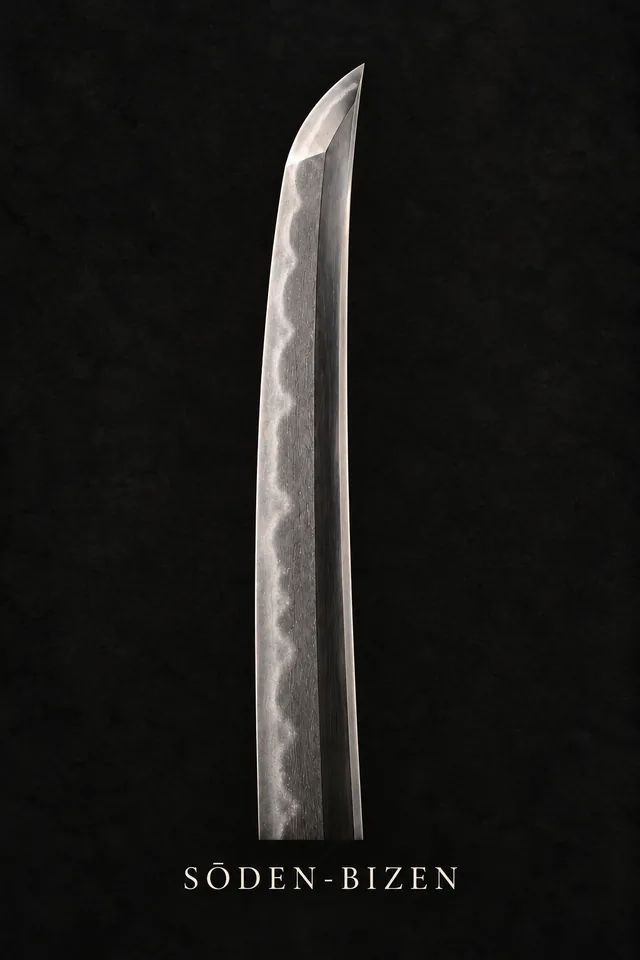
- Sōden-Bizen
- Bizen work showing Sōshū influence, with stronger nie and more flamboyant midare than classical Bizen. The manner of Kanemitsu and Chōgi in the Nanbokuchō period.
- Wazamono
- A ranking of smiths by cutting ability, from Edo-period cutting tests. Grades from highest: Saijō Ō-wazamono, Ō-wazamono, Yoki/Ryō-wazamono, Wazamono.
- Aoe
- The Bitchū-province school (Ko-Aoe and Aoe), known for a fine, slightly dark "chirimen" hada (sumihada), suguha or saka-ashi midare, and distinctive jifu-utsuri; a major non-gokaden tradition.
- Hizen
- The Tadayoshi-led Saga tradition of the Shintō period, defined by an extremely fine konuka-hada and bright, even suguha; among the most important Shintō schools.
- Ichimonji
- The great Bizen chōji school of the Kamakura period (Fukuoka, Yoshioka, Katayama branches), named for the single-character "一" signature; the apex of flamboyant chōji-midare with vivid utsuri.
Mountings
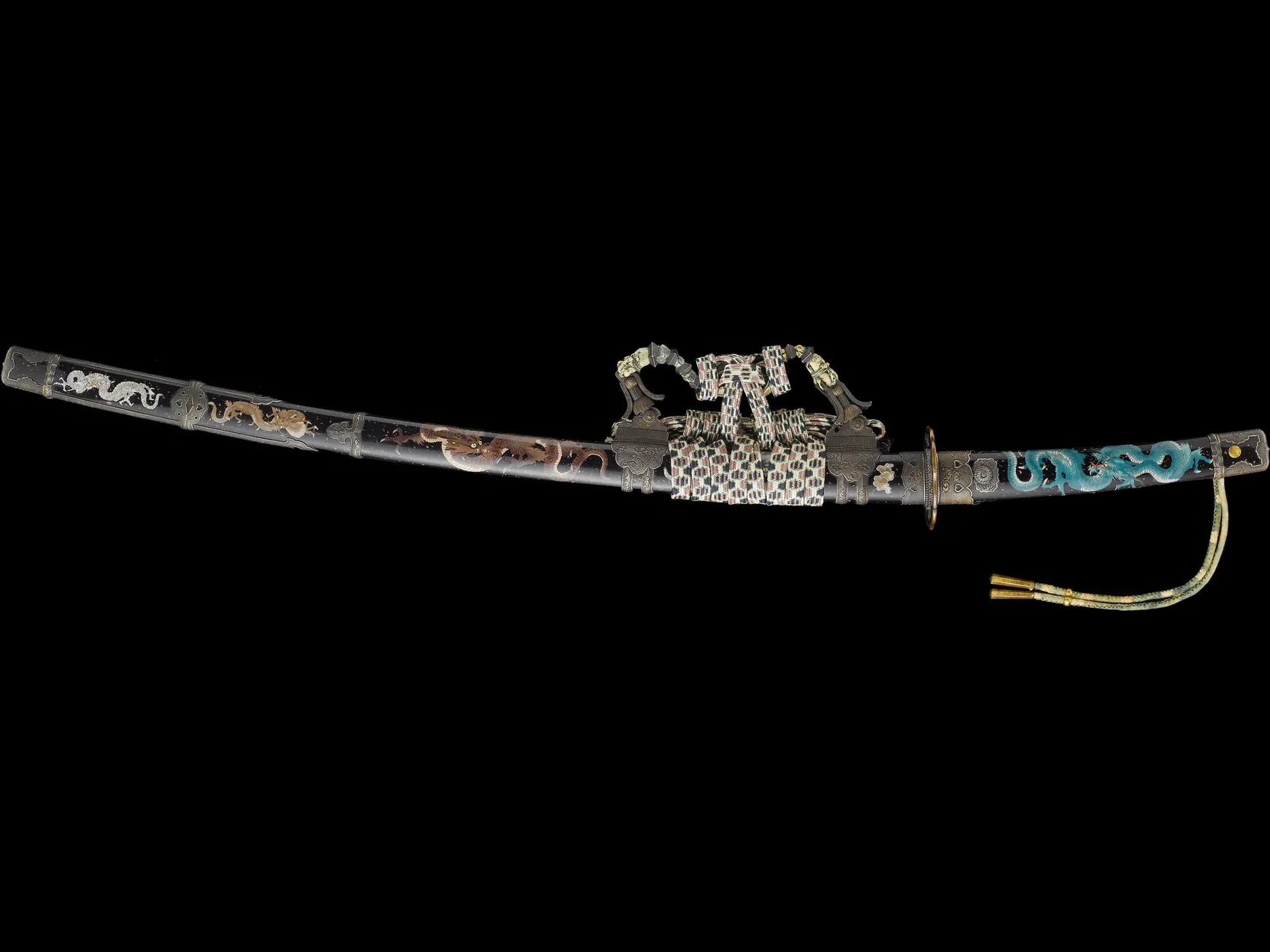
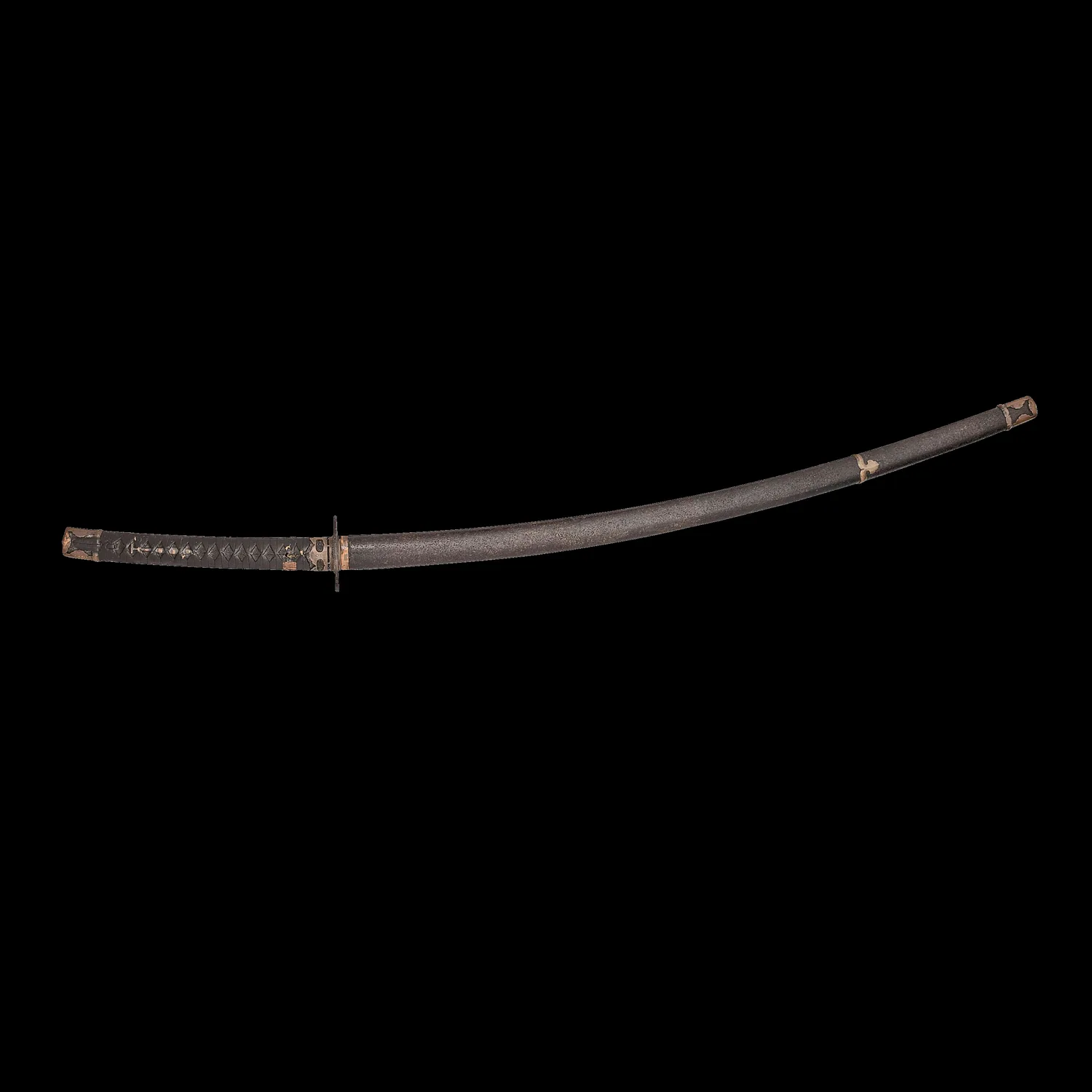
- Koshirae
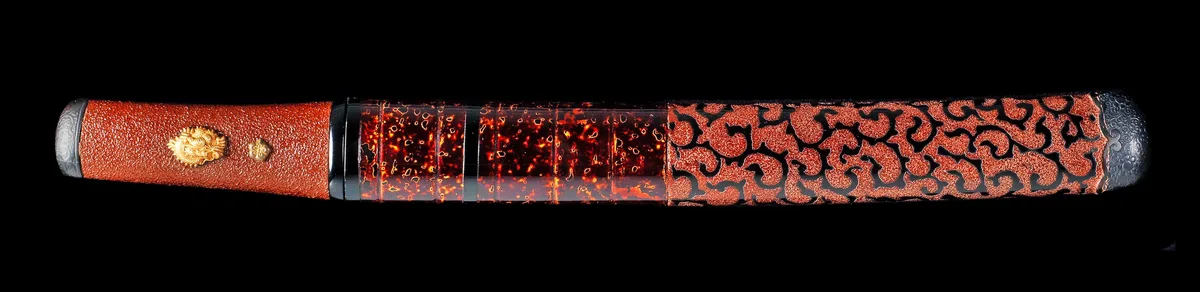
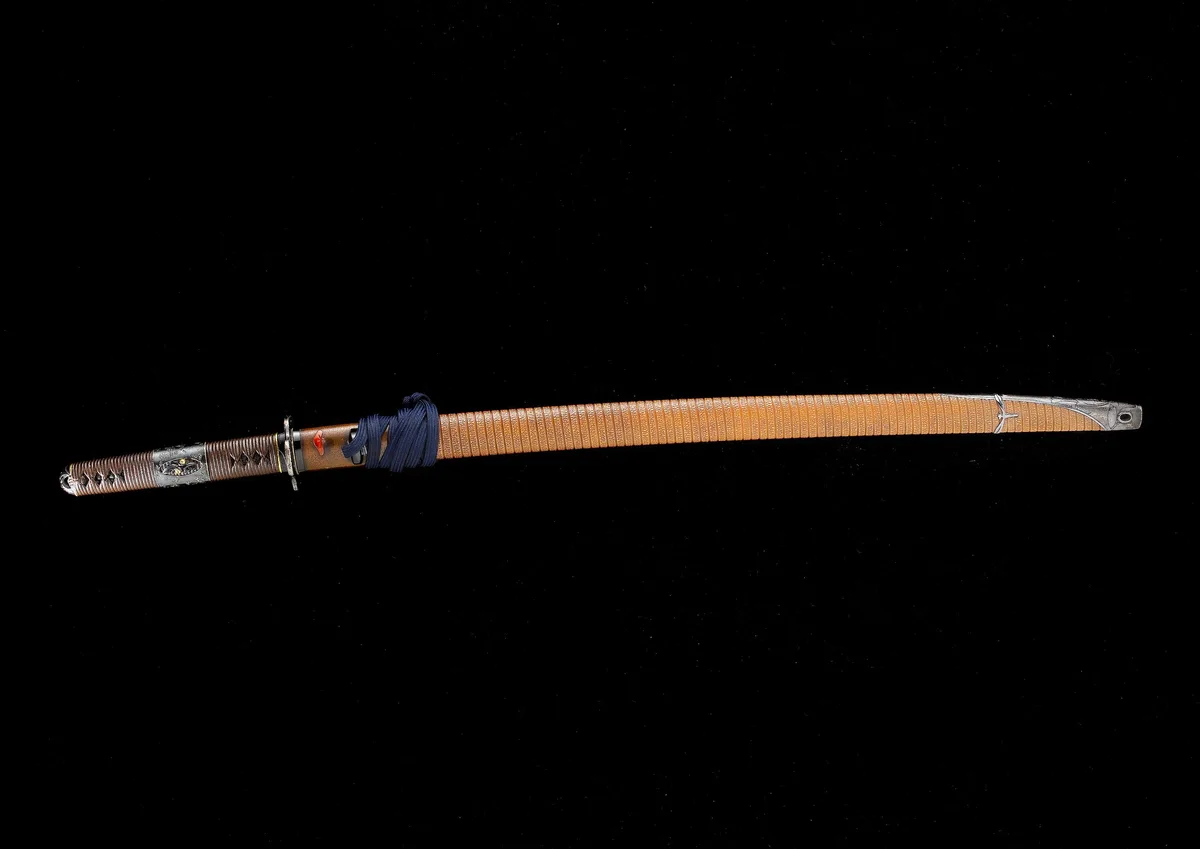
- The complete set of furniture and fittings for a mounted sword — tsuka, saya, tsuba, and all associated metalwork. A blade may have multiple historic koshirae; quality koshirae by named craftsmen are collected independently of the blade.
- Ishizuki
- The metal cap fitted to the butt end of a yari or naginata haft (literally "stone-striker"). It protects the pole, balances the weapon against the blade, and could serve as a striking point. Often matched in metal and style to the other fittings.
- Ebu
- The haft or shaft of a yari — the same character read tsuka on a sword. Fine spear hafts were built up in lacquered wood, sometimes fluted or reinforced, and the better examples were decorated with inlay. A specifically long haft is a nagae.
- Raden
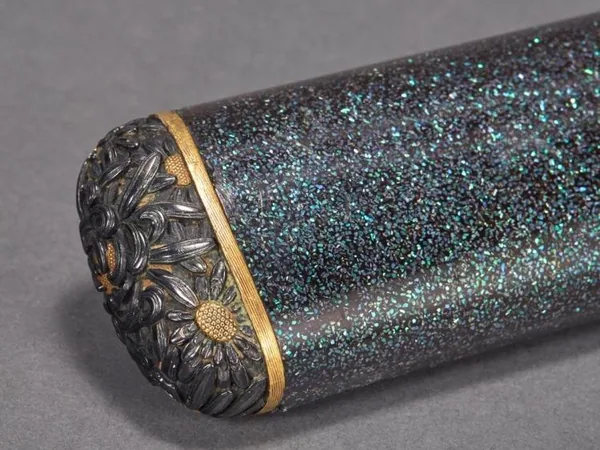
- Decoration in inlaid shell, in which pieces of iridescent mother-of-pearl are set into a lacquer ground. Found on fine saya and on presentation-grade yari hafts, where shell mosaic over black lacquer marks a parade or display mounting rather than a plain field weapon.
- Aogai
- A form of raden using the blue-green iridescent shell of the abalone ("blue shell"), typically applied as small chips to create a shimmering mosaic in black lacquer. A prized decorative technique on high-quality saya and spear hafts.
- Shirasaya
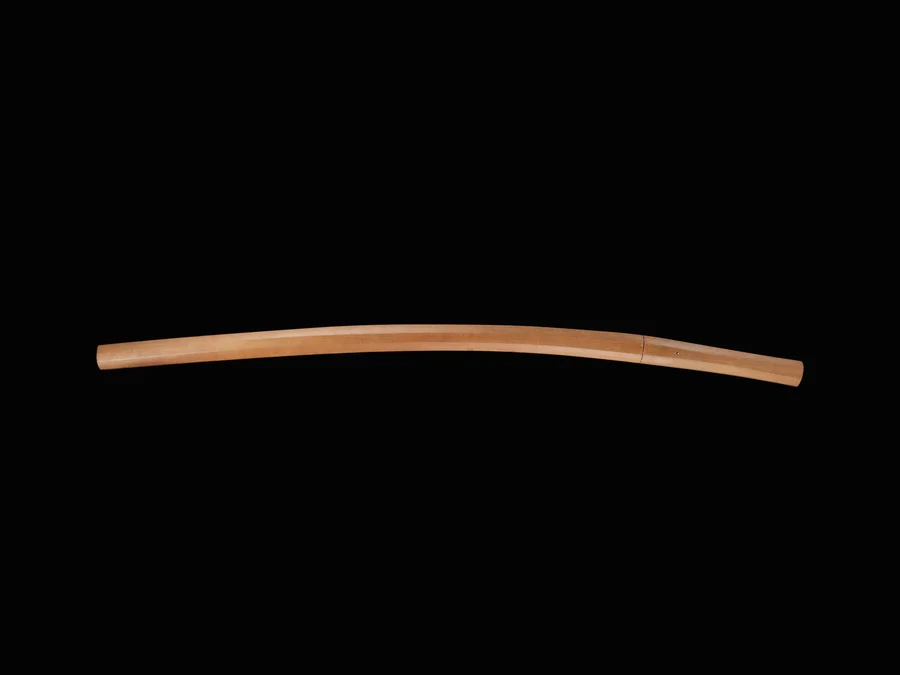
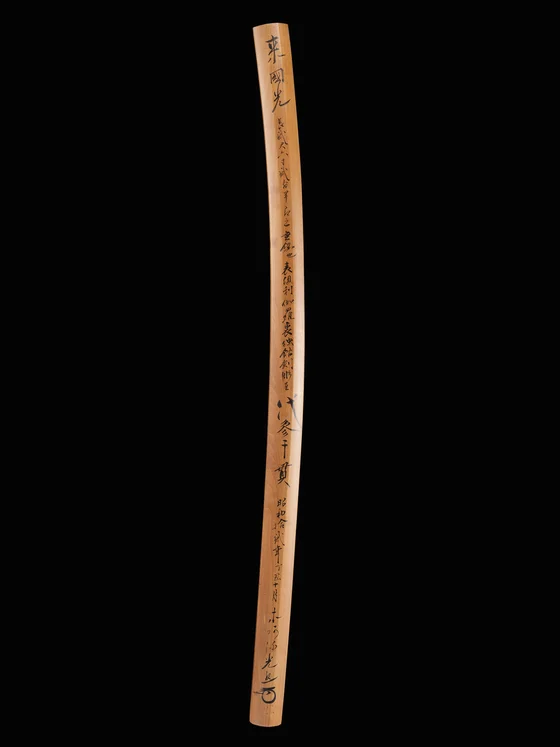
- A plain, undecorated storage mounting of untreated wood (usually honoki magnolia), fitted precisely to the blade for long-term preservation. The presence of a shirasaya does not imply a blade lacks koshirae — blades are routinely stored in shirasaya between exhibitions.
- Tsunagi
- A wooden dummy blade, shaped to the profile and nakago of the real blade, that holds a koshirae together while the blade itself rests in a shirasaya. A koshirae sold with its tsunagi can be displayed complete without the blade in it.
- Tsuka
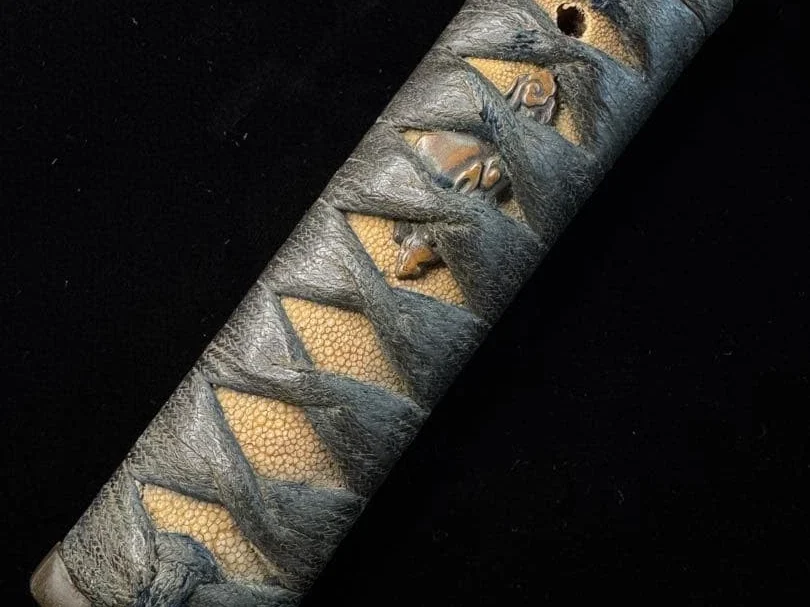
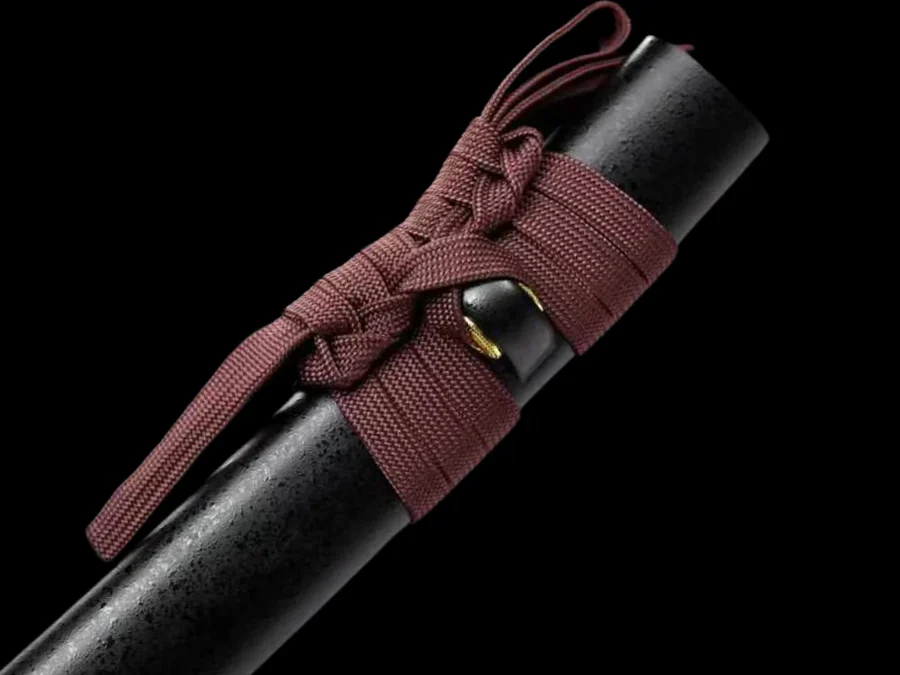
- The handle, constructed over a wooden core (tsuka-gi) wrapped in samegawa and then bound with tsuka-ito in a traditional lozenge pattern. The tsuka houses the mekugi peg that secures the nakago.
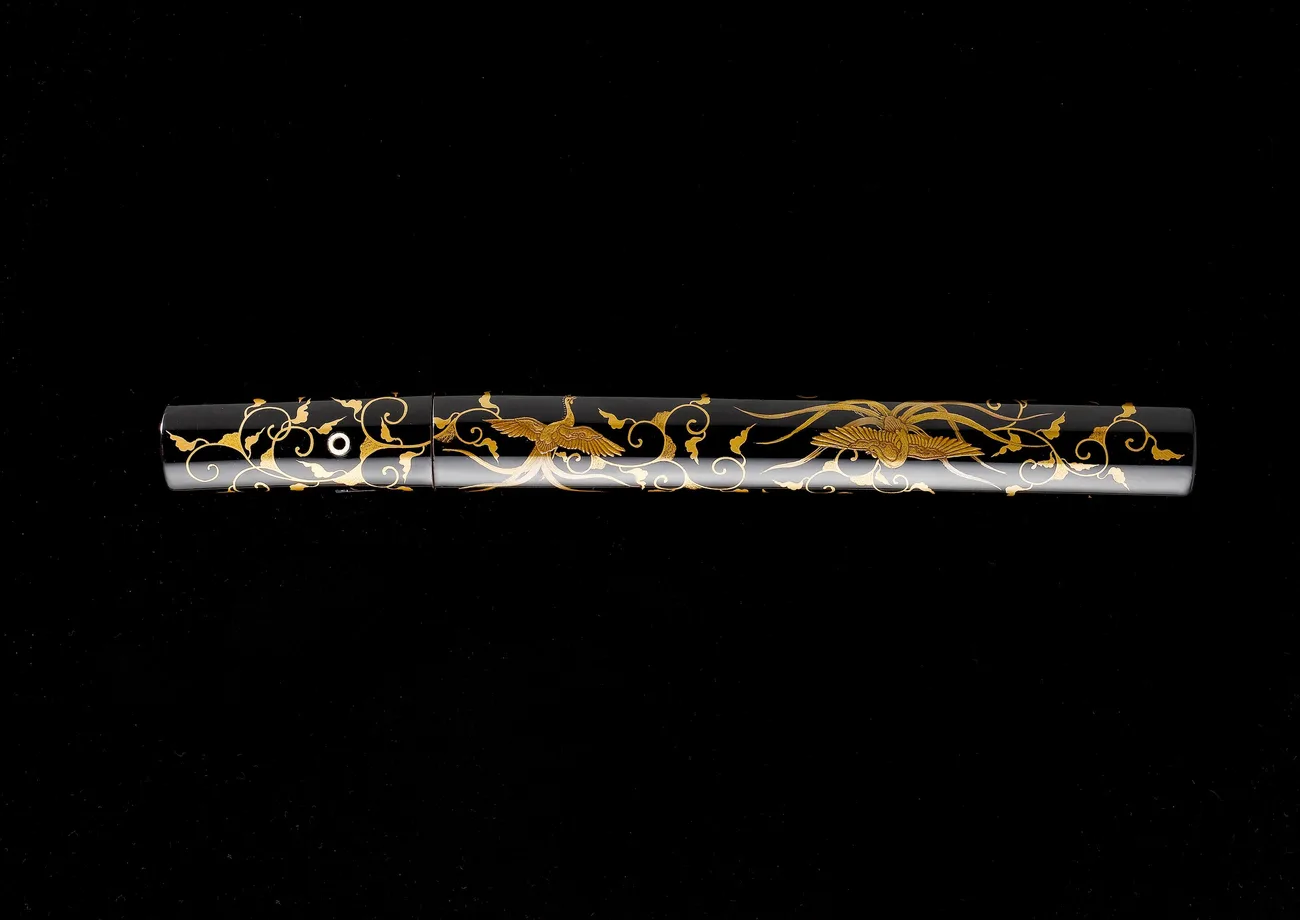
- Saya
- The scabbard, traditionally of honoki wood lacquered in a variety of styles. The saya includes the koiguchi (mouth), kurikata (cord knob), and kojiri (chape).
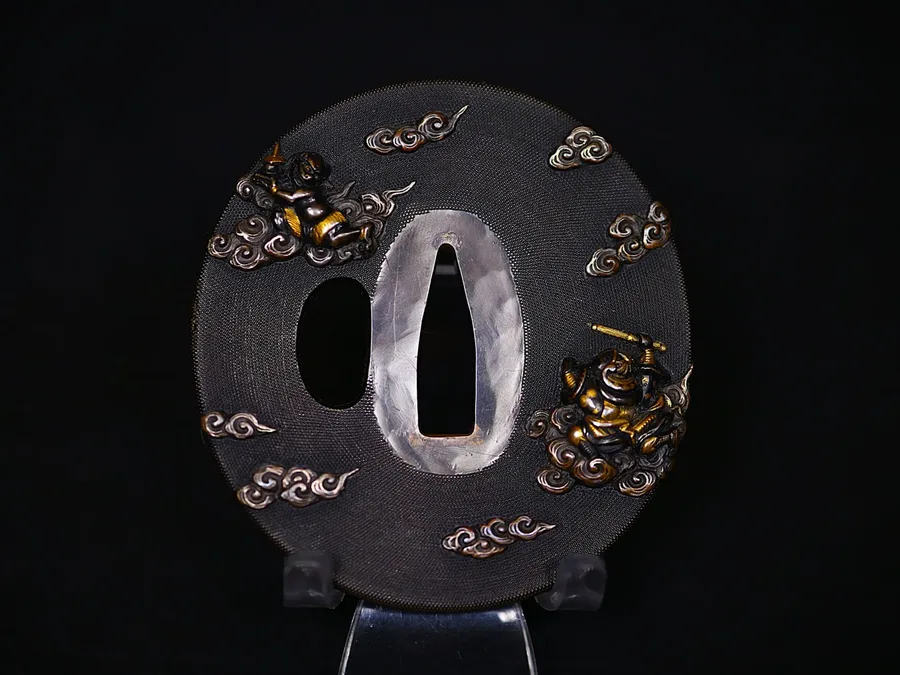
- Tsuba
- The hand-guard, separating blade from handle. Made in iron, shakudō, shibuichi, or brass; decorated by named schools — Goto, Myochin, Shoami — whose work is collected as fine metalwork in its own right.
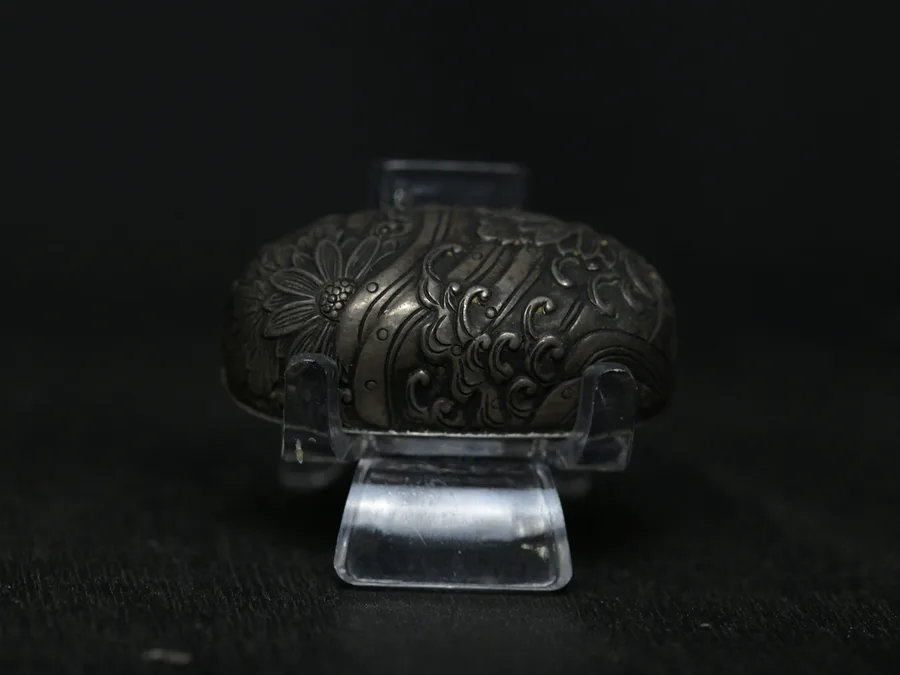
- Fuchi
- The collar fitting at the blade end of the tsuka, forming one half of the fuchi-kashira set. Usually made and signed as a matched pair with the kashira.
- Kashira
- The cap at the butt end of the tsuka, paired with the fuchi. Matching fuchi-kashira sets in shakudō with gold nunome-zogan are among the most desirable koshirae components.
- Menuki
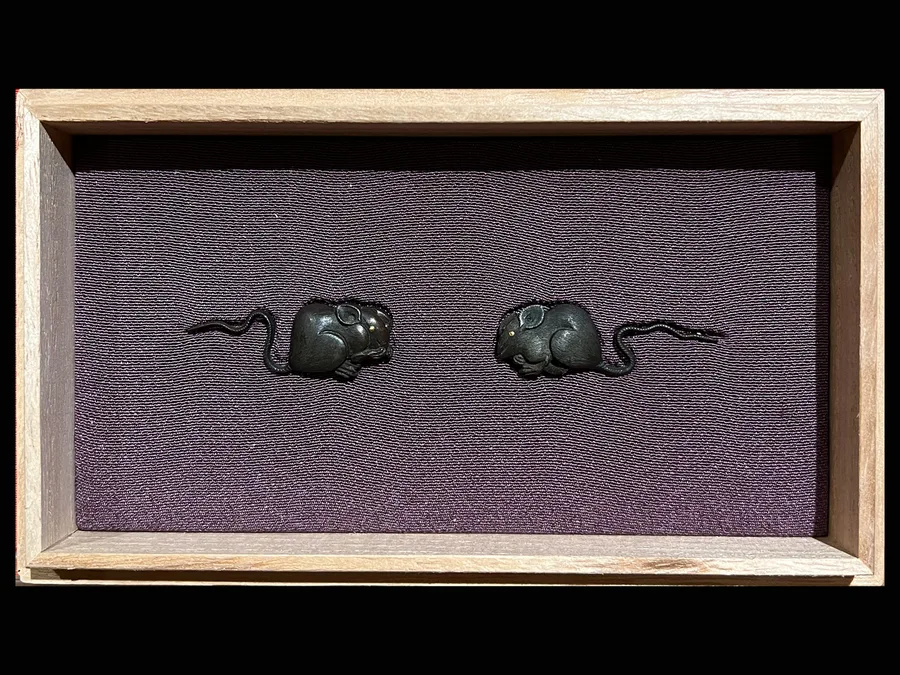
- Small decorative ornaments set beneath the tsuka-ito on either side of the handle, originally placed over the mekugi hole. Usually figural — dragons, shishi, blossoms — and closely associated with the Goto school of metalworkers.
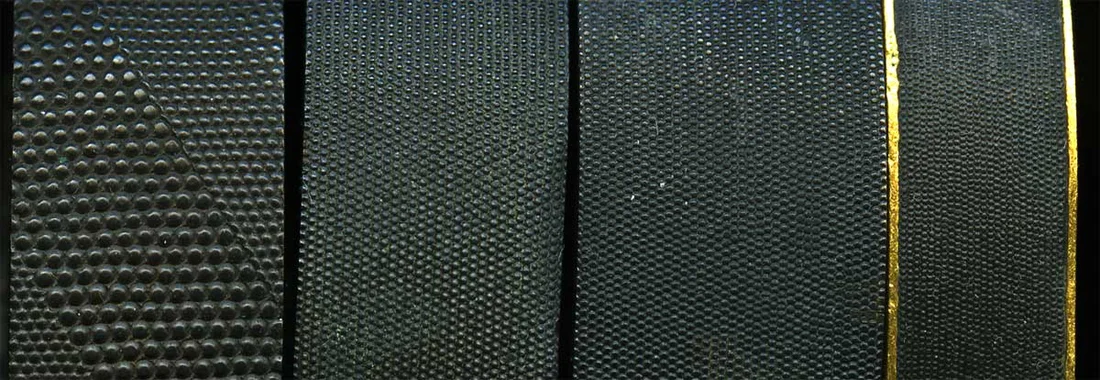
- Samegawa
- Ray or shark skin (same), traditionally from rays, used to wrap the tsuka-gi beneath the ito binding. The pebbly surface provides grip and a traditional aesthetic; quality samegawa with large, regular nodes is preferred.
- Tsuka-ito
- The braid or cord wrapped over the samegawa in a lozenge (hishi-gumi) or other pattern to form the finished grip. Silk is traditional; cotton common on military-grade mounts. Colour and pattern vary by period and school.
- Kurikata
- The knob on the saya through which the sageo is threaded. Its position on the saya and material (horn, ivory, lacquered wood, metal) reflect the formality of the mounting.
- Sageo
- The cord threaded through the kurikata, used to secure the saya to the obi or tie the sleeve during combat. Silk sageo in various colours and braids are associated with particular ranks and ceremonial contexts.
- Kojiri
- The chape or end cap of the saya, protecting the tip. On formal koshirae these are often of matching metalwork; on shirasaya and military scabbards a simple horn or steel fitting is typical.
- Koiguchi
- The mouth of the saya, where the blade enters ("carp's mouth"), often reinforced with horn; a snug koiguchi holds the blade seated against the habaki.
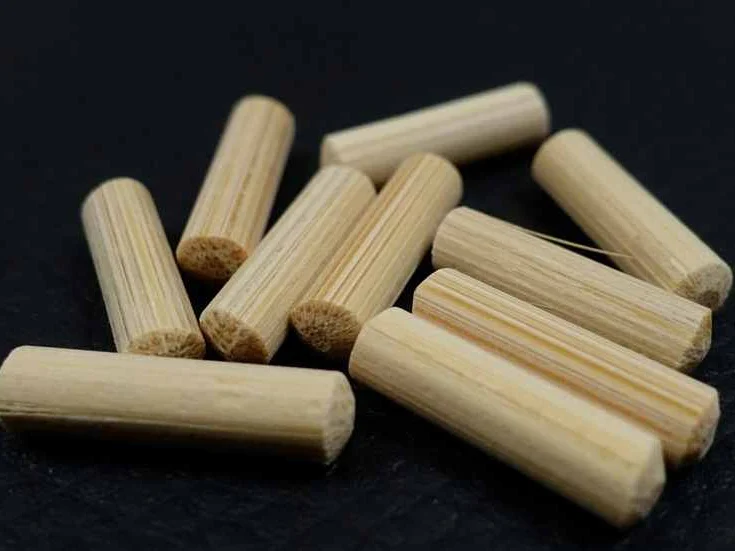
- Mekugi
- The small peg, usually bamboo, passing through the tsuka and the nakago's mekugi-ana to lock the blade in the handle. The key component for safe handling.
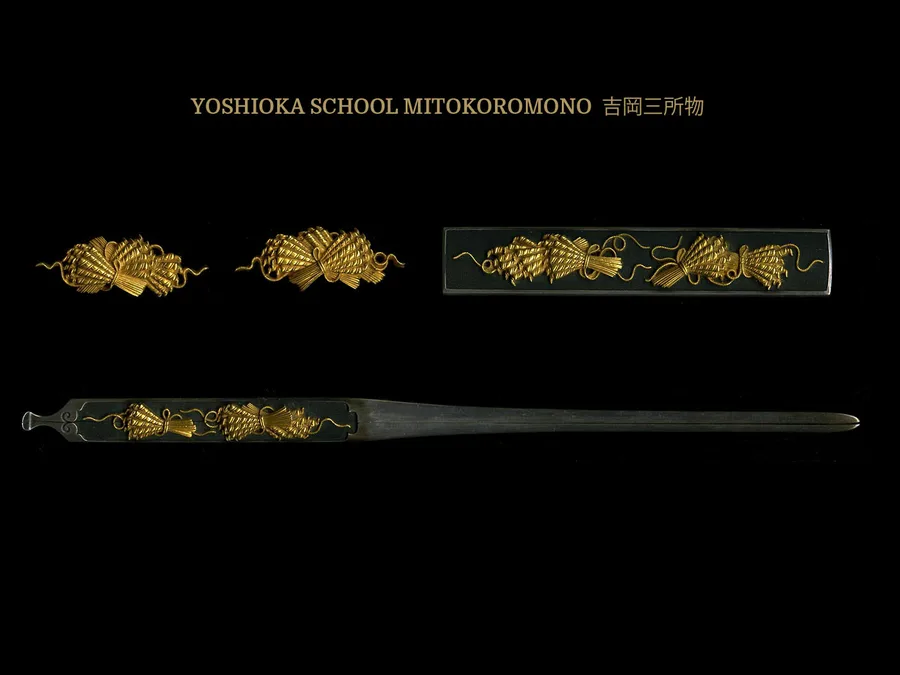
- Mitokoromono
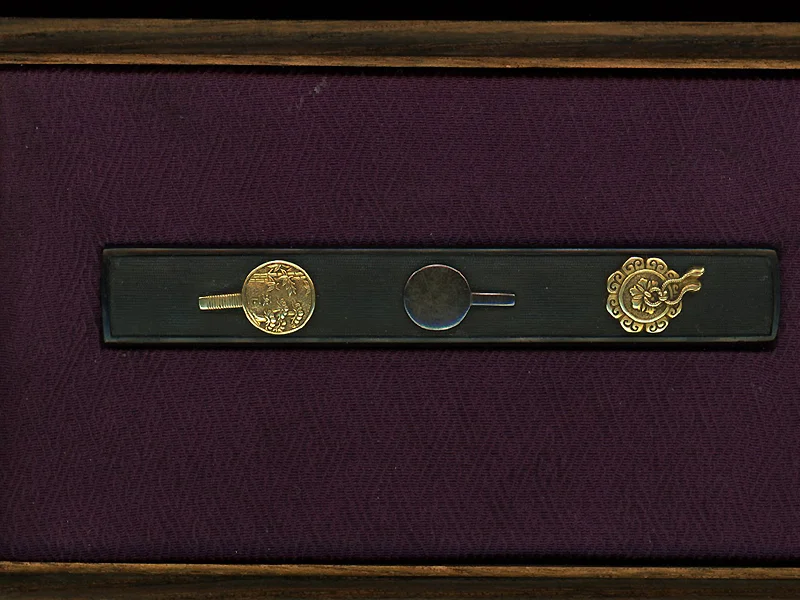
- A matched set of three fittings — menuki, kogai, and kozuka — decorated with one theme by one workshop, classically the Gotō school. A complete set is highly prized.
- Aikuchi
- A mounting with no tsuba, the fuchi meeting the koiguchi directly. A common tantō style.
- Handachi
- A "half-tachi" mounting combining katana-style wear with tachi-style metal fittings on the saya. Popular in the Edo period.
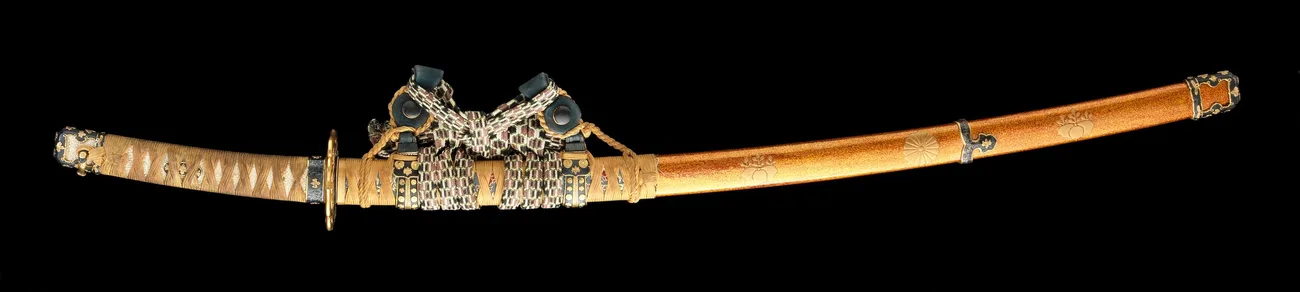
- Itomaki-no-tachi
- A formal tachi mounting whose upper saya is cord-wrapped like the tsuka. The most formal of tachi koshirae.
- Higo koshirae
- A refined, understated mounting style from Higo province under Hosokawa patronage: restrained iron fittings and fine proportion.
- Nanako
- A ground of fine, regular raised dots punched into soft metal, like fish-roe. A hallmark of Gotō-school work and a sign of quality.
- Shakudō
- A copper-gold alloy patinating to a deep blue-black. The premier soft metal for fine fittings, classic for Gotō work.
- Fukurin
- A rim of softer metal (gold, silver, shakudō or brass) fitted around the outer edge of a tsuba, or along the edge of a fuchi, kashira or saya fitting. It protects the edge from wear and adds a line of contrasting colour; on iron tsuba a gold or brass fukurin is a mark of a finished, high-quality mount.
- Shibuichi
- A copper-silver alloy patinating to soft grey tones. Favoured for naturalistic and pictorial fittings.
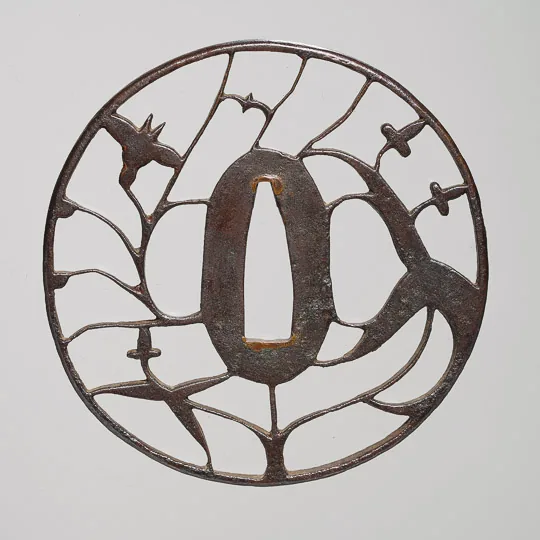
- Sukashi
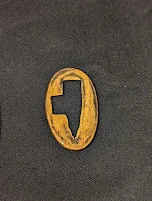
- Openwork in a tsuba, the design formed by piercing. A major decorative tradition, especially in iron tsuba.
- Nunome-zōgan
- Decoration in which gold or silver is hammered into a cross-hatched surface to form patterns. Widely used on iron fittings.
- Kyū Guntō
- The "old army sword" pattern adopted c. 1875–1934: a Western-influenced cavalry sabre mounting used by Meiji and early Shōwa officers. Blades ranged from imported European sabres to remounted nihonto; now largely supplanted in collector interest by later patterns.
- Shin Guntō
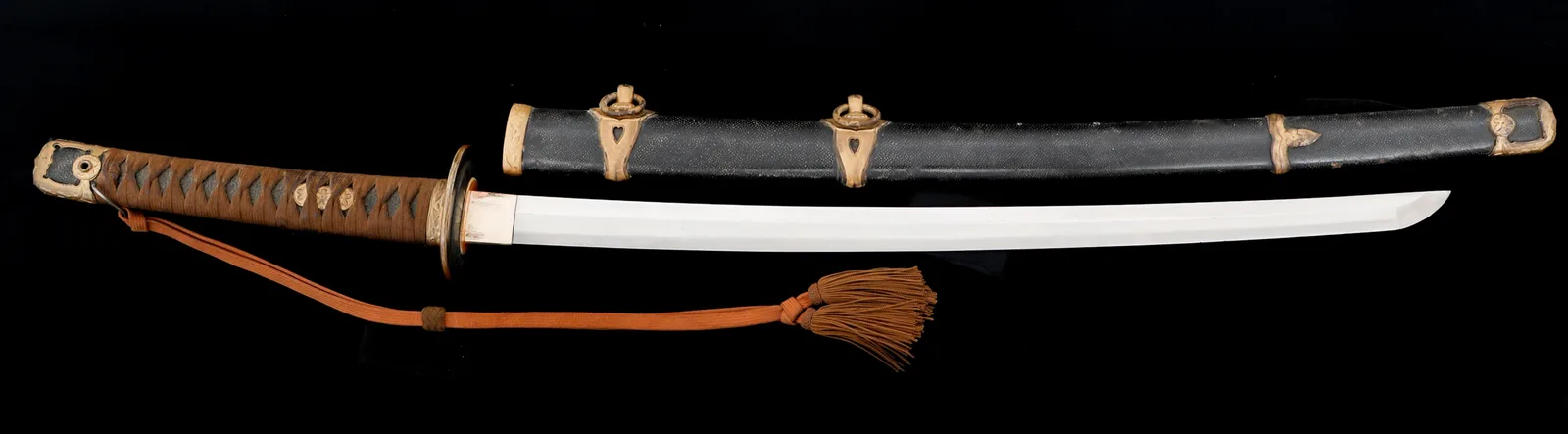
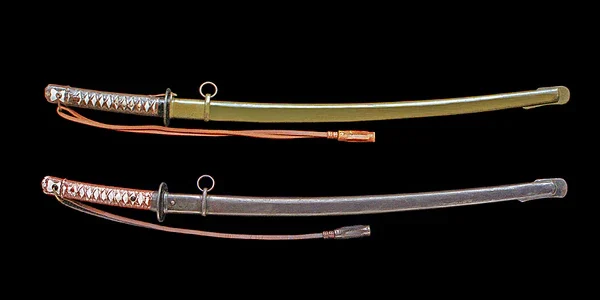
- The "new army sword" introduced in 1934 for Imperial Japanese Army officers, deliberately echoing the classical tachi in its traditional brown ito-wrapped tsuka and cherry-blossom menuki. The most commonly encountered WW2 Japanese sword mounting. Blades may be nihonto (traditionally made) or shōwatō (machine-made).
- Kai Guntō
- The Imperial Japanese Navy officer's sword, distinct from the Shin Guntō in its black same-wrapped tsuka and different furniture style. Often mistaken for the army pattern; the navy anchor mon on fittings is the clearest identifier.
- Mon
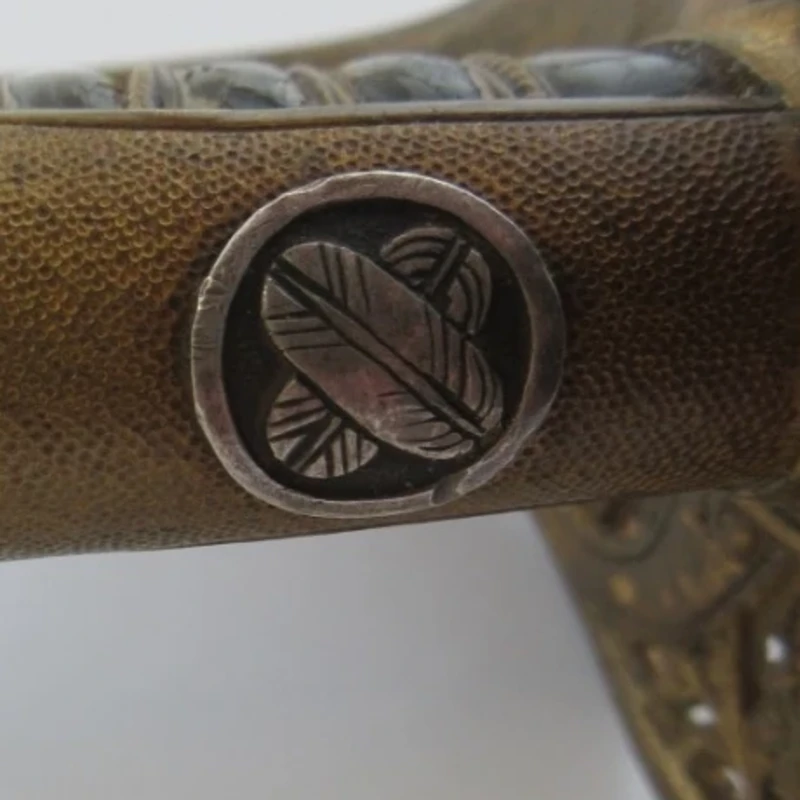
- A Japanese family or clan crest, typically a stylised roundel design. Found engraved or inlaid on sword fittings to mark a piece as a named family's own property rather than standard-issue kit. Some crests, such as the crossed-hawk-feather chigai taka-no-ha, were borne by many unrelated families, so a mon alone rarely identifies a specific owner.
- Type 95 NCO Sword
- The standard-issue sword for Imperial Japanese Army non-commissioned officers, produced 1935–1945. Fully machine-made with a cast aluminium or zinc alloy tsuba and a non-removable blade; not a nihonto. Collectable as militaria; ineligible for NBTHK papers.
- RJT — Rikugun Jumei Tōshō
- Army-Appointed Swordsmith — a designation granted by the Imperial Japanese Army to traditionally trained smiths authorised to produce blades for military officers. RJT-stamped blades are genuine nihonto, traditionally made from tamahagane, and are eligible for NBTHK papers. The stamp (usually on the nakago) is an important authentication detail for WW2-period blades.
- Kogai
- A skewer-like grooming/utility implement carried in a slot in the saya, often paired with the kozuka; one of the three mitokoromono fittings.
- Kozuka
- The decorated handle of the small utility knife (kogatana) seated in the saya; a primary canvas for fittings artists and part of the mitokoromono set.
- Seppa
- The washers seated on either side of the tsuba that take up play and lock the assembly tight; their fit and number are basic to a sound mounting.
- Seppa-dai
- The flat oval platform at the centre of a tsuba where the seppa bear and signatures are often placed.
- Mokkō
- A four-lobed, melon-flower outline; one of the commonest tsuba shapes.
- Tekkotsu
- "Iron bones" — dark, hard inclusions standing proud at the rim of a well-forged iron tsuba, prized as evidence of quality steel.

Papers and authentication
- NBTHK
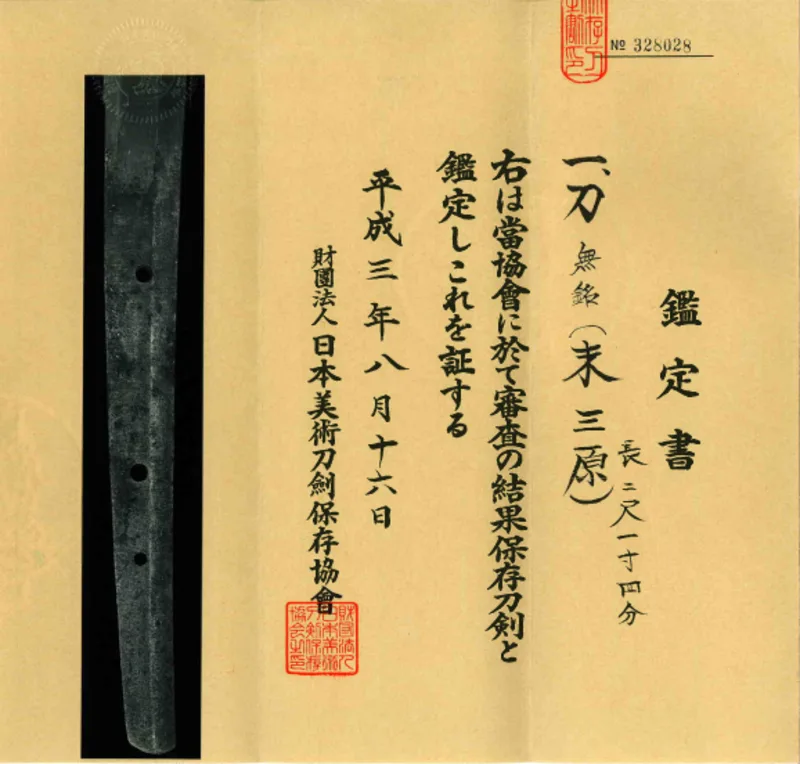
- Nihon Bijutsu Token Hozon Kyokai — the Society for the Preservation of Japanese Art Swords, founded 1948. The principal authentication body; NBTHK papers (origami) are the international standard for nihonto authentication and are essential for export from Japan under cultural property law.
- NTHK
- Nihon Token Hozon Kai — an independent authentication society offering an alternative to NBTHK papers. NTHK papers are respected within the collecting community but generally considered secondary to NBTHK for high-value transactions.
- Kantei
- The structured discipline of examining and attributing a nihonto blade by physical evidence — sugata, hada, hamon, boshi, and nakago — rather than by signature alone. Not a guess; a reasoned argument from observable characteristics against accumulated school and period reference material. The intellectual foundation beneath every NBTHK attribution.
- Shinsa
- The formal examination process conducted by NBTHK or NTHK judges, at which blades are assessed for authenticity, attribution, and quality. Shinsa sessions are held in Japan and at major overseas events; submission requires the blade to be present.
- Hozon
- The entry-level NBTHK preservation certificate, confirming that a blade is a genuine nihonto worthy of preservation. The baseline standard for any serious transaction; a blade without at least Hozon papers carries meaningful attribution risk.
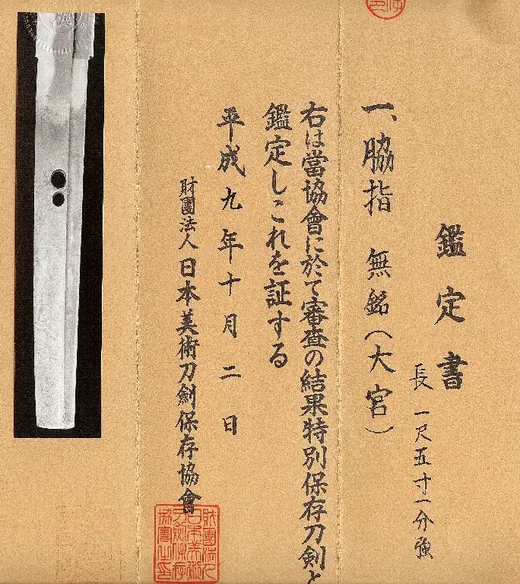
- Tokubetsu Hozon
- NBTHK "Specially Preserved" — the second tier, awarded to blades of superior quality and condition above the Hozon standard. A Tokubetsu Hozon paper significantly affects value and is the typical threshold for mid-to-high market pieces.
- Jūyō
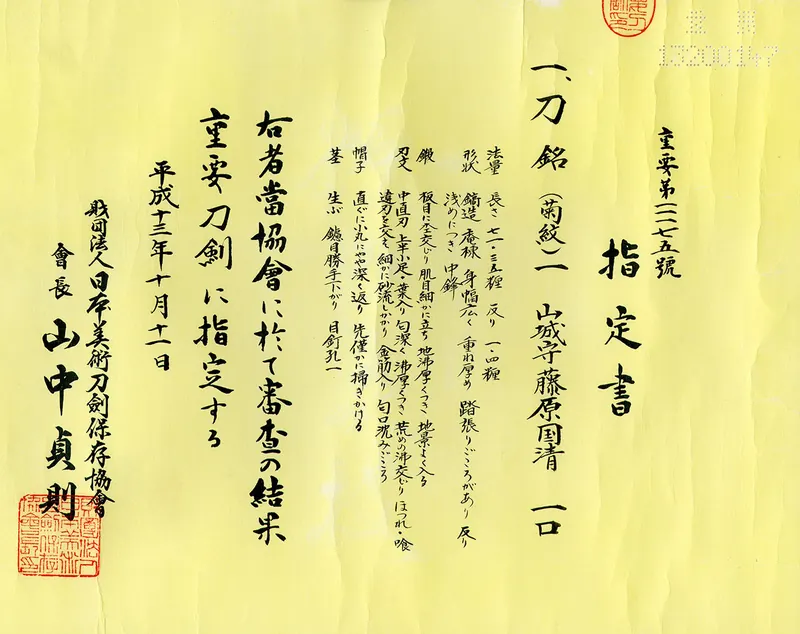
- NBTHK "Important" — the third and highly selective tier, awarded to blades of outstanding historical or artistic significance. Jūyō papers represent a major distinction; fewer than a few thousand blades hold this status. Substantially affects both value and export eligibility.
- Tokubetsu Jūyō
- NBTHK "Specially Important" — the highest tier of NBTHK certification, reserved for blades of exceptional national importance. Fewer than 1,000 blades hold this designation; most are held in institutional or major private collections.
- Origami
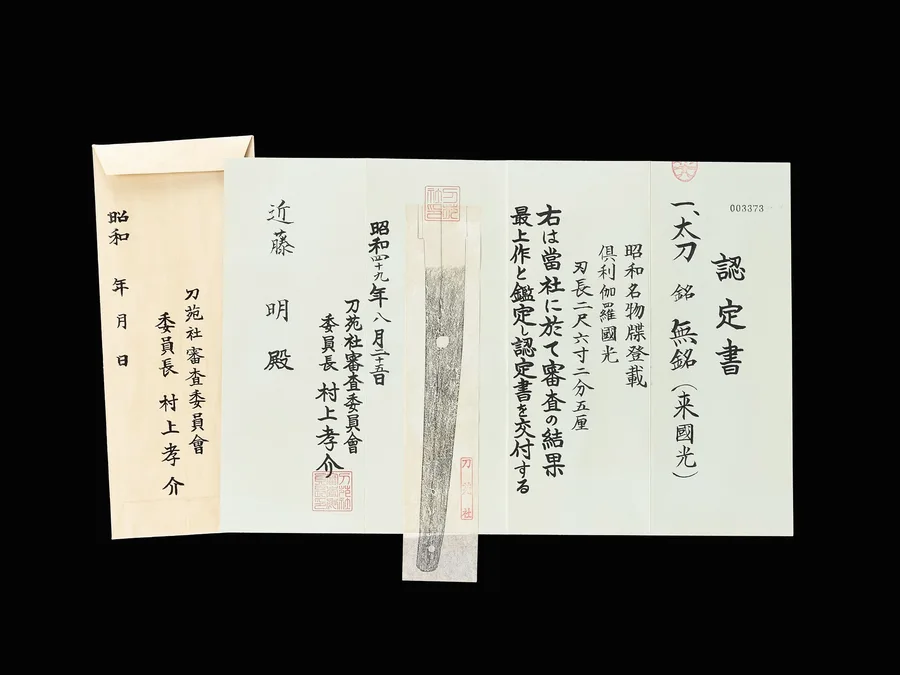
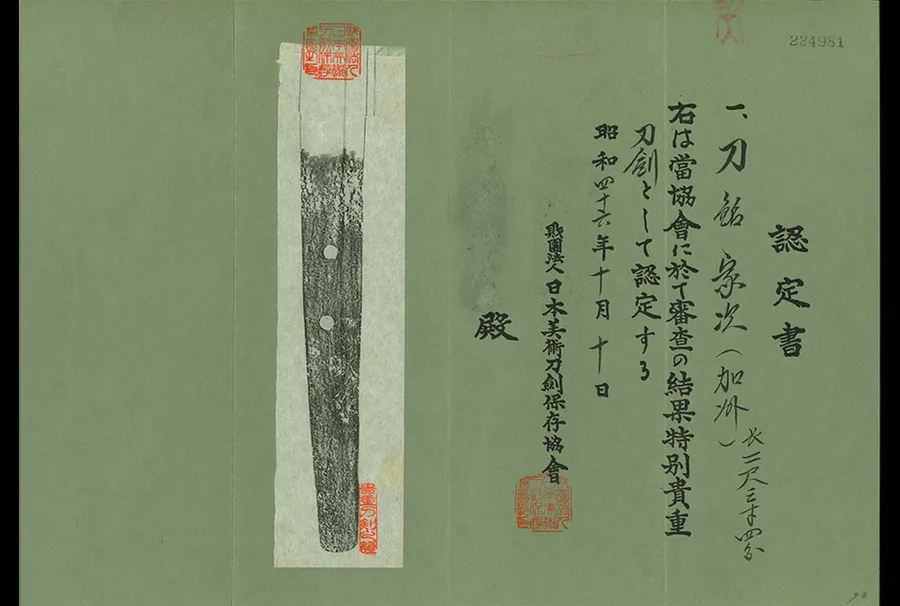
- Literally "folded paper" — the informal term for any NBTHK authentication certificate, derived from the traditional practice of folding the document. In the trade, "it has origami" means a blade carries valid NBTHK papers; always verify the certificate number against NBTHK records when purchasing.
- Kanteishō
- The formal certificate of authentication issued after shinsa, stating attribution and grade. The current NBTHK kanteishō (Hozon and above) supersede the older origami forms.
- Sayagaki
- An appraisal inscription brushed onto a shirasaya by a recognised authority, recording the attribution and opinion. Weight depends entirely on who wrote it; an anonymous, unsigned inscription carries little.
- Jūyō Bijutsuhin
- "Important Art Object," a pre-war (1933–1939) government designation protecting cultural objects from export. An older, generally higher distinction than the NBTHK Jūyō grade; no longer issued but still in force.
- Jūyō Bunkazai
- "Important Cultural Property," a national government designation one rank below National Treasure. Such blades cannot be exported.
- Kokuhō
- "National Treasure," the highest Japanese government designation for cultural property. Only a few swords hold it; they effectively never leave Japan.
- Hon'ami
- The hereditary family of polishers and appraisers who, from the Muromachi period, were the foremost authority on attribution and quality. Their attributions remain part of a blade's provenance.
- Kichō papers
- The older NBTHK certificates issued before 1982 ("green papers"). After a reliability scandal around 1980–81 the NBTHK discontinued them for the Hozon system; the trade treats green papers with caution.
- Oshigata
- A hand-made rubbing or tracing of a blade's nakago, mei, and sometimes hamon, used to record and study signatures; the standard reference form in smith dictionaries.
- Shoshin
- "Genuine" — said of a signature judged authentic, the opposite of gimei; the core verdict of signature kantei.
- Gimei
- A false or added signature; a gimei attribution by shinsa fails the blade's papers regardless of the blade's actual quality.
- Saidan-mei
- A gold- or lacquer-inlaid inscription on the nakago recording a successful cutting test (often naming the tester, e.g. the Yamada family) and its result; adds provenance and value.
Armour and fittings
- Yoroi
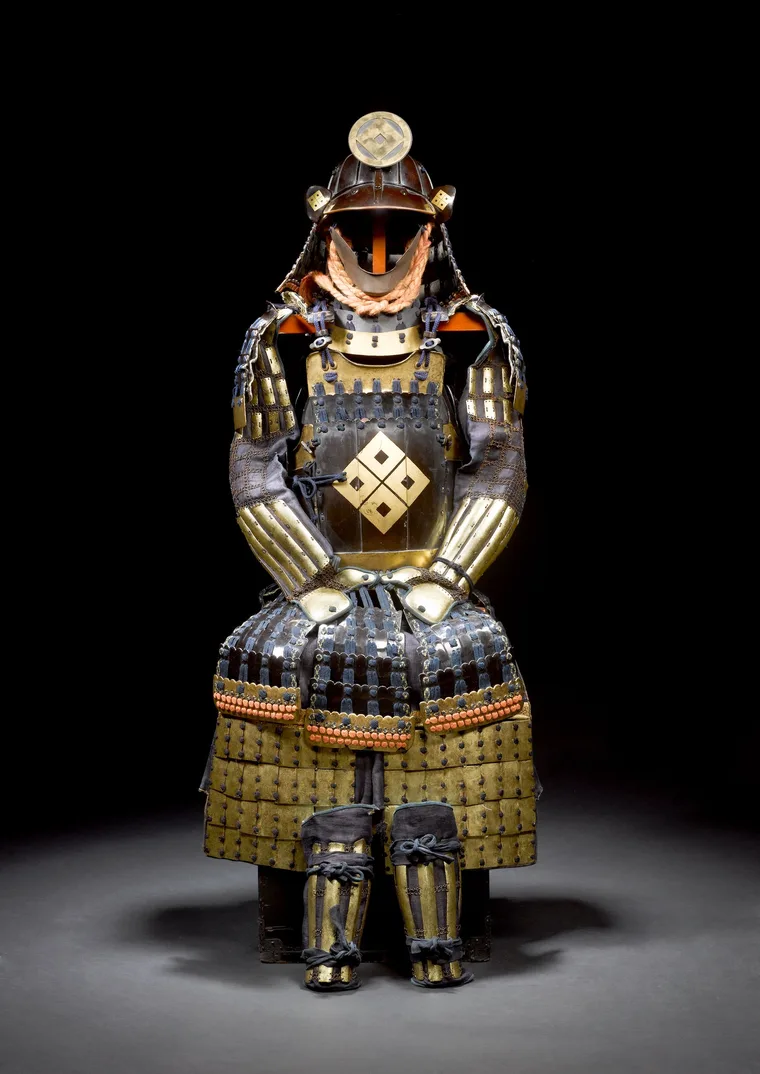
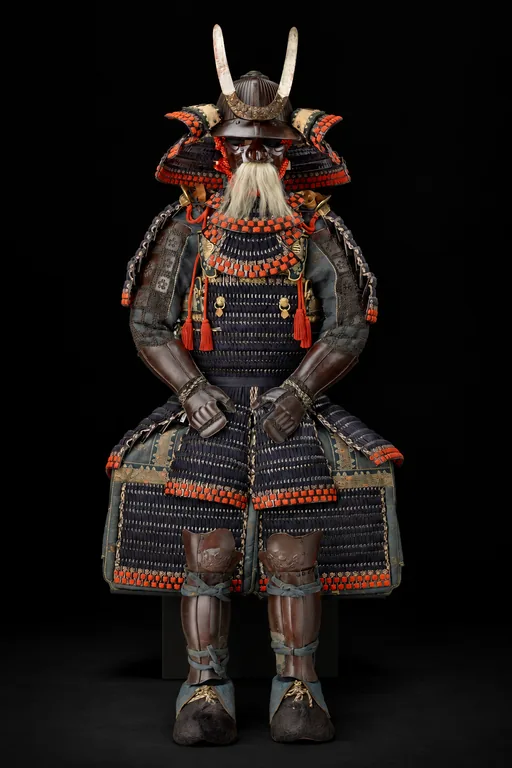
- Japanese armour in the broad sense — the full set of defensive equipment worn by a samurai. Encompasses kabuto, dō, kote, haidate, and suneate; the term is used both specifically for the laced ōyoroi of the Heian period and generally for all forms of Japanese armour.
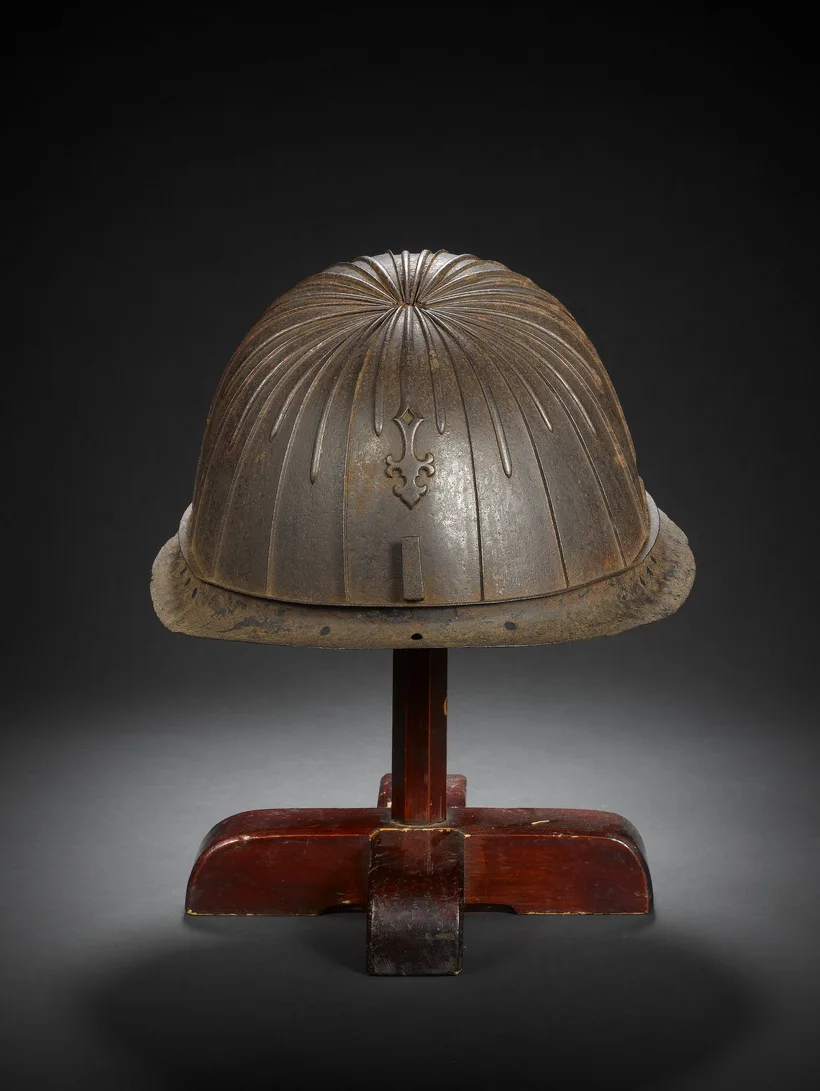
- Kabuto
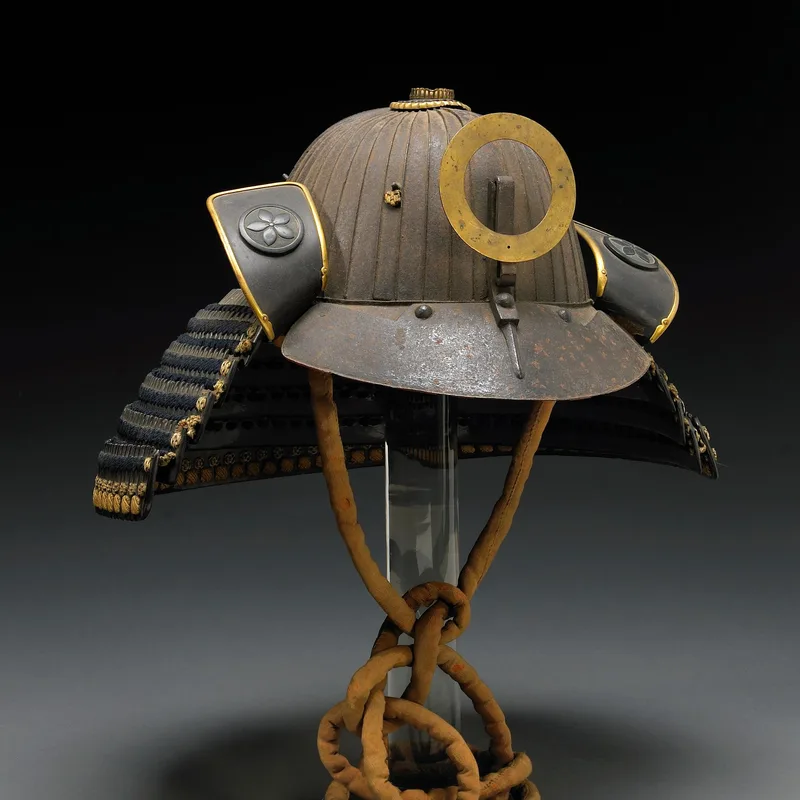
- The samurai helmet, consisting of the iron bowl (hachi) and its attached neck-guard (shikoro). Kabuto were produced by named armourers and regional schools across several centuries; surviving examples are dated and attributed primarily by construction method, lacquer style, and regional tradition.
- Hachi
- The iron bowl of the kabuto — the main dome-shaped skull piece to which the shikoro, fukigaeshi, and maedate fittings are attached. Construction details of the hachi — the number of plates, riveting pattern, and lacquer treatment — are primary evidence in dating and attributing a helmet.
- Shikoro
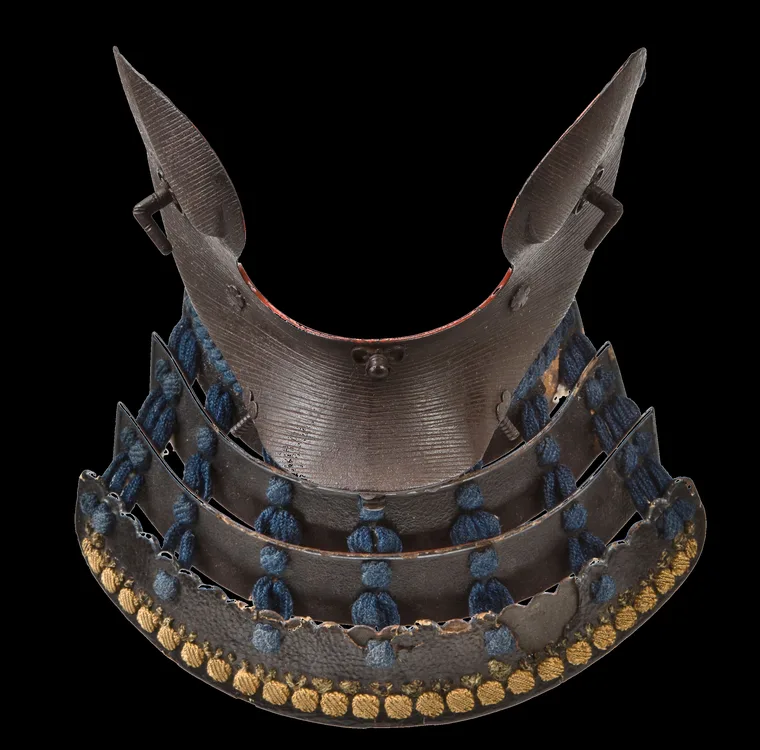
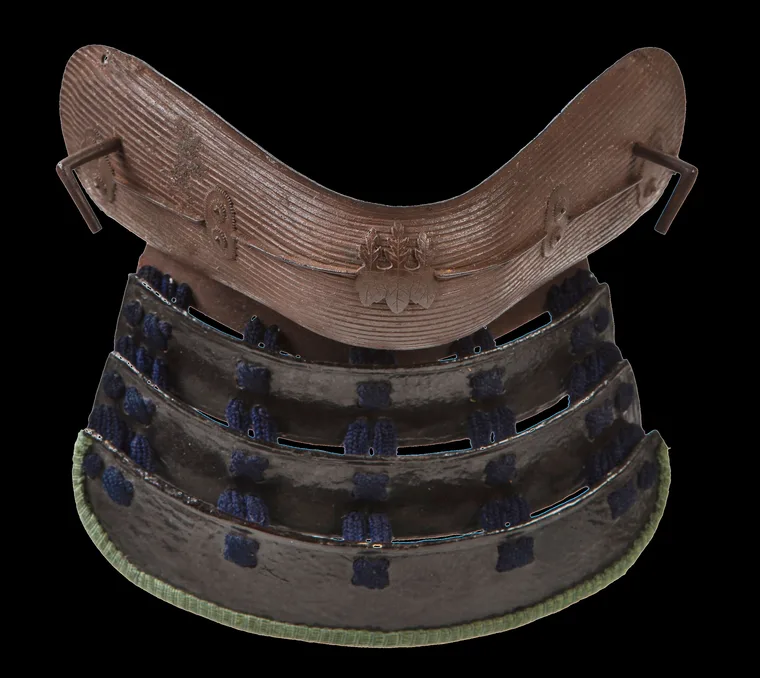
- The neck-guard of the kabuto, composed of lamellar plates suspended from the lower rim of the hachi and flaring outward to protect the neck and upper shoulders. Lacing colour and plate construction reflect the period and regional tradition of the armour.
- Fukigaeshi
- The wing-like side-pieces of the shikoro that are turned back and upward at the front of the kabuto to protect the face and prevent a sword from sliding down into the neck. Their shape and decoration are a useful regional and period indicator.
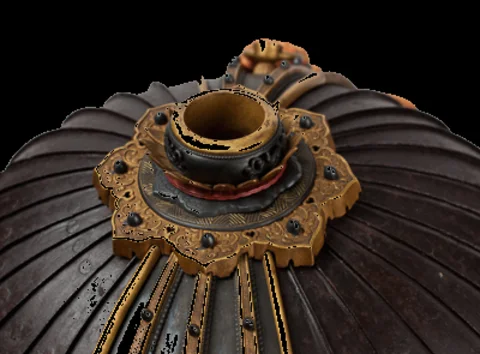
- Tehen
- The small opening or ring at the crown of the kabuto hachi, originally left to accommodate the topknot. The tehen fitting is usually a decorative metal ring; its condition and style are minor but useful dating details.
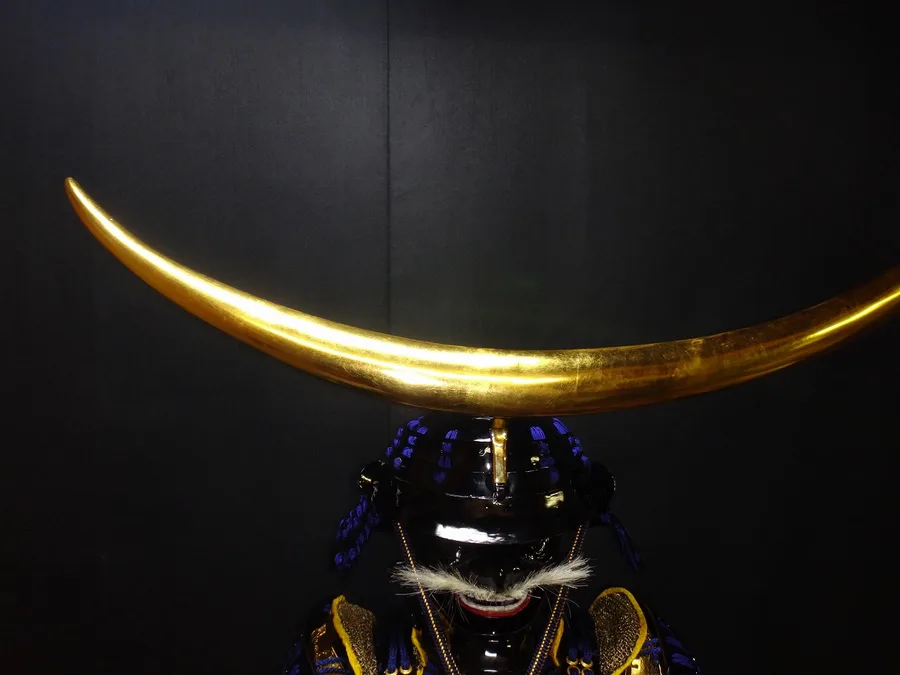
- Maedate
- The crest ornament mounted at the front of the kabuto, ranging from simple geometric forms to elaborate sculptural pieces depicting dragons, shishi, or Buddhist iconography. Maedate are frequently missing on antique helmets that passed into storage; their absence is common and does not imply damage.
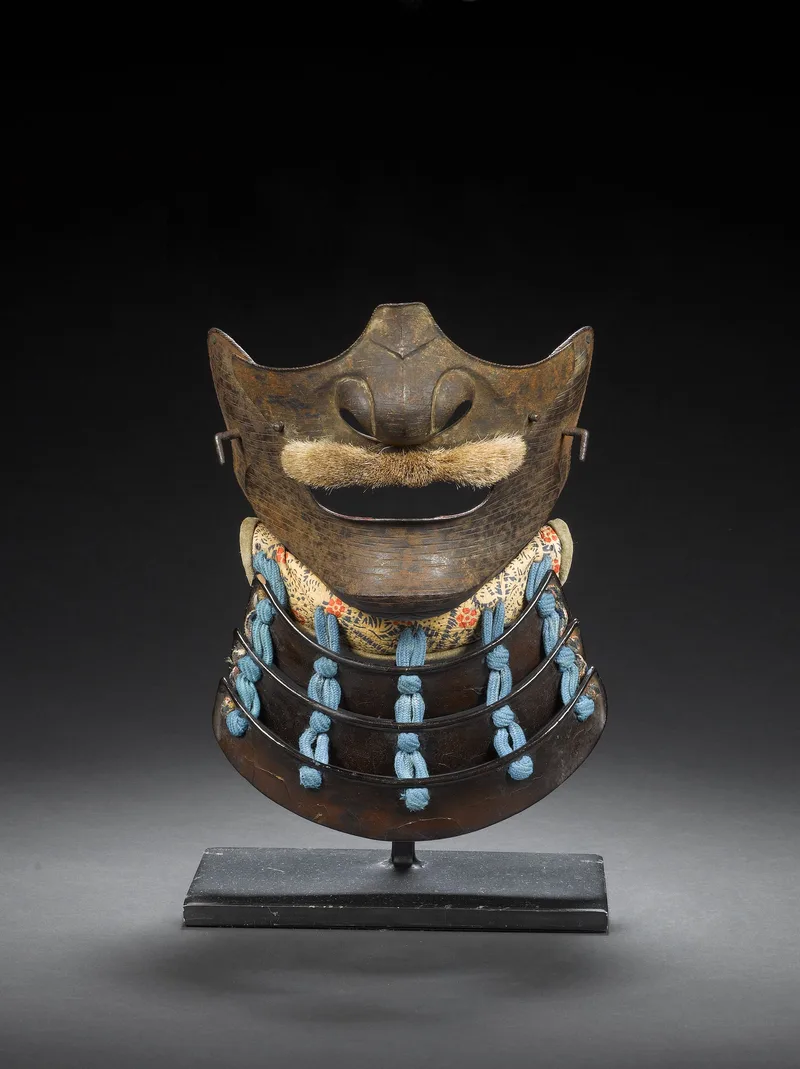
- Menpo
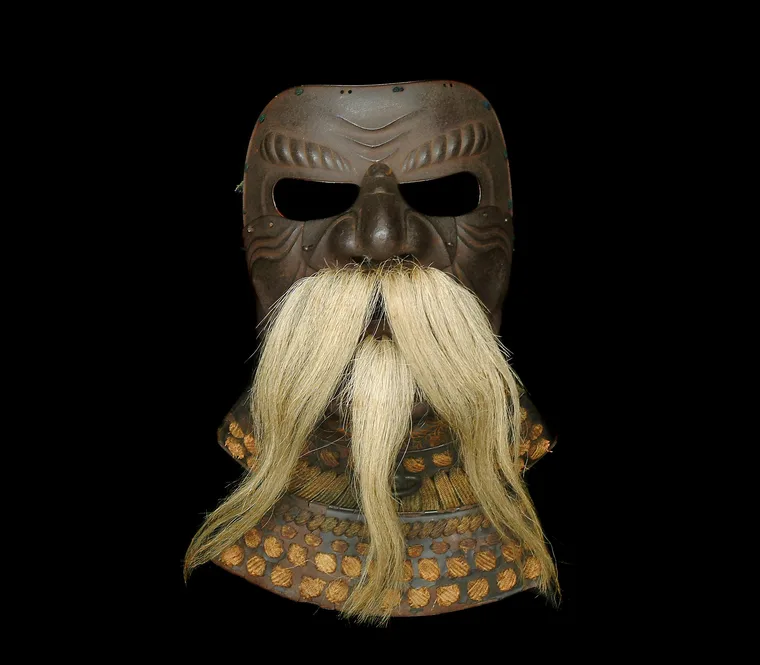
- Face armour worn with the kabuto, in several forms covering different amounts of the face. The most common types are the hanbo (lower half), hoate (cheeks and chin only), and sōmen (full face). Menpo typically incorporate nose pieces, lacing for the yodare-kake, and attachment cords to secure the piece under the kabuto.
- Hanbo
- A menpo covering the lower half of the face — roughly from the nose downward — the most commonly produced and surviving form across the Edo period. Often fitted with a detachable nose piece and the yodare-kake throat plates.
- Hoate
- A minimalist menpo covering only the cheeks and chin, leaving the nose exposed. Lighter than the hanbo and associated with periods or contexts favouring mobility over full protection.
- Sōmen
- A full-face menpo mask covering the entire face including forehead and nose. Less common than hanbo forms; elaborate sōmen with sculpted or grimacing expressions were produced as ceremonial and display pieces in the Edo period.
- Yodare-kake
- The lamellar throat-guard plates suspended from the lower edge of the menpo, protecting the neck and throat. Their presence and articulation confirm a menpo is substantially intact; missing yodare-kake are a common condition issue.
- Dō
- The cuirass — the armoured section covering the torso. Dō construction varied significantly by period and region: okegawa-dō (horizontal-plate) and tosei-dō (five-plate) forms are common in Edo-period armour; the distinctive Sendai-dō of the Date-clan domain is a regionally significant variant. See also: sendai-do.
- Sendai-dō
- A cuirass form associated with the Date-clan domain at Sendai — characterised by horizontal plate construction with a restrained dark lacquer finish, reflecting the aesthetic of Tōhoku armour more broadly. A Sendai-dō in situ is one of the clearest regional identifiers for northern Edo-period armour.
- Myōchin school
- The dominant lineage of Japanese armour smiths, tracing a claimed ancestry back to the Heian period and producing helmets and armour fittings across many centuries. By the Edo period, Myōchin smiths were active across Japan; the name became both a school designation and, in some cases, a prestige attribution applied loosely to unsigned work. Major centres included Kyoto and Edo.
Military & WW2
- Shōwa stamp
- An arsenal/association stamp (the "Shō" of Shōwa) applied from the mid-1930s, indicating a non-traditionally made shōwatō; generally means the blade is not a traditionally forged nihonto and is ineligible for NBTHK papers.
- Seki stamp
- A stamp of the Seki Cutlery Manufacturers' Association on commercially produced Seki blades from c.1940. Like the Shōwa stamp, it indicates a non-traditional shōwatō.
- Star stamp
- The small five-pointed star applied to blades made by Army-Appointed Swordsmiths (RJT) that passed Army inspection. Unlike the Shōwa/Seki stamps it indicates a traditionally made gendaitō, forged from tamahagane, and such blades are eligible for NBTHK papers.
- Mantetsu
- Blades produced by the South Manchuria Railway Company, best known marked "Kōa Isshin." Made by a semi-industrial, oil-quenched process for reliability in extreme cold; durable and well regarded, but not traditionally made nihonto. "Kōa Isshin" is a slogan, not a smith's name.
- Yasukuni-tō
- Swords forged at the Yasukuni Shrine forge in Tokyo (1933–1945) by shrine-appointed smiths in fully traditional methods. Genuine gendaitō of consistently high quality, avidly collected and routinely papered.
- Minatogawa-tō
- Swords forged at the Minatogawa Shrine forge in Kobe, the naval counterpart to the Yasukuni forge. Traditionally made gendaitō, much scarcer than Yasukuni-tō.
- Rinji Seishiki
- The army's "contingency model" mounting introduced c.1943 (loosely the "Type 3"), simpler and more robust than the Type 98 Shin Guntō. Blades within may be traditionally made or shōwatō.
- Gunzoku
- Civilian employees attached to the military rather than commissioned officers; relevant to the variety of privately purchased period blades and mountings.