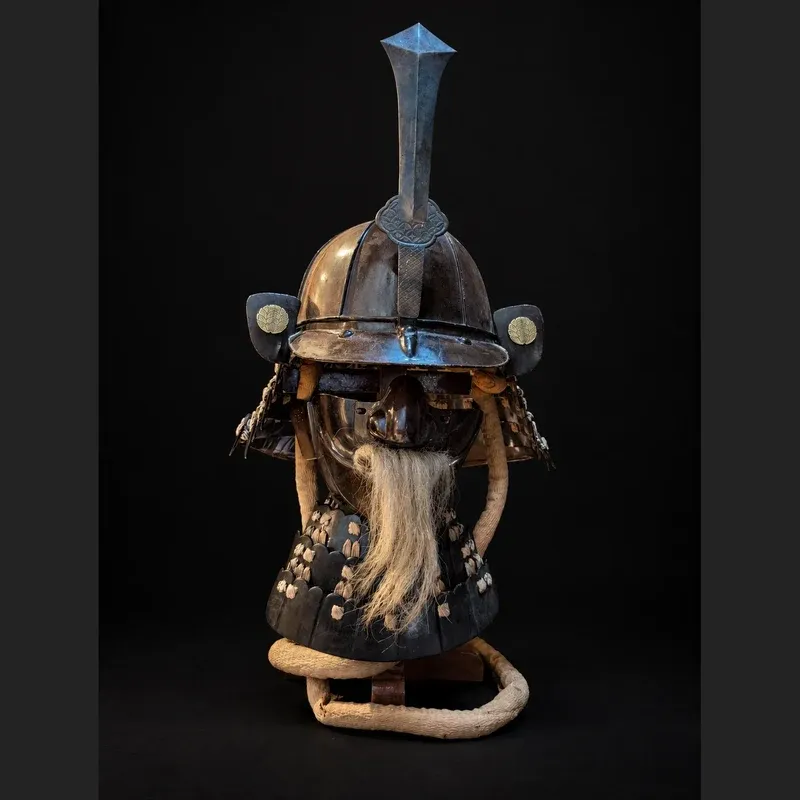
A matched samurai kabuto and menpo in the Tōhoku regional style of the mid-to-late Edo period — a complete head-and-face armour set with the dark lacquer character of the northern provinces.
A samurai’s kabuto and menpo survive most often apart: the helmet in one collection, the face armour in another, their shared origin erased across the centuries of dealer sorting and private sale. A matched pair, coherent in regional style and consistent in period lacquer and construction character, is what a collector hopes to find and rarely does.
This set belongs to the armour tradition of the northern provinces, the Tōhoku region, whose cultural and political centre in the Edo period was the Date-clan domain at Sendai. Work produced under and around Date patronage has a recognisable character: dark lacquer over russet iron, a relative restraint in surface decoration compared with the elaborate workshops of central Honshū, and a sense of austere mass rather than the ornamental exuberance associated with, say, the Yukinoshita tradition of the Kii domain or the refined metalwork of the Myōchin school in its later urban phases. Central-Japan armourers of the Edo period were increasingly producing armour as worked art objects, with lacework as fine as embroidery, gold-foil decoration, and elaborate sculptural maedate crests. Northern work remained closer in spirit to the functional aesthetic of an earlier era, even when made for ceremony rather than battle.
By the mid-to-late Edo period, roughly the early eighteenth century to the mid-nineteenth, the battlefield context for Japanese armour had effectively ended. What sustained production was status display: formal processions, investiture ceremonies, the visible demonstration of hereditary martial heritage. Armour of this era was made to be seen, and Tōhoku armour of this moment has a dignity suited to that purpose, the dark dō and helmet conveying lineage without advertisement.
The hachi, the main bowl of the kabuto, shows the iron construction and lacquered finish typical of the tradition. The shikoro neck-guard hangs in lamellar plates, and the fukigaeshi side-pieces are turned back at the front in the standard configuration of the period. The fitting point for a maedate crest ornament is present at the front of the bowl; no crest is mounted, which is common on pieces that passed from ceremony into long-term storage. The tehen, the small ring at the crown, is intact, as is characteristic of helmets that have not been damaged or heavily restored at the top.
The menpo is the hanbo form, the lower half-mask covering the area below the eyes, the most practical and widely produced type across the Edo period. The yodare-kake throat plates are present and articulated. The cord-seating lugs for attaching the mask beneath the kabuto are intact on both pieces, and the coherence of the cording and lacquer tone between the two is part of what argues for this being a genuine surviving pair rather than a marriage of convenience.
Attribution is by visual identification of regional style and construction character, not by smith’s mark. Tōhoku armour of this class rarely carries a signature, and the absence of one is standard rather than a gap. Period is dated by construction method and lacquer character: mid-to-late Edo (c. 1700–1850). This is presented as what it is, a piece of preserved northern armour tradition, candid about what can and cannot be determined from the object itself.
Age-verified delivery · UK / EU / international · Insured to declared value.