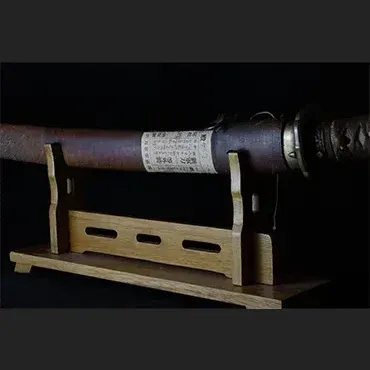
肥後同田貫 School
The Higo Dōtanuki school (also written Dotanuki) produced some of the most uncompromisingly functional swords in Japanese history: blades built for soldiers, not ceremonies, by smiths working in Higo Province (modern Kumamoto) from the mid-Muromachi period onward. Dōtanuki is as much a tradition of intent as it is of technique. These are sturdy, practical swords, and their value lies precisely in that plainness of purpose.
History and lineage
The school’s origins are placed in the mid-to-late Muromachi period, with active production centred in Higo Province under the patronage of the Katō and later Hosokawa clans. The name Dōtanuki — meaning roughly “body-cutter” or drawn from a place name in Higo — became synonymous with a school of smiths known for producing blades intended for hard use by ashigaru and lower-ranking samurai rather than the officer class. The most frequently cited early smith is Dōtanuki Masakuni, active in the late sixteenth century, though attribution in this school is complicated by a tradition of shared or hereditary mei conventions. Production continued through the Edo period, with later smiths maintaining the school’s utilitarian character even as the peace of the Tokugawa era removed the original battlefield context. Munehiro is among the Edo-period smiths working within this tradition.
Identifying characteristics
Dōtanuki blades tend toward a sturdy, deep-bodied sugata — full shinogi-zukuri with a somewhat thick kasane and minimal, functional sori. The jihada is typically itame with mokume, often with a somewhat rough or unrefined surface quality that reflects the school’s prioritisation of structural integrity over aesthetic refinement. The hamon is generally a wide, robust notare or gunome, with nie activity and a straightforward boshi. The characteristic that most clearly marks the school is the overall impression of mass and durability: these blades do not aspire to the refined elegance of Yamashiro or the complexity of Sōshū work. Mei conventions in this school are variable; saya-label attributions (where the blade’s school or smith is recorded on the scabbard rather than the nakago) are documented and considered acceptable evidence in the absence of a signed tang.
Why this matters for collectors
Dōtanuki blades are undervalued relative to their historical significance, which makes them interesting entry points for collectors who prioritise martial authenticity over refinement. A good example is a sturdy, well-proportioned blade with consistent hamon activity and a nakago showing appropriate age. The main risk is over-attribution. The school’s name-recognition means blades of general Higo character sometimes acquire Dōtanuki labels without strong basis. Saya-label attributions should be treated as directional rather than conclusive, and NBTHK kantei is advisable for significant purchases.