相州 Tradition
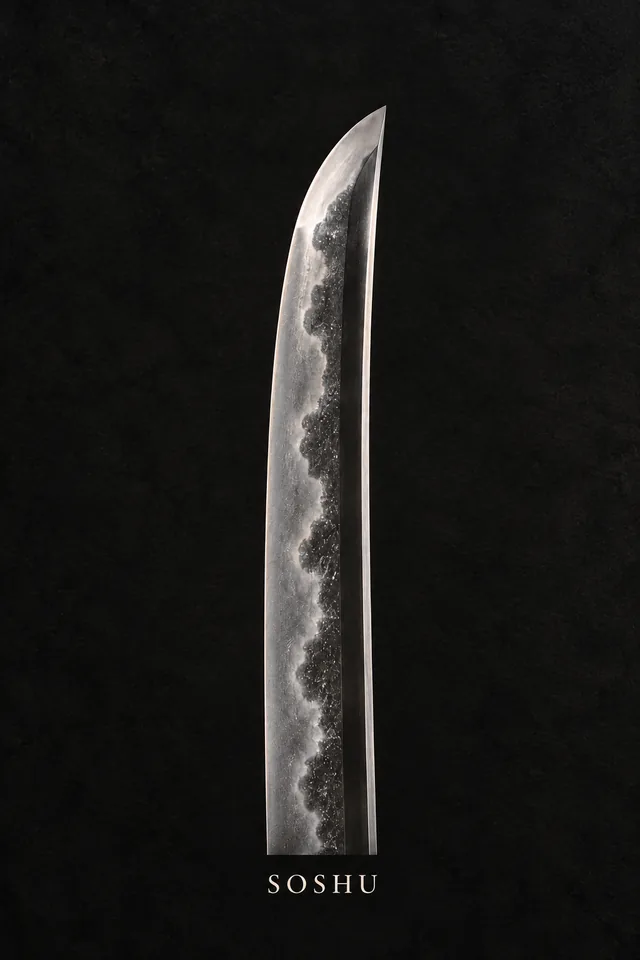
Sōshū-den, the tradition centred on Sagami Province (modern Kanagawa), produced swords of a technical and aesthetic ambition that changed the entire direction of nihonto. It is the tradition of Masamune, the most celebrated name in Japanese swordmaking, and of a metallurgical vocabulary so distinctive that it became one of the five canonical schools (gokaden) against which all other nihonto is measured. What defines Sōshū work is its nie, the coarse, bright, active steel granules, and the complex, almost turbulent activity that results. Nothing else in nihonto looks quite like it.
History and lineage
The school’s origins lie with Shintōgo Kunimitsu, active in the late Kamakura period in Sagami Province, who brought together Yamashiro and Bizen influences and began working the steel in ways that produced the characteristic Sōshū surface. His student (or close successor) Masamune — active in the early to mid-Kamakura/Nanbokuchō transition, traditionally dated to around 1264–1343, though the dates remain debated — elevated the tradition to its apex. Masamune produced no dated work and signed infrequently; attribution of his blades is based entirely on kantei, and the NBTHK treats Masamune attributions with the highest scrutiny. His students — the “Masamune Jittetsu” (ten great students) including Sadamune, Go Yoshihiro, Norishige, and Rai Kunimitsu — spread the Sōshū technical vocabulary across Japan, influencing schools as far away as Kyushu and Mino. The school’s active Kotō period is relatively compressed: it peaks in the Nanbokuchō and effectively closes by the early Muromachi, though Sōshū influence persisted in many later schools.
Identifying characteristics
The defining characteristic of Sōshū work is abundant, coarse nie in the hamon and in the ji. The nie in the ji produces chikei — dark, thread-like nie-formations running through the surface — and the hamon itself is rich with activities: kinsuji (bright, running lines), sunagashi (brushed sand effects), and nie-kuzure (nie-frothing at the hamon edge). The hamon form is typically notare or gunome-notare, sometimes with irregular hitatsura (full-surface tempering) in extreme examples. The jihada is itame or mokume, often with a somewhat rough, active surface quality — the ji does not have the silky refinement of Yamashiro, but it has tremendous vitality. Utsuri is absent. Sugata in peak Nanbokuchō Sōshū work tends toward an elongated, imposing tachi with an ō-kissaki — these are swords that command attention. A Masamune blade is said to feel dangerous even undrawn; whether or not one accepts the legend, it captures something true about the visual intensity of the work.
Why this matters for collectors
True Sōshū Kotō work, genuine Masamune, Sadamune, or Go Yoshihiro, is museum-grade material and essentially unavailable on the open market; the great examples sit in Japanese national collections or are designated Kokuhō (National Treasures). What collectors can realistically encounter is work in the Sōshū tradition: smiths clearly influenced by the school’s vocabulary, or later revival work by Shinshintō smiths (Masahide, Naotane, and Minamoto Kiyomaro produced deliberate Sōshū-revival pieces). The risk is over-attribution to the school on the strength of abundant nie alone. Nie-rich work appears in several traditions, and without the full kantei picture, assignment to Sōshū proper is premature.
If you’re hunting for a Sōshū or Sōshū-tradition piece, we welcome enquiries. Many of the best examples never appear on public listings.
Related guides: Kantei: attributing a Japanese sword · Periodisation of the Japanese sword
