山城 Tradition
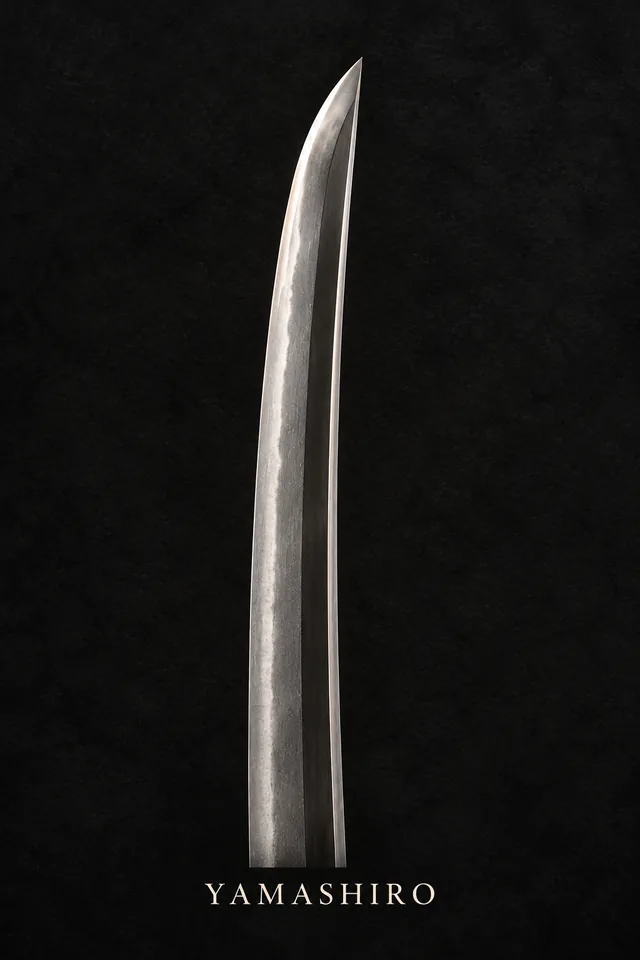
Yamashiro Province, the ancient capital region and modern Kyoto, produced the most refined swords in Japanese history. Where Bizen is the tradition of abundance, Yamashiro is the tradition of elegance: blades made for the aristocracy and the highest-ranking samurai, marked by a quiet, deeply considered beauty that takes time to see fully. For collectors the practical reality is that genuine Yamashiro Kotō work is rare and expensive and closely scrutinised. No tradition shows more clearly what classical nihonto aspired to be.
History and lineage
The earliest named Yamashiro smiths work in the Heian and early Kamakura periods. The Sanjō school — Munechika (active late Heian, traditionally credited with producing the celebrated Mikazuki Munechika now in the Tokyo National Museum) and his successors — establishes the tradition’s origins in the imperial capital. The Awataguchi school (Kuniyuki, Yoshimitsu, and the celebrated Awataguchi Toshiro Yoshimitsu, the greatest tantō-maker in nihonto history) dominates the Kamakura period and defines the school’s aesthetic peak. Rai Kuniyuki and Rai Kunitoshi then extend the tradition into the late Kamakura and Nanbokuchō, producing tachi and shorter forms of exceptional quality. The Rai school’s output in particular shows how Yamashiro smiths adapted to the changing demands of the period without abandoning the province’s characteristic restraint. By the Muromachi period, Yamashiro work had largely given way to Mino and other traditions, though individual smiths continued under the capital’s influence.
Identifying characteristics
Yamashiro hada is the school’s most consistent identifier: a tight, fine ko-itame with a smooth, well-integrated surface — sometimes described as “nashiji” (pear-skin) in its finest examples. The grain is present but not assertive; it contributes to the blade’s depth without drawing attention to itself. The hamon is typically ko-midare or ko-gunome in nie, with a soft, even nioi-guchi and minimal wild activity — Yamashiro smiths did not favour extravagance. The boshi is characteristically ko-maru with a tendency toward kaeri, small and refined. Sugata in classical Kamakura-period Yamashiro work shows a deep koshizori with an elegant taper, the kissaki proportionally small (ko-kissaki) in early work. Awataguchi tantō are narrow, thick, with uchizori or slight koshizori — the proportions feel inevitable, not designed. What distinguishes Yamashiro from Bizen is the absence of utsuri and the preference for nie over nioi as the dominant activity in the hamon.
Why this matters for collectors
Genuine Yamashiro Kotō work, particularly Awataguchi and Rai, sits at the apex of the nihonto market. Attribution is closely scrutinised, and NBTHK papers at Jūyō or above are effectively mandatory for any serious transaction. The risk for collectors is not fraud so much as misidentification: a fine Shinshintō blade in the Yamashiro revival idiom (several Shinshintō smiths worked deliberately in this tradition) can superficially resemble the original. Period-awareness and rigorous kantei separate the traditions clearly.
If you’re hunting for a Yamashiro piece, we welcome enquiries. Many of the best examples never appear on public listings.
Related guides: Kantei: attributing a Japanese sword · Periodisation of the Japanese sword
