A paper is not the sword. It is one expert body’s considered opinion, written down and sealed, at a single moment in time. Collectors who confuse the certificate for the blade have mistaken the finger for the moon it points at, and they tend to overpay for the paper while underlooking the steel. This guide is written to keep those two things separate in your mind, because most of the trouble in this corner of the market comes from running them together.
What follows assumes you already know roughly what a nihontō is and that you are weighing whether to submit a blade, or trying to judge what a seller’s paper actually certifies. It covers the bodies that issue papers, the ranks they award, how to read the kanji on a certificate, the history that makes some old papers worthless today, the ways papers go wrong, and the practical route for a UK collector who wants a blade examined in Japan.
Why papering exists: the postwar story
The system has a specific origin. The NBTHK, the Nihon Bijutsu Tōken Hozon Kyōkai or “Society for the Preservation of the Japanese Art Sword”, was founded in 1948171. The timing is not incidental. Under the Allied occupation, swords were treated as weapons and were subject to surrender and, in many cases, destruction. The NBTHK was formed by Japanese scholars and collectors, in that climate, to identify and preserve swords of genuine artistic merit so they would not be lost in the disarmament process1. The society began issuing certificates the same year; the earliest Kichō (“precious”) origami date from September 19481. Organisation and paper are, in effect, the same age.
It helps to separate two documents that beginners routinely confuse. The NBTHK origami is a society’s appraisal. The tōrokushō is the government registration card that makes civilian ownership of a blade legal in Japan; it travels with the sword and is a licensing matter, not a judgement of quality1. A paper is not a tōrokushō, and a tōrokushō is not a paper.
For the working collector, a modern paper does three things. It attests that the blade is a genuine Japanese art sword rather than a fake or a non-Japanese copy. It records an attribution, a named smith for a signed (zaimei) blade, or a school, province, or smith opinion for an unsigned (mumei) one. And it places the blade on a quality ladder. The postwar root was preservation. The present-day function is connoisseurship and market trust.
The bodies: NBTHK, NTHK, and NTHK-NPO
Three organisations issue the papers you will encounter, and their names are close enough to cause genuine confusion.
The NBTHK is the largest and the market standard. It is headquartered in Tokyo, runs roughly ninety branches in Japan, and maintains two overseas branches, the European Branch and the American Branch11. Its certificate is now formally headed Kanteishō, and it is terse: type, length, signature or attribution, grade, date, seal. It tells you what was concluded, not why3.
The NTHK, the Nihon Tōken Hozon Kai, is an older lineage organisation, frequently described as the oldest of the sword-preservation bodies525. Its paper comes with a worksheet recording the judges’ observations.
The NTHK-NPO, the incorporated non-profit faction, issues papers under the names Shinteishō, Kanteishō, and Yūshū-tō85. The NTHK and the NTHK-NPO are two separate organisations that resulted from a split in the 2000s, following the death of Yoshikawa Kōen, the long-serving head of the old body525. The exact year of the split is not something I will assert with confidence; the sources agree on the cause and the decade but not on a precise date. Treat any seller who is very precise about it with mild caution.
The practical difference for a reader holding two papers is this. The NBTHK origami carries the most market weight; it is what most buyers and dealers expect to see, and a blade without it is harder to sell at the top of the market. The NTHK and NTHK-NPO papers carry an explicit worksheet, and the NTHK-NPO adds a numerical point score, so they tell you more about the reasoning and the strength of the verdict5. Neither is simply superior. The NBTHK paper is market currency; the NTHK worksheet is transparent reasoning. A serious collector often values the worksheet for what it reveals, while still recognising that the NBTHK paper is what the market settles on.
NBTHK ranks: Hozon to Tokubetsu Jūyō
The NBTHK awards four ranks, in ascending order1073.
Hozon Tōken (“worthy of preservation”) is the entry level. It certifies a genuine, correctly attributed blade worth preserving. Hozon as part of the current system began in September 19821.
Tokubetsu Hozon Tōken (“especially worthy of preservation”) is a clear step above. The blade must be of sufficient quality and condition to merit the higher grade10.
Jūyō Tōken (“Important Sword”) is a major, juried jump. Jūyō shinsa was introduced in May 1958121. It is held less often and is highly selective.
Tokubetsu Jūyō Tōken (“Especially Important Sword”) is the apex. It began in December 1971121. Few blades reach it, and those that do are documented in detail.
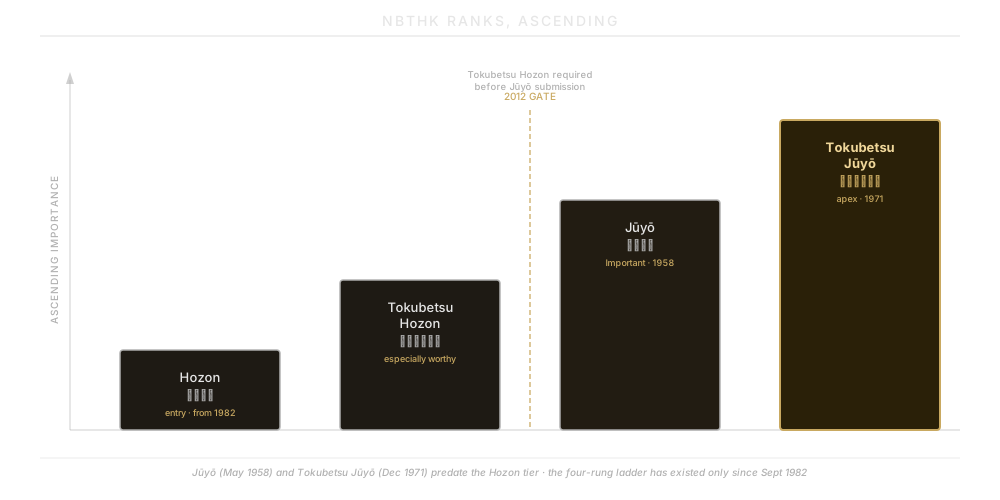
The four current NBTHK ranks in ascending order. Jūyō (1958) and Tokubetsu Jūyō (1971) predate the Hozon and Tokubetsu Hozon tier, which arrived only with the 1982 reorganisation. Since 2012 a blade must hold Tokubetsu Hozon before it can be submitted for Jūyō.
Two points of chronology are worth holding onto, because they catch people out. First, the ranks did not all appear at once. Jūyō (1958) and Tokubetsu Jūyō (1971) are older than the Hozon and Tokubetsu Hozon tier, which only arrived with the 1982 system overhaul. For about twenty-four years, the top of the ladder sat above a different lower tier, the old Kichō papers, not above Hozon. The familiar four-rung ladder has only existed since 19821. Second, since April 2012 a blade must already hold Tokubetsu Hozon before it can be submitted for Jūyō shinsa1. You cannot leap straight to Jūyō from nothing.
A word on the question everyone asks, which is how to tell the ranks apart by the colour of the paper. Be careful here. The strong, four-colour scheme that some dealer pages present as settled fact is not uniformly attested, and the appearance of the papers has varied across reprintings and eras224. Colour is at best a soft secondary cue. The reliable identifier is the grade name written in kanji on the certificate, supported by the document’s format and the embossed seal. Read the words, not the colour. The Jūyō and Tokubetsu Jūyō documents are notably larger and more formal, which is a more dependable signal than any colour claim.
Anatomy of a paper
A modern NBTHK blade origami follows a roughly seven-column layout, read right to left in vertical columns2334. Taken from the right, the fields run:
- The heading, 鑑定書 (Kanteishō), “certificate of appraisal”, with the grade indicated, for example 保存刀剣 (Hozon Tōken) or 特別保存刀剣 (Tokubetsu Hozon Tōken).
- Classification and length: the blade type (katana, wakizashi, tantō, tachi, and so on) and the nagasa, given in shaku, sun, and bu, sometimes with the sori.
- Signature or attribution: for a signed blade, a transcription of the mei as it appears on the nakago; for a mumei blade, the attribution.
- The certifying sentence, usually spanning two columns: the formal statement that, on examination, the NBTHK certifies the blade to the stated grade. This is the operative text of the document.
- The date of issue, conventionally in the Japanese era (nengō) calendar.
- The issuing body and seal: 日本美術刀剣保存会, the NBTHK name, with the embossed society seal23.
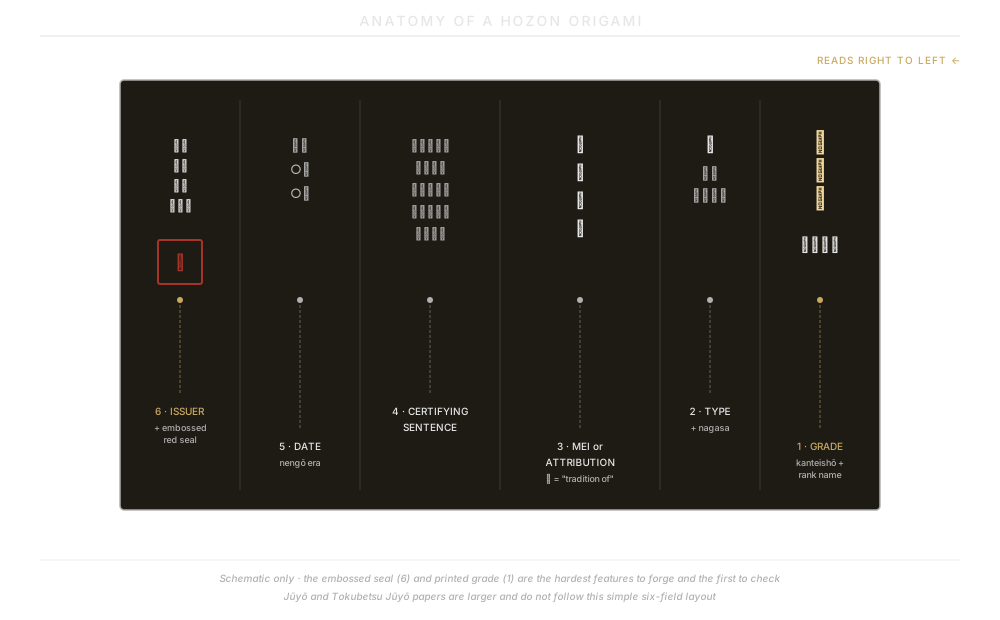
A modern NBTHK Hozon origami, annotated. The layout reads right to left in vertical columns. Jūyō and Tokubetsu Jūyō papers are larger, more elaborate documents and do not follow this simple seven-column model.
Build your mental template on the modern blade origami and label it as such. Older origami, and papers for koshirae and fittings (tōsōgu), vary in field count and arrangement, so the seven-field layout is not universal across all eras and all object types. The Jūyō and Tokubetsu Jūyō papers in particular are physically larger and carry detailed descriptions, so the seven-column description is really a Hozon and Tokubetsu Hozon one3.
The single most useful habit when reading a paper is to cross-check its fields against the blade in your hands. The nagasa and any mei recorded on the paper should match the actual blade. A discrepancy in length or signature is the primary warning sign of a swapped or “married” paper, which the risks section returns to23.
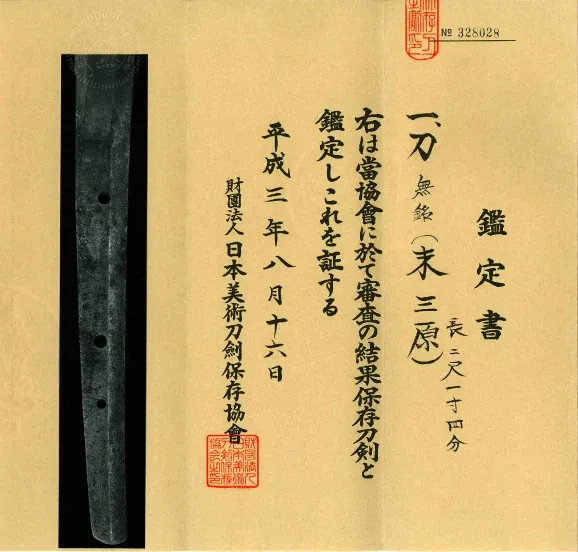
A modern paper. An NBTHK Hozon Tōken origami: the heading and grade at the right, the attribution (here an unsigned katana given to Sue-Mihara), the recorded length, the issue date (Heisei 3, 1991), and the society’s red seals. The nakago oshigata is drawn at the left.
Reading the kanji: name, attribution, date, and seal
You do not need fluent Japanese to get the essentials off a paper, but a small vocabulary goes a long way61923.
Document and grade words. 鑑定書 is kanteishō, the heading on a current certificate. The grades read 保存刀剣 (Hozon Tōken), 特別保存刀剣 (Tokubetsu Hozon Tōken), 重要刀剣 (Jūyō Tōken), and 特別重要刀剣 (Tokubetsu Jūyō Tōken)10. Blade types: 刀 (katana), 脇差 (wakizashi), 短刀 (tantō), 太刀 (tachi), 薙刀 (naginata), 槍 (yari).
Measurement. 長さ is nagasa, the length, given in the units 尺 (shaku), 寸 (sun), and 分 (bu). 反り is sori, the curvature.
The attribution qualifier that matters most. A bare smith name on the paper means the body attributes the work to that smith. The character 伝, den, placed before a name, means “in the tradition of” or “attributable to the line of”. It is a deliberately softer judgement: “we consider this to be in the manner of, or from the line of, this smith”, rather than “by this hand”. The distinction is enormously important on mumei blades, and it is frequently misread by collectors as a flat identification1923. School or province attributions on a mumei blade (備前 Bizen, 美濃 Mino, 相州 Sōshū, 山城 Yamashiro, 大和 Yamato) are likewise a considered group attribution, not a named maker.
Date. The issue date is given in nengō (era) form: 令和 (Reiwa), 平成 (Heisei), 昭和 (Shōwa), followed by the year (年, nen), month (月, gatsu), and often the day (日). The same era table lets you read a blade’s own date-mei, though older blades will draw on earlier eras.
Seal. The round society seal of the 日本美術刀剣保存会 is, on genuine modern papers, blind-embossed: you can feel it raised against the washi, rather than seeing a flat printed stamp23. That tactile detail is one of your better defences against a crude forgery.
One caution on names. A smith’s art-name (gō) or signature can often be read more than one way, and the paper records the body’s reading. If a name on the paper looks different from a reference book, that can be an alternate reading rather than an error. Cross-check against a standard index before concluding anything is wrong20.
The old papers: Kichō, Tokubetsu Kichō, and the scandal
Before the modern system, the NBTHK issued a family of papers under the Kichō name. You will still meet them on the market, and you need to understand why they are treated the way they are.
| Paper (colour) | Japanese | Started | Ceased |
|---|---|---|---|
| Kichō (white) | 貴重刀剣 | September 1948 | May 1982 |
| Tokubetsu Kichō (green) | 特別貴重刀剣 | March 1950 | May 1982 |
| Kōshū Tokubetsu Kichō (blue) | 甲種特別貴重刀剣 | September 1973 | May 1982 |
The dates are drawn from Weissberg’s history and corroborated elsewhere121. Note that Tokubetsu Kichō (“especially precious”), the green paper, was the top rank only until 1958, when Jūyō Tōken was introduced above it21. The green paper’s standing shrank over time even before the whole system was scrapped.
Here it is worth clearing up two dates that look like a contradiction but are not. The figure 1980 and the figure 1982 refer to different events. Around 1980 came the decision to scrap the old system, and the local-branch shinsa that had produced the worst papers was permanently terminated; it had been suspended in 1972 and briefly reopened in June 1974 before being ended for good212. The last Kichō-family papers were then issued through May 1982, and the new Hozon and Tokubetsu Hozon system went live in September 1982121. So: the decision and the end of branch shinsa around 1980, the last old papers in May 1982, the new system in September 1982. There is no real conflict.
The reason for the reorganisation is not flattering, and it is why those old papers are discounted today. During the 1970s and into the early 1980s, regional and branch NBTHK shinsa produced a large number of poorly judged, and in some cases outright forged, Tokubetsu Kichō (green) and Kichō (white) papers21. Organised crime involvement is reported: the certification process at regional branches was influenced by unethical actors, papers were forged, and many blades received grades that did not reflect their true quality or authenticity2. The system was centralised at the head office and reorganised in response.
Does the NBTHK itself stand behind the green papers now? In effect, no. The body treats an existing Tokubetsu Kichō paper as carrying no current weight, and collectors were given decades to replace old papers under the modern system2.
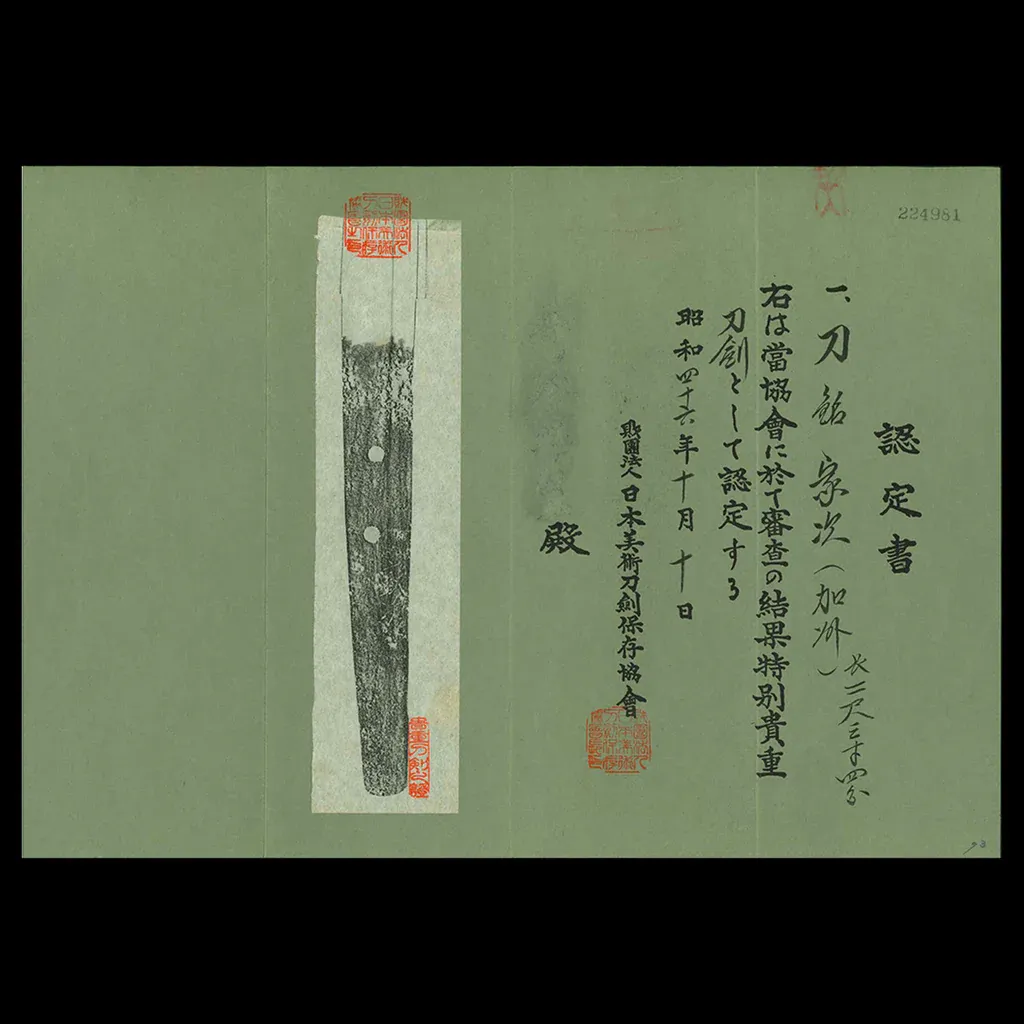
A green paper. A pre-1982 Tokubetsu Kichō origami from the old NBTHK system, the kind now treated as carrying no evidential weight. This one certifies a katana signed Ietsugu of Kashū (加州), dated Shōwa 46 (1971); the nakago oshigata sits at left, the society’s red seals beside the text.
The NBTHK was never the only body issuing papers, and a collector working through an older Japanese collection will meet certificates from other hands. Some predate the modern system; some come from earlier or rival organisations; some are the considered opinion of a single respected appraiser working outside any society. These are read on the standing of whoever signed them, exactly as the den discussion warned. The example below is a Ninteishō from the Tōensha, the appraisal body of Murakami Kōsuke, a connoisseur trained in the Hon’ami line: it attributes an unsigned tachi to the Yamashiro master Rai Kunimitsu. A paper like this carries the weight of its author’s reputation rather than an institutional grade, which is a different kind of authority and worth understanding on its own terms.
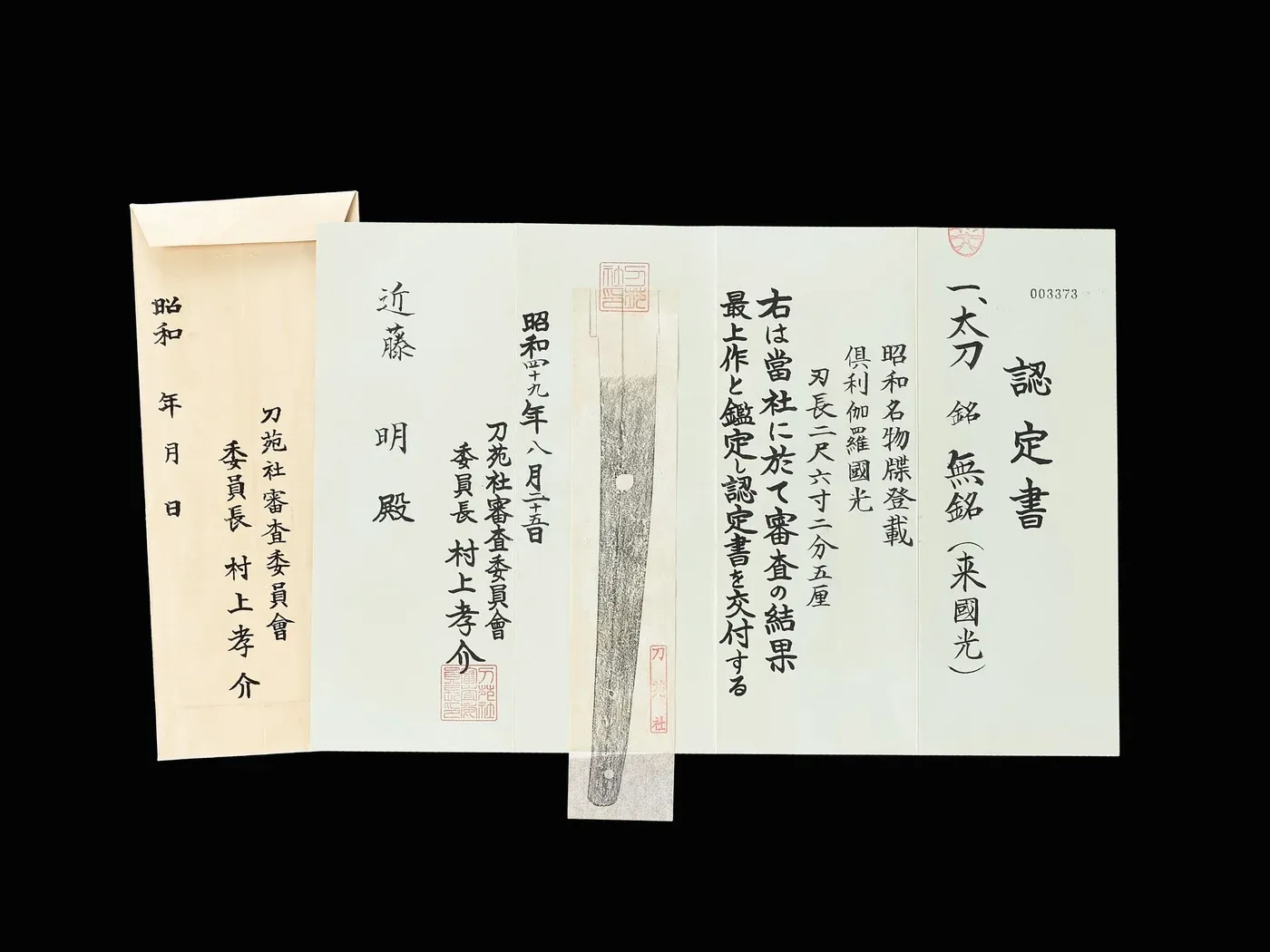
A non-NBTHK paper. A Ninteishō from the Tōensha, signed by Murakami Kōsuke (村上孝介) in the Hon’ami line, attributing a mumei tachi to Rai Kunimitsu (来國光), dated Shōwa 49 (1974). Its authority rests on the appraiser’s name, not an institutional grade.
The risks: forgery, mismatch, and downgrade
Three distinct things can go wrong with a paper, and they call for different defences9232.
Outright forgery. Fake origami exist, including fakes of modern NBTHK papers and, especially, of the discredited Kichō-family papers. Your defences are physical: the embossed (felt) seal on genuine modern papers as against a flat printed one, and the quality and texture of the washi23. Worked examples of bad and forged papers are documented and worth studying before you buy at any level9.
The married paper. This is the commonest real-world trap, and it is not always fraudulent. A genuine paper can be paired with a different blade than the one it was issued for, sometimes innocently, because the paper and the blade were separated over the decades, and sometimes deliberately, when a real paper for a good blade is sold alongside a lesser look-alike. The defence is the cross-check already described: compare the nagasa, the sori, the mei, and any described features on the paper against the actual blade. A length or signature discrepancy is the classic tell239.
The downgrade or non-pass on resubmission. A blade papered at one grade, or under the old system, may fail to reach the expected grade when resubmitted to modern shinsa, or an old green paper may not survive scrutiny at all. Standards evolve and judging is conservative. A paper is not a permanent, transferable warranty of grade210.
The honest framing is that a paper certifies an opinion, at a moment, by a particular body. It is not insurance, it does not guarantee a future grade, and it is not self-evidently bonded to the blade in front of you. The act of verification is the collector’s, not the certificate’s.
Submitting from the UK
Start with the hard constraint. A collector outside Japan cannot submit directly to the NBTHK in Tokyo. You need a licensed Japan-based agent or dealer, or a Japan-resident member, to lodge the submission, handle in-country transport, complete the forms, and receive the result on your behalf2414. Their handling fee is on top of the NBTHK fee, and both are non-refundable whether the blade passes or fails24.
There are two realistic routes. The first is through the NBTHK European Branch, the official European body and the natural first point of contact for a UK collector; it offers membership, study meetings around Europe, and a published fee schedule1112. One nuance is worth stating carefully: the European Branch is the coordinating point and the fee schedule exists, but the judging is the NBTHK’s and submissions are ultimately resolved through Japan. I would not state flatly that full shinsa is held in the UK. The second route is to contract a reputable Japanese agent directly, bypassing the European Branch, and let them manage the whole cycle2414.
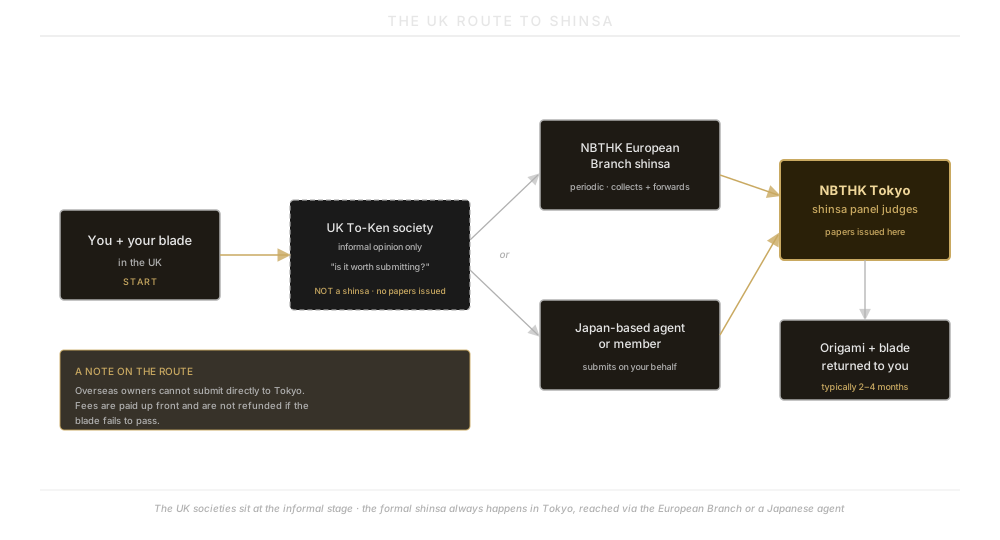
The realistic UK submission route. The To-Ken societies sit at the informal-assessment stage, not the formal one. The actual shinsa happens in Tokyo, reached either through the European Branch or a Japanese agent.
A clear word on the UK societies, because their role is often misunderstood. The To-Ken Society of Great Britain (founded 1964 and described as the oldest Japanese sword society in Europe) and the Northern To-Ken Society are study and community bodies1516. They run meetings, handling sessions, and provide expertise and a way into the knowledgeable community. They are not shinsa coordinators. They are where you learn, get a blade looked at by experienced eyes, and find trustworthy contacts. The formal shinsa goes through the NBTHK, via the European Branch or a Japanese agent, not through the society itself.
On timelines and cost, give yourself bands rather than precise figures. NBTHK shinsa sessions run roughly four to five times a year in Tokyo2413. From the blade arriving in Japan to the papers being returned, expect about two to four months, longer if you miss a session deadline, which falls several weeks before the shinsa date24. On money: the NBTHK Hozon fee alone is in the order of ¥30,000, and a combined Hozon and Tokubetsu Hozon submission is discounted against running them separately241214. Once you add agent handling, two-way insured international shipping, and insurance, a realistic all-in figure for an overseas Hozon submission is roughly £320 to £560 as of 202624. Jūyō-level submissions cost substantially more and are a different undertaking. All currency conversions move with the exchange rate, and the schedules change, so treat these as bands dated to 2026.
The practical recommendation is straightforward. Attend a UK society and get the blade assessed informally first, so you avoid paying to paper a blade that obviously will not pass. Then route a genuinely worthwhile blade through the European Branch or a reputable Japanese agent, budget in bands, and treat the fees as spent regardless of the outcome. This is the kind of end-to-end handling our own polish and shinsa coordination service exists to manage, for collectors who would rather not run the logistics themselves.
What a paper does not tell you
A paper is silent on several things that collectors wrongly expect it to cover18210.
It says nothing about the health of the blade. A paper attests authenticity and a grade of artistic importance. It does not certify that the blade is free of fatal flaws such as fukure, hagire (a hardening crack), or exposed core steel from over-polishing. Some flaws can sit on a papered blade if they do not bar the grade. The paper is not a condition report18.
It says nothing about polish quality or current state. A blade is judged as presented, but the certificate does not grade the polish, and an old paper may predate damage or a re-polish.
It says nothing about market value. The NBTHK does not appraise price10. The grade correlates with value because important blades tend to be valuable, but value turns on the smith’s desirability, condition, koshirae, provenance, and demand, none of which the origami quantifies.
It does not make a mumei attribution into a forensic proof. As the den discussion made clear, an attribution on an unsigned blade is a considered expert opinion, and different bodies, or the same body at different times, can attribute differently. This is the territory of kantei, set out in full in our guide to attributing a Japanese sword, and it is why we are careful never to present a mumei attribution as more certain than the evidence allows.
And it is not permanent. A grade is not guaranteed on resubmission; standards shift. A paper is a snapshot, not a perpetual warranty.
The closing posture is the one this guide opened with. A paper narrows uncertainty; it does not remove it. It tells you that a respected body believed, on a given day, that the blade is genuine and of a certain importance. Everything else, the health, the polish, the value, and the firmness of an unsigned attribution, the collector must still learn to see. The water is clear, but you must still look into it yourself.
