A signature tells you what a sword claims to be. The steel tells you what it is. Kantei is the discipline of reading the second and treating the first with suspicion, and it is the skill that separates a collector who owns swords from one who understands them. This guide is about how that reading is done: the order an examiner works in, the features that carry the weight, the five traditions that organise the field, and the honest limits of the whole exercise.
It assumes you already know roughly what a nihontō is and have perhaps read a paper or two. Where this guide differs from the papers walkthrough is in subject. That one covers what a certificate says. This one covers the reasoning underneath it, the judgement a panel reaches before anyone writes anything down. The two are companions: the paper is the verdict, kantei is the argument.
What kantei is, and isn’t
Kantei (鑑定) means attribution by examination of the work itself. You reason from the shape, the steel, the hardening, the tip, and the tang to a conclusion about period, province or school, and where the evidence allows, an individual smith1729. It is a study discipline first and a verdict second. The certificate is the output. Kantei is everything that happens in the appraiser’s eye before the certificate exists.
What it is not is signature reading. The governing maxim, repeated wherever the subject is taught, is mei yori mejitsu, workmanship over signature: the truth of a blade lies in its work, not in its inscription18. In formal study the nakago is deliberately covered so the examiner cannot be swayed by any mei, and the signature, if it is consulted at all, is checked at the end as confirmation rather than read at the start as an answer1817. This inversion is the whole point. A signature can be forged, added, or simply optimistic. The steel cannot lie about how it was made.
It is also not an algorithm. The sources are unanimous that the familiar examination order is the most effective approach, a teaching scaffold rather than a fixed procedure, and that an experienced practitioner internalises it and then keys off whichever feature is most diagnostic on the blade in hand615. Treat anyone who recites kantei as a rigid five-step checklist with mild caution. The steps are real, but the mastery is in knowing when to depart from them.
The single most useful thing to hold onto, especially as an intermediate collector, is this: an attribution is at root a quality appraisal, not an identity certificate. When a body attributes an unsigned blade to a named smith, it is placing the work on a quality gradient, saying in effect that this is workmanship of that smith’s level and character, not delivering a forensic identification of the hand that held the hammer21. Attributions sit as points on a scale of quality and confidence. The honest endpoint of much kantei is “this school, this era, a top hand” rather than one name, and collectors who read every attribution as a flat identity claim are reading more certainty into it than the system ever intended21.
The examination sequence: sugata, jihada, hamon, bōshi, nakago, mei
The conventional order moves from the general to the particular, and each step does a distinct job. Shape dates the blade. Steel localises it. Hardening narrows it to a school and sometimes a hand. Sesko states the spine of it plainly: shape (sugata), then steel (jigane), then hardening (hamon), in that order, because shape gives the period, the steel gives the area, and the hardening gives the school6. It is a funnel, not a tick-list: period, then region, then maker.
Read in full, the sequence runs sugata, then jihada (the surface grain of the steel), then hamon (the hardened edge), then bōshi (the hardening in the point), then the nakago and finally the mei. Two things about that order are worth fixing in your mind, because they are where loose accounts go wrong.
First, the order is convention, not law. Every instructional source frames it as the approach that works best in practice, and Sesko is explicit that he keeps to it only because it proved most effective and that the exceptions are learned over time6. There is even a genuine wobble in the middle: some authorities read the steel before the hardening, others the hardening before the steel61815. The safe way to state it, and the way this guide will treat it, is that sugata comes first and the mei comes last, with the two surface readings, grain and temper, taken together in the middle in whatever order suits the blade.
Second, the mei is deferred on purpose. In a study setting the tang is hidden and the signature is revealed only afterwards, as a check against the conclusion the workmanship already produced18. Even outside a contest, when you can see the whole sword, the workmanship leads and the signature confirms. A collector who looks at the mei first has not done kantei. He has read a label and gone looking for reasons to believe it.
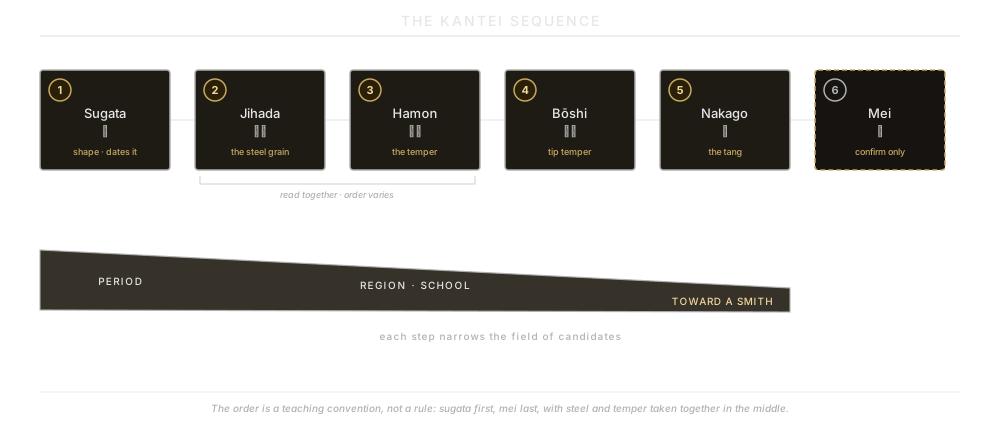
Figure 1. The sequence is a funnel from period to maker. Shape dates the blade, the steel and temper localise it, the point and tang narrow it further, and the signature is consulted last, only to confirm. The order is a convention, not a rule.
Reading sugata: period and school signals
Sugata, the overall shape, is the first reading because it is the most reliable guide to age. As Sesko puts it, the shape dates the blade first of all, and only in a second step do its details point towards particular schools6. Before going further, one honest caveat that governs this whole section: every period boundary below is conventional, and the eras themselves are walked through in our periodisation guide. These are political-era dates used as a convenient proxy for a gradual drift in fashion. No smith changed his shape on the day a shogunate fell, and blades made either side of a boundary look much alike16.
With that understood, the progression runs roughly as follows166102:
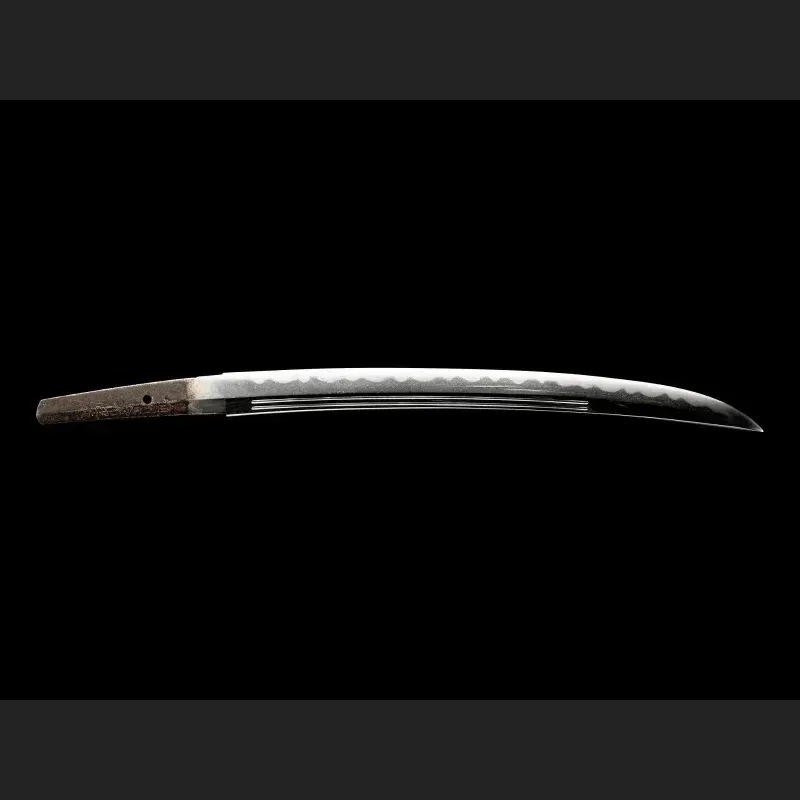
- Late Heian to early Kamakura (tachi of about the late twelfth century): long, narrow, and graceful, with a deep koshizori where the curve sits low near the hand, clear funbari (the blade noticeably wider at the base than further up), and a small ko-kissaki. This is the archetypal early tachi shape.
- Mid-Kamakura: stout and powerful, much less taper, a thicker kasane, and the stubby ikubi-kissaki, the so-called boar’s neck point. The ikubi-kissaki is specific to this window and fades afterwards, which makes it a reliable period tell when you see it.
- Late Kamakura: a little shorter, slightly less curve, and a balanced chū-kissaki; the ikubi is gone.
- Nanbokuchō (fourteenth century): flamboyant. Wide blades with little taper and shallow curve, long ō-kissaki, and the enormous ōdachi that sometimes ran past ninety centimetres. Most of these great blades survive today heavily shortened and unsigned, for reasons the suriage section explains.
- Muromachi (the uchigatana era): blades of around seventy to seventy-six centimetres with a shallower curve that has migrated towards the tip (sakizori), and a chū-kissaki. A useful gradient here, from Sesko: the stronger the sakizori, the later in the Muromachi period the blade was made6. Mass production of plain blades grows toward the end.
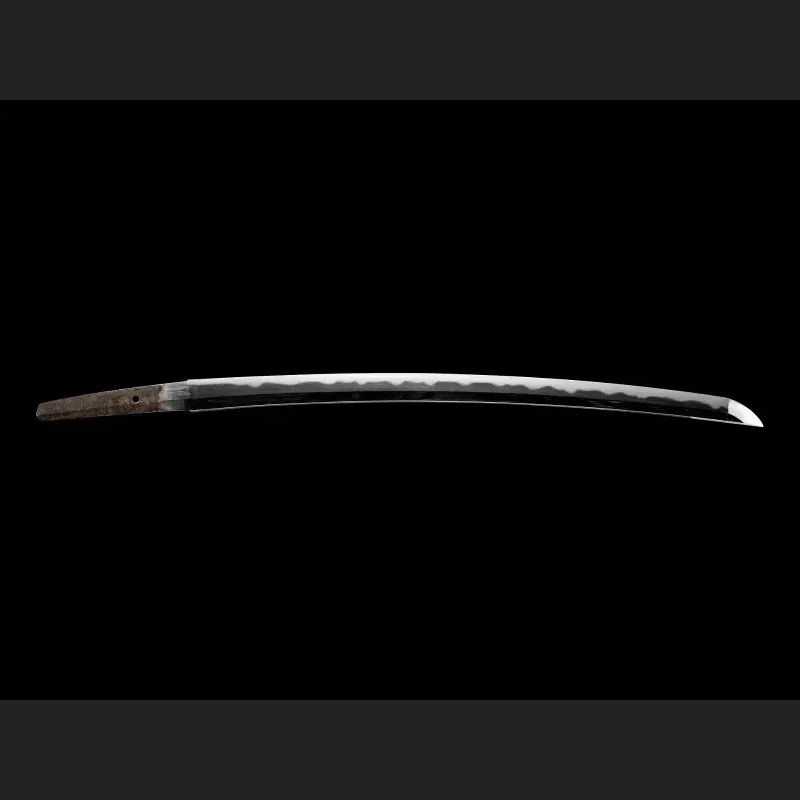
- Shintō (after roughly 1596): the early Keichō years revived grand Nanbokuchō proportions, but the defining Shintō shape arrives with the Kanbun era of the 1660s, a blade with strong taper, shallow curve, and a stiff, almost straight profile, thought to follow a thrust-oriented fashion in swordsmanship6. This Kanbun-shintō shape is the single most recognisable silhouette in the later sword.
- Shinshintō (from around 1800): revivalist and eclectic. The fukkotō movement under Suishinshi Masahide deliberately revived classic Kamakura shapes, while other smiths copied Nanbokuchō or Muromachi models, so there is no single shinshintō target shape, only a field of copies across the older styles616.
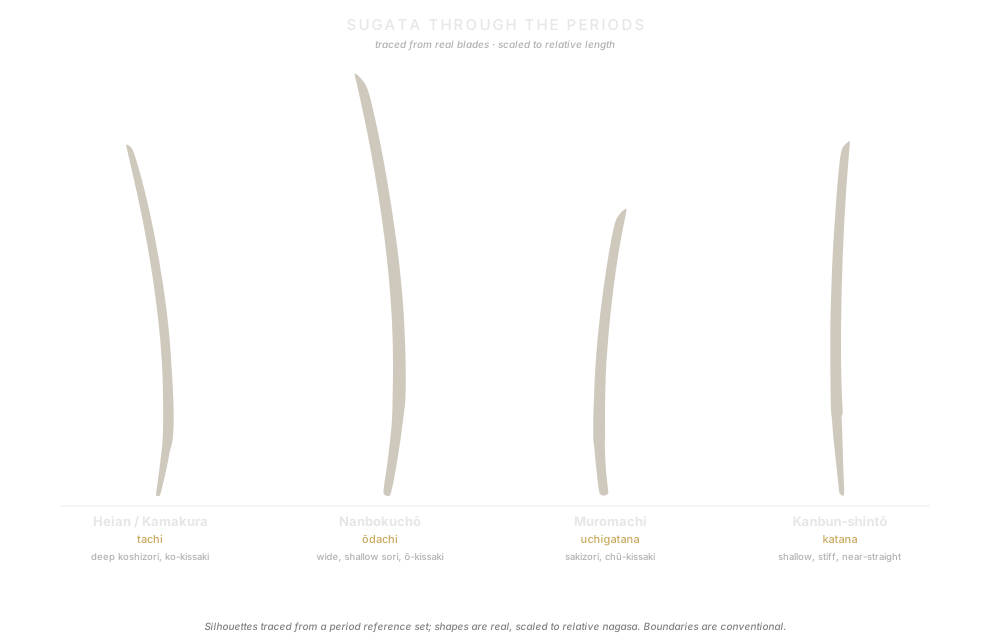
Figure 2. The same drift in shape across the periods. Note where the curve sits, low near the tang in the early tachi, shifted toward the tip in the Muromachi blade, almost gone in the stiff Kanbun katana, and how the point grows then shrinks. Boundaries are conventional.
Shape narrows a school far less reliably than it narrows a period. An exaggerated Nanbokuchō width nudges you toward the Sōshū orbit, for instance, but shape alone rarely fixes a school. For that you turn to the steel and the temper.
Reading jihada: itame, mokume, masame, ayasugi, nashiji
Once shape has dated the blade, the grain of the steel begins to localise it. Jihada is the visible pattern left in the surface by folding, and the principal patterns are few1065:
- Itame, a wood-plank grain, is the most common ground and the base of Bizen, Sōshū, and much of Mino.
- Mokume, a burl or whorl, usually appears mixed into itame.
- Masame, a straight grain running parallel to the edge, is the Yamato signature. Pure masame from the hand-end to the tip is the so-called Hōshō-hada of the Hōshō school6.
- Nashiji, a very fine, dense ground evenly covered in ji-nie so it reads like pear skin, belongs to the early Yamashiro schools, especially Sanjō and Awataguchi, and less consistently Rai. Awataguchi above all is the nashiji school6.
- Ayasugi, a regular wavy variant of masame, is the hallmark of the Gassan school of Dewa. It is not one of the five-tradition grounds, but it is about as school-diagnostic as a single feature gets.
Two features in the ground are worth singling out, because each is close to a one-word verdict on a tradition. Chikei, bright lines of nie lying in the body of the blade rather than along the edge, is the strongest single pointer to Sōshū: the more chikei present, the more likely the blade follows the Sōshū tradition6. Utsuri, a misty reflection that floats in the steel above the hardened edge, is the strongest single pointer to Bizen; as a rule of thumb, when you see true utsuri there is a high chance you are looking at a Kotō Bizen work6.
A word of caution on utsuri, because it has look-alikes. True midare-utsuri or bō-utsuri is original to the blade and points to Bizen. Shirake-utsuri, a whitish, dry-looking haze, is a different thing and points instead toward Mino or Kaga work. And a tired blade can show tsukare, a ghost of utsuri produced by over-polishing rather than by the smith. Reading utsuri well means telling these three apart.
Reading hamon: chōji, suguha, gunome, notare, midare
The hamon, the hardened edge, is where a school often becomes a smith. Before the shapes, learn the single most useful distinction in the whole subject: nie against nioi. Nioi-deki, where the edge of the hardening reads as a soft, misty line of particles too fine to resolve individually, belongs to Bizen and largely to Mino. Nie-deki, where that boundary is built of coarser crystals you can pick out one by one, belongs to Sōshū, Yamato, and the early Yamashiro schools61029. After sugata, this is the most powerful single discriminator you have, and Nagayama’s standard manual organises much of its kantei around exactly this reading of grain and temper1.
The named patterns then layer on top610:
- Suguha, a straight temper, is the base of Yamashiro and Yamato work, carried in nie. Yamato suguha is rarely plain; it runs with vertical activity such as hotsure and nijūba.
- Chōji, the clove-shaped, head-heavy temper, is the Bizen signature, worked in nioi. Small ko-chōji marks ko-Bizen and Rai; the exuberant ō-chōji of the Ichimonji school is chōji at its most theatrical.
- Gunome, the regular row of semicircles, is universal, but two variants are near-signatures: kataochi-gunome, a leaning, flat-topped saw-tooth, is Kagemitsu’s hallmark, distinctive enough that an unsigned tantō can be assigned to him with real confidence12, and sanbonsugi, a repeating group of three peaks, is Magoroku Kanemoto and Mino.
- Notare, a gentle wave, when carried in abundant nie with gunome, is the Sōshū idiom.
- Midare is the umbrella word for any irregular temper. Its most dramatic form, hitatsura or full-surface hardening, belongs to the Nanbokuchō Sōshū smiths and the later Sōshū and Mino work that followed them.
Inside and around the hamon you will also see the activities that betray the Sōshū hand more than any single pattern does: kinsuji, a thin bright line of nie; inazuma, the same effect thicker and forked like lightning; and sunagashi, streaks of nie like drifting sand. A notare-gunome in strong nie, lit up with kinsuji, inazuma, and sunagashi, is the Sōshū activity signature written plainly106.
Reading bōshi: the temper at the kissaki
The bōshi is the hamon as it turns through the point, and it is heavily habitual, a strong corroborating reading that is rarely decisive on its own. The principal forms a collector should know are these626:
- Ko-maru, a small rounded turnback, is the workhorse of Yamashiro and Yamato.
- Ō-maru, a large rounded turnback, runs through Awataguchi and some late-Kamakura Sōshū.
- Midare-komi, an irregular bōshi that simply follows a midare hamon into the point, belongs to no single school; you see it wherever the temper itself is irregular.
- Jizō, a profile likened to the head of the Jizō statue, appears in Mino, but also in Rai work and in the Shintō Mishina line, so it is not the Mino-exclusive marker some accounts make it.
- Kaen, a flame-like bōshi heavy with nie, suits the dramatic Nanbokuchō point.
- Yakizume, where the hardening simply runs off the tip with no turnback, and hakikake, fine sweeping brush-like lines of nie in the point, are both Yamato signatures.
- Ichimai, where the entire point is hardened, is a hardening choice rather than a school marker.
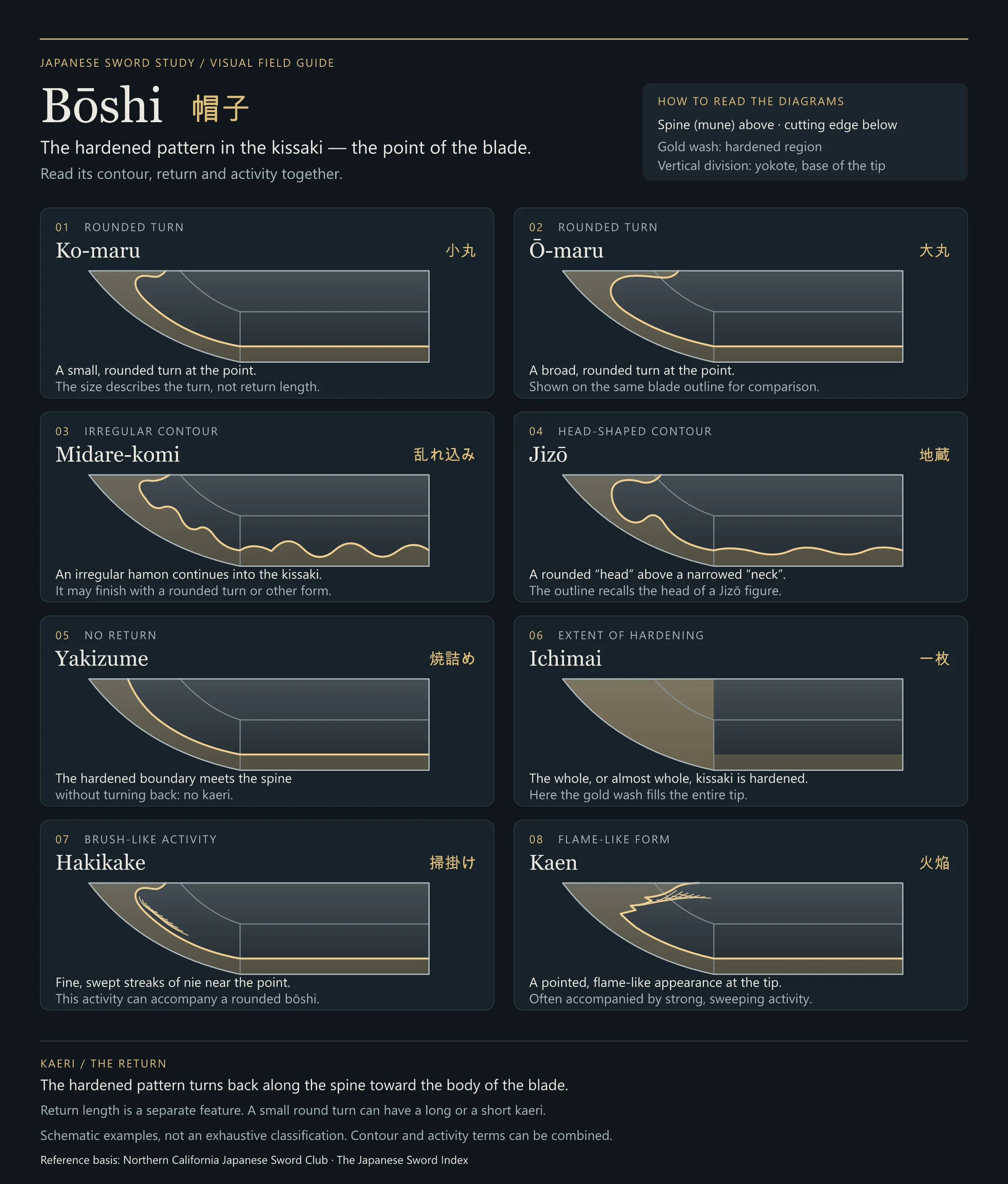
Figure 3. The principal bōshi, the temper read through the kissaki. The round turnbacks (ko- and ō-maru) grade by size; yakizume runs off the tip with no return; kaen and hakikake are nie-driven; ichimai hardens the whole point. Schematic, not to scale.
Reading the nakago: jiri, yasurime, mei, ageing
The nakago, the tang, is the one part of the sword never polished, so it carries the most direct record of age and of the maker’s habits, and also the most opportunity for deceit1915. Three things are read here: the file marks, the shape of the tang’s end, and the patina.
The file marks, or yasurime, are decorative finishing that smiths applied by habit19. Kiri is plain horizontal filing and weak as a discriminator on its own. Sujikai, a single slant, is so nearly universal that it points to almost nothing by itself, despite occasional claims that it marks Sōshū. Ō-sujikai, a steep slant, is associated with Aoe, Samonji, and the Horikawa school rather than primarily with Mino; the genuine Mino tang reading is the steep slant combined with a particular tip shape, not the slant alone. Higaki, a cross-hatch like a cypress fence, is a genuinely useful tell for Yamato (Hōshō) and Mino. Keshō, a dressed, cosmetic filing, marks the Shintō era onward and so helps separate older work from newer.
The shape of the tang’s tip, the nakago-jiri, follows similar logic1915. Kurijiri, a rounded chestnut end, is the common default and not diagnostic. Kengyō, a symmetric pointed V, is a neat formal finish. Iriyamagata, an asymmetric point likened to entering a mountain, is the classic Mino and later Shintō tang tip, and it is iriyamagata together with the steep file slant that actually signals Mino.
The count of peg-holes, the mekugi-ana, is a much weaker cue than collector lore suggests. More holes loosely suggest an older, re-mounted, or shortened blade, but holes can be added and wear can be faked, so weight the wear of a hole over the mere number of them; fresh, clean, unworn holes on a supposedly old tang deserve suspicion25. Finally the mei itself, read last and only against the workmanship. On an unsigned blade the relevant marks are not a smith’s signature at all but later attribution marks: kinzōgan-mei, an attribution inlaid in gold; kinpun-mei, one written in gold lacquer; and shumei, one in red lacquer. And watch for mizukage, a cloudy diagonal near the hand-end, which commonly signals saiha, a retempering, the kind of workmanship-killing finding the tang region can quietly betray.
The gokaden in practice
The field is organised around five traditions, the gokaden: Yamashiro, Yamato, Bizen, Sōshū, and Mino710. Almost every kantei conversation starts here, so it pays to understand both the framework and its limits.
First, the history, because it is routinely mangled. It is commonly said that the gokaden system was introduced by the connoisseur Hon’ami Kōson (1879 to 1955), and his dates are right, but the verb is a trap7. Kōson did not invent the five traditions. He drew on inherited Hon’ami knowledge when he formulated his version of them, and the grouping demonstrably predates him: an anonymous manuscript dated 1610 already sorts swords into five traditions, Bizen, Yamashiro, Kyūshū, Sagami, and Yamato, some two hundred and seventy years earlier, and notably with Mino absent from that older list7. The accurate way to put it is that Kōson formalised and popularised the gokaden as the modern teaching and appraisal framework in the early twentieth century, building on a much older idea. Before any of this, swords were classified simply by their province of production, so that a Bizen blade was a Bizen-mono, a system that named where a blade came from without ever showing the stylistic kinships that the tradition framework makes visible728.
Second, and just as important, the gokaden is a useful simplification, not an exhaustive taxonomy287. The five-element mnemonic that sometimes accompanies it was exactly that, a memory aid. Real practice constantly crosses the lines. The Sōshū idiom travelled into Mino through Shizu Kaneuji, who trained in the Yamato tradition, studied under the Sōshū master Masamune, and then settled in Mino, so that his early work keeps its Yamato character while his mature work is pure Sōshū4. The Nanbokuchō Bizen smiths fused their native nioi chōji with Sōshū nie and notare to produce what collectors call Sōden-Bizen; Kanemitsu himself shows the drift within one career, his earlier work keeping his father’s Bizen kataochi-gunome in nioi while his later blades move toward a notare in nie that openly borrows the Sōshū manner13. And a whole population of capable schools, Aoe, Hōki, Naminohira, Uda, Mihara and more, sits outside the five entirely4. The gokaden is the map you start from, not the territory.
The lines are also clearest in the middle of each tradition and blurriest at its edges, especially early on. A fine Awataguchi blade of the early Kamakura can look like ko-Bizen at a glance, separated chiefly by the brighter, tighter nioiguchi of the Bizen work; the honest answer at that boundary is a spread of possibilities, not a crisp line9.
What each tradition looks like, reduced to the characteristic ground, the characteristic temper, and the single most telling feature, is set out below. (The diagram in this section gives the same five-way comparison at a glance.)
- Yamashiro (Awataguchi, Rai): a very tight ko-itame tending to nashiji-hada, blanketed in ji-nie; suguha or a shallow ko-chōji in nie. Most telling: the dense, even, nie-covered nashiji ground.
- Yamato (Tegai, Hōshō): masame, or itame mixed with masame, with Hōshō running pure masame; suguha in nie carrying vertical activity. Most telling: pure masame together with a yakizume or hakikake bōshi.
- Bizen (Osafune): itame with mokume, carrying utsuri in the ji; chōji-midare or gunome in nioi. Most telling: utsuri above a nioi-based chōji.
- Sōshū (the Masamune line): a compact itame-mokume rich in ji-nie and chikei; notare-gunome in nie, lit with kinsuji and inazuma. Most telling: chikei in the body plus that nie activity in the temper.
- Mino (Seki): itame with masame near the edge, the later jigane dark and dry with shirake; togariba and gunome, including sanbonsugi. Most telling: pointed togariba with a dry whitish jigane and an iriyamagata tang.
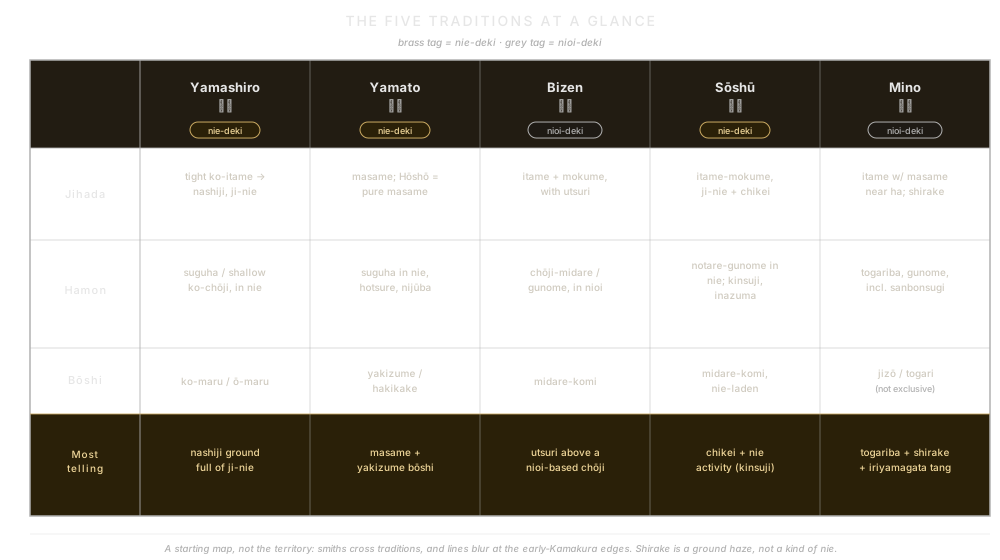
Figure 4. The five traditions reduced to their characteristic grain, temper, and most diagnostic tell. The nie versus nioi split (brass tags versus grey) is the first cut: Bizen and Mino work in nioi, the rest in nie. A starting map, not the territory.
Suriage and ōsuriage: how attribution survives shortening
A great many of the finest old blades are shortened, and understanding why is central to understanding mumei attribution. An ubu tang is in its original state, with any signature where the smith set it. A suriage blade has been shortened from the hand-end, which can remove information the market values. An ōsuriage blade has been shortened so heavily that the lower tang, and with it any original signature, is gone entirely, so the blade must stand on its workmanship and its shape as preserved23. The reason so many Kamakura and Nanbokuchō masterpieces are now unsigned is mundane: long tachi were routinely cut down into shorter katana for later fashions of wear, and the signed portion went with the offcut22.
The crucial point for a collector is that shortening lowers the certainty of an attribution without necessarily lowering its standing. The literature states it almost verbatim: an ōsuriage Kamakura blade of strong workmanship can reach Jūyō Tōken status despite its missing signature, while a fully signed blade by a minor Muromachi smith will not22. Of the many thousands of blades raised to Jūyō over the decades, a large share are precisely these unsigned Kotō pieces attributed to Kamakura and Nanbokuchō masters22. The body attributes such a blade by studying its grain, temper, shape, and tang against reference works of known makers, the smith dictionaries such as Fujishiro’s being the standard yardstick3, and expresses the result with the cautious den where appropriate22.
Sōshū Yukimitsu is the textbook case. All of his surviving long swords are ōsuriage and unsigned; the only works that carry his genuine signature are tantō11. A Jūyō ōsuriage Yukimitsu katana bearing a two-character gold-inlaid attribution is therefore an entirely normal and respectable object, its name carried by the paper and the kinzōgan-mei rather than by a signature the blade lost centuries ago.
Mumei attribution: honest practice versus sales talk
This is the section where a careless guide gets into trouble and an honest one earns its keep. The plain fact is that unsigned blades attributed to the most celebrated names are over-supplied relative to how few genuine examples exist, and the mechanism is simple: buyers want the famous name, so the trade finds reasons to attach it20. The names most prone to this are Sōshū, especially Masamune and his circle, along with Ichimonji and Rai24.
The Masamune numbers make the point without exaggeration. The largest catalogue counts roughly eighty-one works of Jūyō rank and above attributed to him, and of those about half carry a Hon’ami gold-inlay attribution or origami rather than the smith’s own signature14. Genuinely accepted signed Masamune blades number only a handful, his midareba works having been only rarely signed and many long blades later shortened31. Even Sadamune, his foremost pupil, left no blade that can be reliably attributed to him by signature1431. So the entire top tier of Sōshū work is, structurally, unsigned and Hon’ami-attributed, which is exactly the condition under which loose attribution flourishes lower down the market. The honest line that follows: a blade offered with a Masamune signature should be treated as gimei until extraordinary evidence says otherwise.
What should reassure a collector is that the modern system walks back its own loose old calls. The clearest single piece of evidence for honest practice is the blade known as Ochiba: long attributed to the Sōshū master Sadamune, with a 1913 note from Hon’ami Kōson himself affirming it, the blade was re-attributed to the lesser Kashū Sanekage at the sixty-first Jūyō Shinsa on 20 October 2015 as scholarship improved21. Late-Edo judgements were looser, made under economic and social pressure, and a good many old “Masamune” and “Sadamune” calls are now recognised as Shizu and other hands21. A system that demotes its own past attributions when the evidence changes is one doing kantei honestly, even at the cost of a famous name. The dealer who quietly inflates an attribution is doing the opposite, and the den-versus-plain distinction on a paper is the first place to check which you are dealing with.
Kantei-kai: how the NBTHK competition works
The training ground for all of this is the kantei-kai, the study meeting where the theory meets a blade you have never seen. Several swords are displayed with the tangs covered, and each attendee submits a written guess at the maker; the answers are then graded and revealed with the reasoning2629. The mechanism is nyūsatsu-kantei, “bidding” kantei: you submit a bid, the judge gives a standardised response that lets you narrow your thinking and bid again, usually up to three times per blade266.
The grades, from best to worst, run as follows2627:
- Atari (当たり): the exact correct maker, the best answer.
- Dōzen (同然): not the named smith but a member of the right family or school group, treated as very good.
- Kaidō-yoshi: correct as to the broader tradition or line, but not the family.
- Jidai-yoshi: the period is right, the maker wrong.
- Hazure (外れ): wrong.
Two honest qualifications belong with that list. First, the grade set varies between groups; some kantei-kai do not use the period-only grade at all, so do not treat the five rungs as universal26. Second, beware elaborate ladders of extra grades that circulate online. The ones above are what the reachable English sources actually attest; finer named grades could not be reliably sourced and are best left out of a serious account.
It helps, finally, to keep two NBTHK formats apart. The shijō-kantei is the in-print contest in the society’s journal Tōken Bijutsu: readers study an oshigata of the hamon with a list of characteristics, mail in a single answer by a deadline, and find the correct attribution with its reasoning in the next issue3029. The teirei kanshō-kai is the live monthly appreciation meeting where the physical blades are present, tangs covered, and the same discipline is practised in the hand29. What actually comes up for kantei at these meetings is itself a studied question, and it tends to reflect the run of good, instructive blades that pass through the society rather than only its greatest treasures8. The in-print contest trains your memory and your reasoning; the live meeting trains your eye. Both reward the same thing, which is hours spent looking, and there is no substitute for them. The water is clear, as the older books like to say, but you still have to learn to see into it.
If you are weighing a blade and want the attribution and the signature read properly before you commit, that is what our mei translation and polish and shinsa coordination services are for. And if you would rather understand what the resulting paper actually certifies, the companion guide on how to read nihontō papers takes the verdict apart field by field.