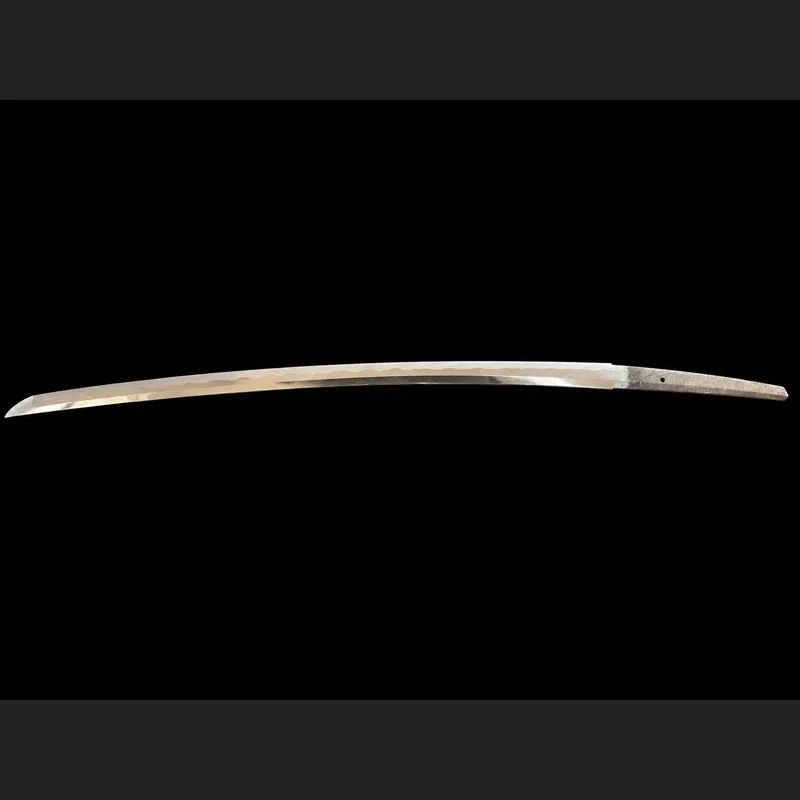
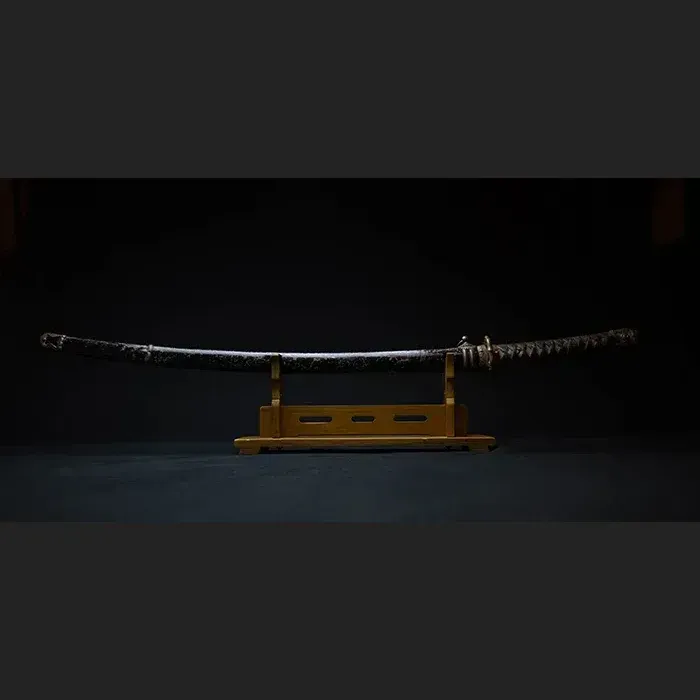
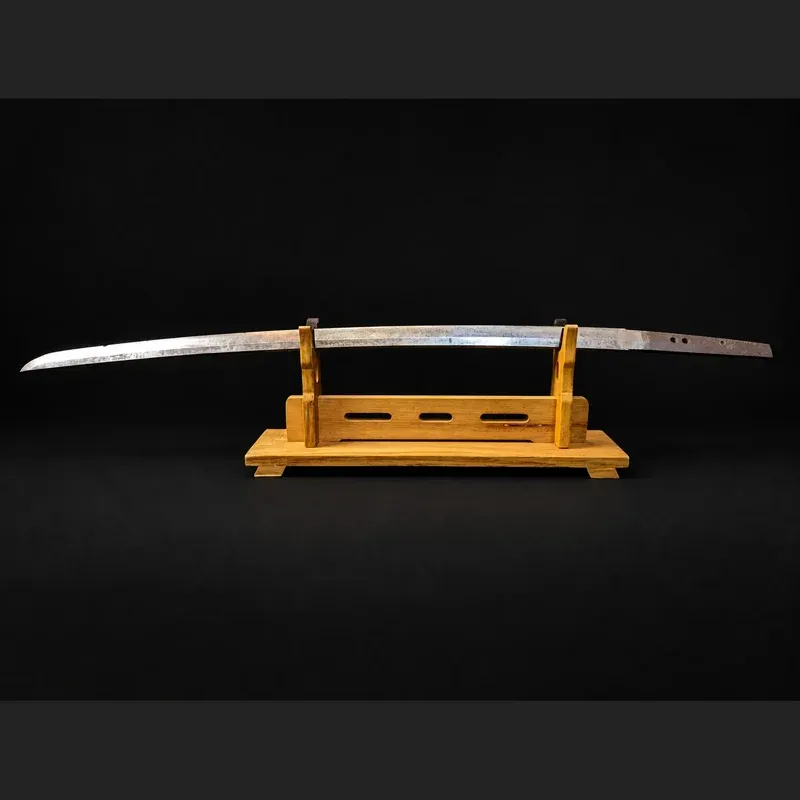
A katana signed 輝秀 (Teruhide) — the niji-mei of Musashi Ishidō Teruhide, last of the Ishidō Korekazu line — in characterful civilian koshirae bearing a manji family crest.
The nakago carries the two-character mei 輝秀 — Teruhide, the niji-mei of Musashi Ishidō Teruhide (石堂輝秀, 1900–1982), the tenth and last generation of the Edo and Tokyo Ishidō Korekazu line and a descendant of Musashi Daijō Fujiwara Korekazu. Teruhide was ranked betseki in the 1943 swordsmith rankings; an example of his work received NBTHK Hozon papers in 1997, judged a true gendaitō. He signed in several forms (a long mei, the simple “Ishidō saku,” and this compact two-character signature), and the tang here is signed in that last manner.
The blade shows a quiet, nioi-based gunome hamon with a soft, misty habuchi running into a gentle komaru boshi at the kissaki. Teruhide is recorded as having worked in both traditional and non-traditional (sunobe) methods.
It rests in characterful civilian koshirae: a black ray-skin (same) saya, an iron tsuba with traces of gold inlay, a teal silk wrap over white same, and a fuchi bearing a maru-ni-manji, a circle-enclosed manji (卍). This is the long-established Japanese family and Buddhist auspicious crest, here in its correct upright orientation, distinct from the diagonally-set twentieth-century European emblem with which it is sometimes confused. The wrap is worn with age. Principal measurements (nagasa, sori) available on request.
Age-verified delivery · UK / EU / international · Insured to declared value.