石堂輝秀 Smith
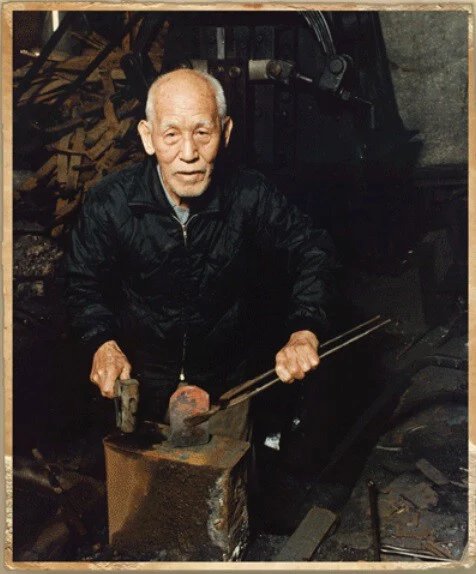
Ishidō Teruhide stands at the very end of a long line. He was the last smith to sign the Ishidō name in steel, recorded as the tenth and final generation of the Edo and Tokyo Korekazu line, a lineage that had kept the flamboyant Bizen chōji of the Kamakura age alive for the better part of three centuries. When swords could no longer sustain the forge, he turned the family’s command of edged steel to the carpenter’s plane, and it was as a maker of fine plane blades, not swords, that the Ishidō name carried on into the present day. Both things are true of him, and together they say something quiet about how a tradition ends and yet does not quite die.
History and lineage
His civilian name was Kikuchi Seiichi (菊池清一), and he lived from 1900 to 1982. He trained under the previous head of the line, Ishidō Hidekazu (1874–1931), and on Hidekazu’s death he succeeded to the headship, recorded thereafter as the tenth and last generation of the Ishidō Korekazu line of Edo and Tokyo (Tōtō) and a descendant of the celebrated Musashi Daijō Fujiwara Korekazu. That succession is best read in the manner of the old craft houses, where the name and the workshop passed by adoption and formal inheritance as often as by direct blood, so “descendant” describes the carrying of a lineage rather than a documented unbroken bloodline. Sources also count the generations of the line a little differently, and the tenth-generation designation follows the swordsmith records rather than the family’s own tool-making genealogy.
The Ishidō forge had already made its peace with the modern age. After the Haitōrei edict of 1876 ended the wearing of swords, the family, like many, turned to edged tools, and in particular to kanna, the carpenter’s plane blade. Teruhide worked within that changed world. He made swords through the Shōwa period, including blades for military officers and for civilians during the war years, and was placed at betseki in the 1943 swordsmith rankings compiled by the Nihon Tōken Tanrenjo. After the war, with the making of swords first forbidden and then tightly restricted under the Occupation, he returned to the plane blade to earn his living, and it was here that he found a second and considerable fame: his kanna were prized by joiners and are still sought after, and the workshop bearing his name has carried on making fine woodworking tools into the present day. It is a fitting coda for a family that had always understood steel and the edge.
Identifying characteristics
Teruhide worked within the Ishidō idiom, and the school’s programme is the right frame for reading his blades. The Ishidō ideal is a tall, vigorous chōji-midare hamon modelled on Fukuoka Ichimonji, clove-shaped heads rising in busy sequences, but rendered in the bright nie of the later tradition rather than the misty nioi of the Kamakura Bizen original it emulates. Ishidō blades often carry a shadow in the ji resembling Bizen utsuri, and the hada is usually a tight ko-itame. Those are the features to look for, and the fuller account of the tradition sits on the school page.
Of Teruhide’s own hand the documented picture is thinner than for the great historical names, and it is more useful to describe a range than a single signature style. His surviving work runs from a lively, active chōji-ba in the inherited Ishidō manner to quieter blades worked in a nioi-based gunome, with a soft habuchi and a gentle komaru bōshi. He is a smith to be read within his tradition rather than by some strongly personal departure from it, which is what one would expect of a man carrying a three-hundred-year name at the very end of its life.
His signatures took several forms, and this matters when reading the nakago. He signed a long mei, a simple “Ishidō saku,” and a compact two-character niji-mei reading 輝秀, at times adding a kaō. He is also recorded signing Mitsunobu; it has been suggested, though the point is not settled, that he kept the Teruhide signature for blades made by the traditional method and used Mitsunobu on non-traditionally forged (sunobe) work. The reading itself invites one small caution, since 石堂 is now and then transliterated Sekidō, though Ishidō is the accepted reading. A mei should therefore be weighed against the particular manner rather than against the name in the abstract.
Why this matters for collectors
Teruhide offers something specific: a genuine gendaitō from the closing generation of a historically important Kotō-revival line, at a level far more approachable than the classical Ishidō and Bizen work that stands behind it. The interest of such a blade lies in the lineage it completes and in the competence of the work, rather than in any exalted cutting or quality rating.
Two cautions are worth stating plainly. The first is a matter of names. The star-stamped Rikugun Jumei Tōshō rolls of the war years include an Ihara Teruhide, a different smith entirely; Ishidō Teruhide is not recorded among the army-appointed swordsmiths, and his wartime standing rests on the betseki placement and on his blades being judged true gendaitō, not on any army star stamp. The two Teruhide should never be run together. The second concerns method: since the same hand is recorded working in both traditional and non-traditional ways, a Teruhide-signed blade points toward traditional forging, but the steel and hamon should be allowed to confirm it. As ever, NBTHK papers are the clearest resolution; an example of Teruhide’s work received NBTHK Hozon in 1997, judged a true gendaitō, which is the kind of confirmation to look for.
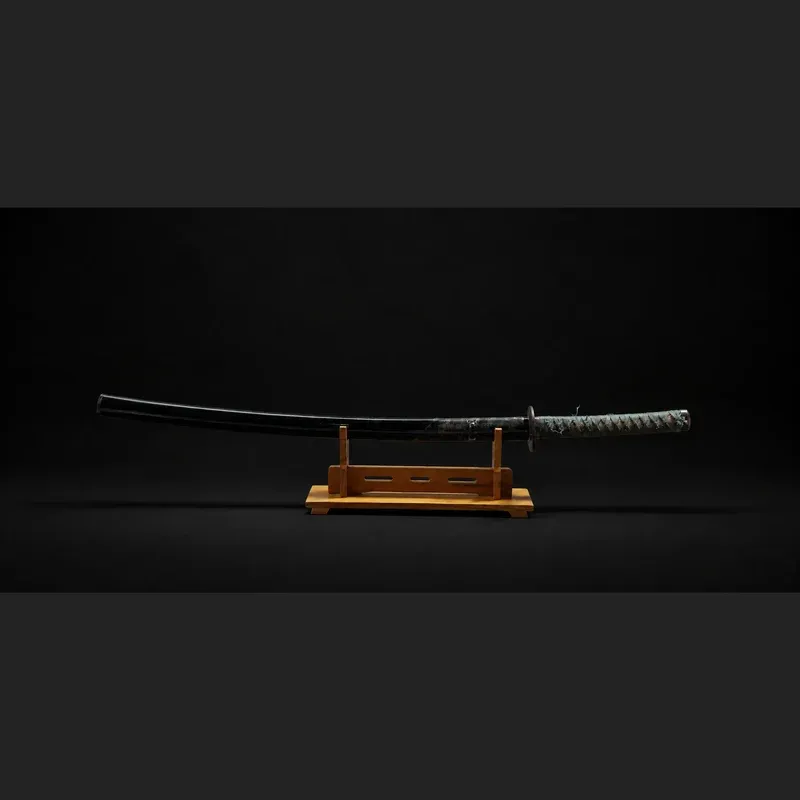
We presently have a katana signed with Teruhide’s niji-mei, resting in characterful civilian mounts. For the tradition he closed see the Ishidō school, for the Bizen chōji it set out to revive see Bizen, and for the model both took as their ideal see Fukuoka Ichimonji.
If you are weighing a blade signed Teruhide, we welcome enquiries, and would counsel proper papers before any commitment.