一文字 School
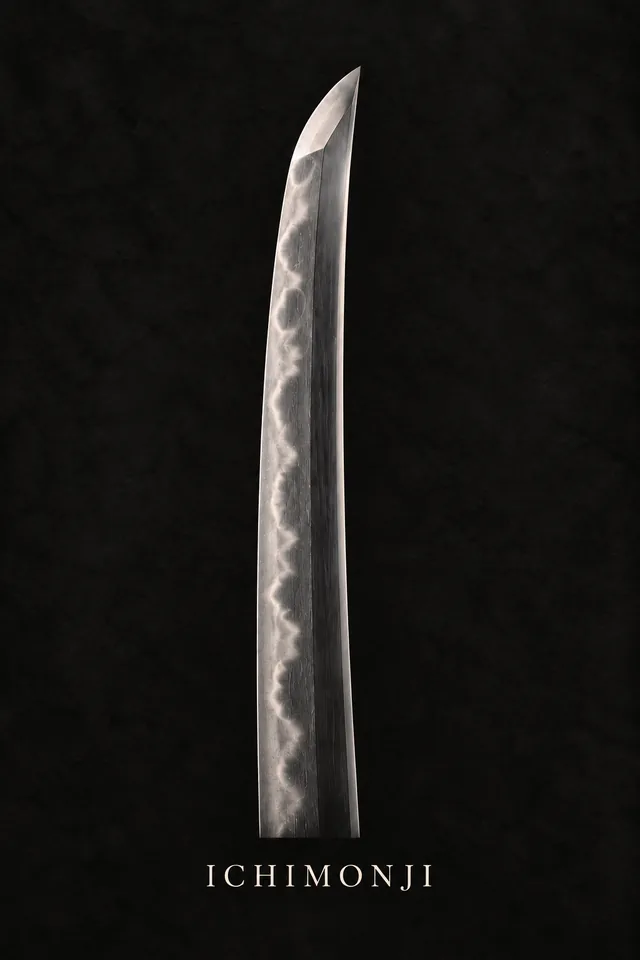
The Ichimonji school produced the most flamboyant hamon in all of nihonto: tall, clustered chōji like rows of cloves, set against a Bizen ji lit with utsuri. It takes its name from the single character 一 (“ichi”) that many of its smiths cut as their whole signature. Ichimonji is judged by its work rather than its mei. The great pieces are almost all heavily shortened (ō-suriage) and unsigned, so attribution rests on reading the steel.
History and lineage
The school flowered in Bizen province during the Kamakura period and is conventionally divided into three branches. Fukuoka Ichimonji is the celebrated mid-Kamakura peak: its smiths — among them Norimune, Sukemune, Yoshifusa, Sukezane, and Norifusa — worked at the height of the art, several of them summoned for Emperor Go-Toba’s rotating-smith (goban-kaji) service. Yoshioka Ichimonji is the later, slightly more restrained sub-line of the late Kamakura. Katayama Ichimonji relocated to Bitchū province and carries some of that region’s character. Sukezane is traditionally said to have gone east to Kamakura, seeding a “Sagami Ichimonji” strand. These are as much a shared aesthetic programme as a single bloodline, which is why kantei proceeds branch by branch rather than by name alone.
Identifying characteristics
The mature Fukuoka sugata is a broad, powerful mid-Kamakura tachi, often with an ikubi-kissaki. The hada is a fine ko-itame, and clear midare-utsuri in the ji is expected. The hamon is the signature: exuberant ō-busa (large-tassel) and jūka-chōji (overlapping clove heads) in a misty nioi-guchi, busy with ashi and yō, often with kinsuji. The bōshi is typically midare-komi with a small turn-back. The mei, when present, is frequently just the “一” character.
Reading it against its neighbours is the heart of attribution. Against Ko-Bizen, Ichimonji chōji are larger, wilder, more clustered. Against the Osafune mainline (Mitsutada, Nagamitsu), Ichimonji stays more nioi-based with stronger utsuri, where Osafune introduces rounder gunome and tighter control. Fukuoka is the most exuberant; Yoshioka more orderly; Katayama shows Bitchū traits. One caution worth knowing: a chrysanthemum (kiku) mon paired with “一” marks an Edo-period “Kiku-Ichimonji,” not Kamakura work.
Why this matters for collectors
Ichimonji sits at the summit of the chōji tradition, and its influence runs straight to the Ishidō school’s later Bizen revival. Because so many genuine pieces survive ō-suriage and mumei, two pitfalls follow: optimistic attribution up the famous branches, and confusion with the Bizen mainline it so closely resembles. As elsewhere, NBTHK papers are the clearest resolution, and an attribution leaning on a bare “一” should be weighed against what the chōji and utsuri actually show.
If you’re looking for Bizen chōji work, we welcome enquiries.
Related guides: Kantei: attributing a Japanese sword · Periodisation of the Japanese sword
