A river does not change at the bridge built over it. The bridge is set where the crossing is easiest, and the dates that divide the Japanese sword into periods work the same way. They mark where a change was easiest to see, not where it happened. Every boundary in this guide is a convention, a convenient marker for a gradual drift in fashion, steel, and need. Smiths worked straight across every one of them, and dated blades sit on both sides of every line.
With that understood, periodisation is the most useful single frame a collector can carry. Period is the first thing a trained eye reads from a blade, because shape dates a sword before anything else narrows it to a region or a hand4. Knowing the eras tells you what a blade should look like, what is plausible for it, and what you can realistically expect to find and afford. What it does not tell you is whether the particular sword in front of you is any good. That is a separate judgement, and it is the subject of our companion guides on kantei and on reading papers. This guide is the chronological scaffold those two hang on.
Why period matters
The conventional division is fourfold by manner of making: kotō, shintō, shinshintō, and gendaitō, with jōkotō standing before them all for the straight blades of antiquity10113. These are not merely date ranges. Each marks a real shift in how swords were made and what they were for. The kotō centuries are the age of the regional traditions, the gokaden, working distinct local steels. The shintō break corresponds to a unified country in which iron circulated nationally and the old regional grounds dissolved into a brighter, more uniform steel made in the cities108. The shinshintō era is a deliberate attempt to undo that and recover lost kotō method16. The gendai era is the sword after it stopped being a weapon.
One honest warning before we walk the periods. Treating the timeline as a quality ladder, with Kamakura at the top and everything after a decline, is a beginner’s mistake. The Kamakura golden age produced the supreme blades, true, but a fine shinshintō or a top Osaka shintō will outclass a tired or flawed kotō blade without difficulty. Period sets expectations. It does not grade the individual sword. Judge the steel, not the date.
It helps to know, too, what the periods mean for what you will actually meet on the market. Genuine Kamakura masterpieces are rare and dear, and most pass quietly between museums, shrines, and a few serious collectors. The blades a UK buyer encounters in practice are weighted toward the later end of the story: late-Muromachi production swords, shintō and shinshintō work, gendai blades, and the occasional cut-down kotō tachi that has lost its signature along the way. None of that is cause for disappointment. A sound Sue-Bizen katana or a crisp shinshintō blade is a fine thing to own, and a working knowledge of the periods is exactly what lets you buy one well, rather than overpay for a famous era name pinned to a worn-out blade.
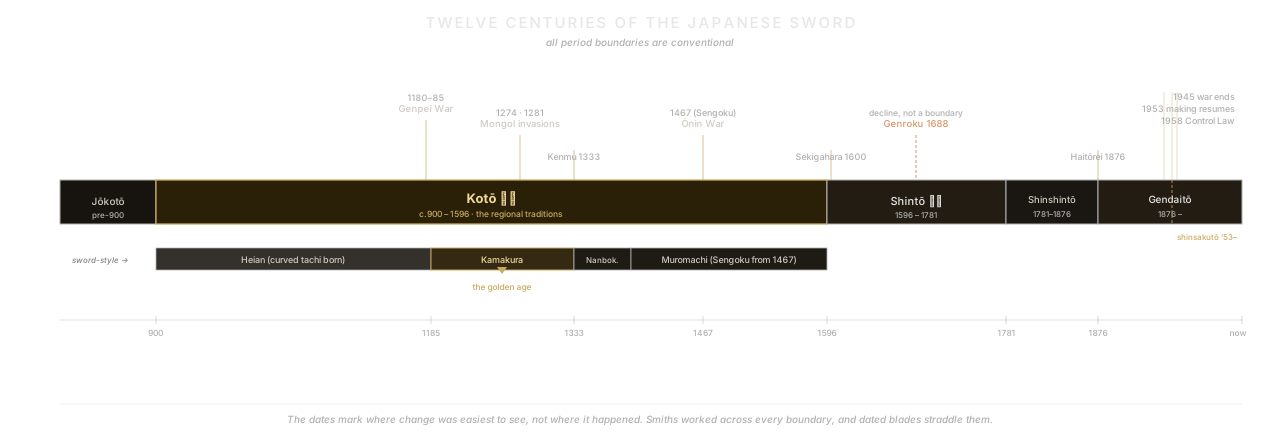
Figure 1. The whole frame at a glance: the five making-periods on the main band, the Kotō sword-style sub-periods beneath, and the political shocks that punctuate them. Genroku is marked as a decline within the shintō age, not a boundary. Every boundary is conventional.
Jōkotō: the straight blades, to about 900
Jōkotō, “ancient swords”, covers everything before curvature, which is to say before roughly the tenth century. This is the loosest boundary of all, and you should treat “to about 900” as the vaguest marker in the whole scheme2011. What survives from this age is overwhelmingly straight: the chokutō, a straight single-edged blade, and the ken, a straight double-edged blade that was often votive and Buddhist in purpose. The forms are early, the hira-zukuri flat construction and the bevel-edged kiriha-zukuri among them121.
The reference collection for the age is the Shōsōin repository at Tōdaiji in Nara, which preserves eighth-century straight blades and fittings and is the touchstone for what a pre-curvature Japanese sword looked like2. The transitional form to watch for is the kissaki-moroha-zukuri, double-edged toward the point with a partial back-edge, the type of the famous Kogarasu-maru, the “Little Crow”, traditionally tied to the smith Amakuni.
For a collector, jōkotō is mostly a category to study rather than to own. The finest straight blades are designated cultural properties and effectively never trade, so the honest expectation is that you will meet them in a museum case or a book, not in a dealer’s rack. Their value to the rest of the story is as the baseline. They show what the sword was before the curve, so that the Heian leap that follows reads as the genuine break it was.
Heian: birth of the curved tachi, 794 to 1185
The defining event of the Heian period is the appearance of sori, curvature, and with it the classical tachi, the long slung sword of the mounted warrior106. The driver everyone agrees on is the rise of fighting on horseback among the emerging warrior class. A curved blade drawn and cut from the saddle does work a straight thrusting blade cannot1.
The Heian shape is unmistakable once you have seen a few. The curvature is koshizori, deepest down near the hand and straightening toward the tip. The blade is slender, with pronounced funbari, the flare that makes it noticeably wider at the base, and it ends in a small ko-kissaki124. The whole effect is elegant rather than powerful, a tall narrow blade with its weight low.
The names to attach to the late Heian are few but luminous. Sanjō Munechika of Yamashiro stands at the head of the Kyoto tradition, his Mikazuki Munechika tachi one of the celebrated Five Great Swords of Japan12. In the west, the ko-Bizen smiths Tomonari and, a little later, Masatsune are the effective founders of the surviving Bizen line, since it is their work that comes down to us, and the Ō-Kanehira tachi is the most famous ko-Bizen blade of all, a designated National Treasure14.
Two things are worth holding onto about Heian work. The first is that almost every genuine Heian tachi you will encounter has been shortened over the centuries and now carries a high-level paper rather than a signature, so the period is met through attribution far more than through a mei. The second is that the two great streams of the later sword are already running here: the refined, nie-bright Yamashiro manner of the capital, and the utsuri-laden Bizen manner of the western provinces. Almost everything in the golden age that follows grows from these two roots.
Kamakura: the golden age, 1185 to 1333
The Kamakura period is the connoisseur’s peak, and it needs the most careful handling, both because its best blades are unsurpassed and because the period’s most repeated myth lives here. The shape evolves across three conventional sub-phases54. Early Kamakura continues the slender Heian tachi, koshizori and ko-kissaki, so closely that early Kamakura and late Heian work form one continuous stretch. Mid-Kamakura brings the magnificent, powerful shape: the body widens, the taper slackens, the kasane thickens, and a stubby ikubi-kissaki, the “boar’s neck”, appears5. Late Kamakura then begins to lengthen the point and thin the body, the direction that runs on into Nanbokuchō.
This is where the most popular story about Japanese swords goes wrong, so it is worth being precise.
The reason the Kamakura era earns its reputation is the concentration of master schools working at once14. In Yamashiro, the Awataguchi school and its supreme tantō maker Tōshirō Yoshimitsu set the standard for refined nashiji-ground steel, and the Rai school, whose Rai Kunitoshi carried Yamashiro work on into the late Kamakura. In Bizen, the Ichimonji school carried the flamboyant chōji temper to its height under Norimune, Yoshifusa, and Sukezane, while the Osafune mainline of Mitsutada, Nagamitsu, and Kagemitsu became the most prolific great workshop in sword history. And in Sagami, late in the period, Shintōgo Kunimitsu founded the Sōshū tradition that his successor Masamune would carry to its nie-laden summit24. What makes the era the golden age is precisely this simultaneity: all of the regional traditions reach their peak within the same century, which is why a great mumei blade most often draws a Kamakura attribution, and why the period’s names carry such weight in the market. The Mongol invasions belong to this era as background, the great external shock of the age, but their mark on the sword is the indirect, delayed one described above, not the tidy cause the guidebooks claim.
It is also the period in which the tantō comes into its own as an art form, the Awataguchi and Sōshū masters raising the short blade to the level of the long one. For the collector, the Kamakura era sets a particular trap and a particular opportunity. The trap is the famous name: a great Kamakura smith’s signature is among the most forged things in the whole field, and an unpapered Kamakura attribution should be read as a hope, not a fact. The opportunity is the cut-down masterpiece. A genuine ōsuriage Kamakura blade, unsigned because its tang was shortened in a later century, can carry a top-rank paper and a price well below a signed but lesser sword, and these are among the most rewarding blades a serious collector can pursue.
Nanbokuchō: ōdachi extravagance, 1333 to 1392
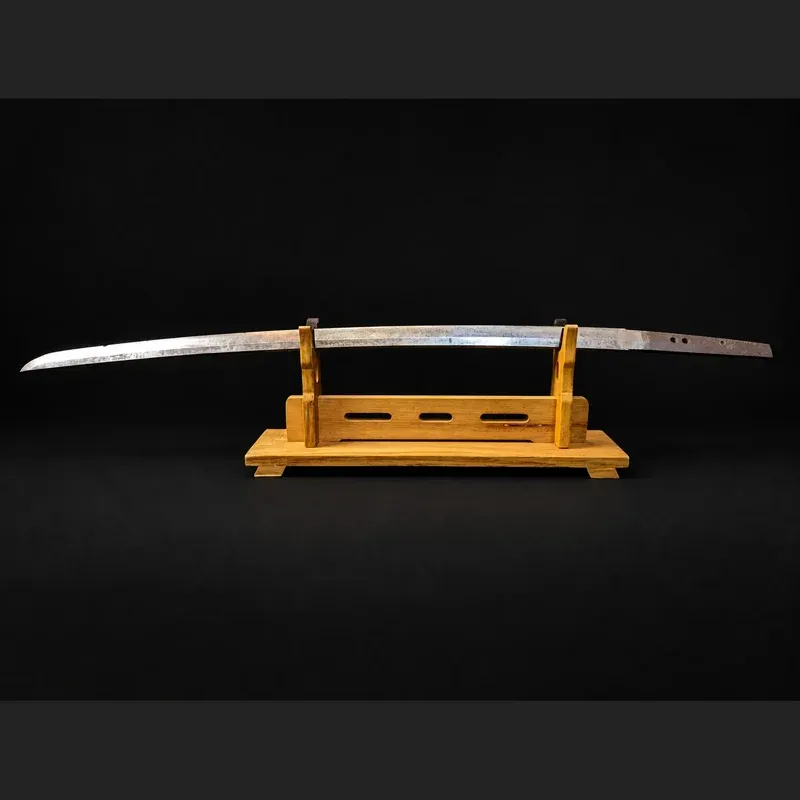
If Kamakura is refinement, the Nanbokuchō period is grandeur. The age takes its name from the split between rival northern and southern courts that the Kenmu Restoration of 1333 set in motion23. The signature of its swords is sheer size. The mid-century is the height of length in the whole history of the sword, with tachi reaching past ninety centimetres and ōdachi of a hundred and twenty centimetres or more made in real numbers4. The shape that carries this is wide and dramatic: little taper, a thin kasane, scant niku, a narrow shinogi-ji, a shallow curve, and a long ō-kissaki with little fukura4. This is the full realisation of the post-invasion direction begun in late Kamakura.
Two consequences matter to a collector. First, most of the great Nanbokuchō ōdachi do not survive at their original length. They were cut down in later centuries to a wearable katana size, a process called ōsuriage, which removed the signed portion of the tang, so the majority come down to us unsigned and rest their names on attribution rather than a signature. Second, the dominant idiom is Sōden-Bizen, the fusion of Bizen’s nioi-based chōji with Sōshū nie, notare, and the bright activities of kinsuji and inazuma. The Osafune masters Kanemitsu and Chōgi lead it; in Sōshū proper, Sadamune carries the tradition on from Masamune, leaving no signed work of his own, so that his hand, like his father’s, is known through attribution rather than a mei, while Hiromitsu and Akihiro develop the spectacular full-surface hitatsura temper.
The great ōdachi were not, for the most part, battlefield weapons in the ordinary sense. Many were offerings, carried in procession or dedicated at shrines, their length a statement as much as a function, which is part of why so many were later cut down to a usable size once fashion and practicality changed. The collector’s encounter with Nanbokuchō is therefore almost always with a shortened blade: wide, shallow in curve, with that long bold point, its grandeur intact even at katana length. Read the width and the ō-kissaki together and you are reading the fourteenth century.
Muromachi: the uchigatana transition, 1392 to 1573
The structural change of the Muromachi period is the rise of the uchigatana, the sword worn edge-up through the sash and drawn in a single motion, displacing the slung tachi610. The driver is the shift to mass infantry war, where a quick-draw foot weapon mattered more than a cavalry sword. The diagnostic shape follows the wear: the curvature moves up toward the tip, the sakizori that suits an edge-up draw, on a blade of moderate width with a balanced chū-kissaki. A useful rule from Sesko: the stronger the sakizori, the later in the Muromachi the blade was made412.
The era splits in two for a collector. The Ōei years of the early fifteenth century produced a brief return to classical, near-Kamakura proportions, the so-called Ōei-Bizen of Yasumitsu and Morimitsu, the most refined Muromachi Bizen work4. A handy dating cue here: a straight, board-like bō-utsuri points to Ōei and later, as against the cloudy midare-utsuri of Kamakura Bizen. After that comes the long decline into mass production, which the next section covers.
The later Muromachi is the collector’s most common kotō encounter, precisely because so much of it was made. A sound Sue-Bizen or Sue-Seki katana of the early sixteenth century is an affordable, genuine, fightable old sword, and there is nothing second-rate about a good one. The caution is only to know which half of the era’s output you are holding. A bespoke blade signed with a full date and a smith’s name is a different object from an unsigned bundle-forged munitions sword, even when the two left the same workshop in the same decade, and because the Sukesada name was attached to so much, a Sukesada signature without papers tells you almost nothing on its own.
Sengoku and Momoyama: mass production and the last kotō, 1467 to 1603
The Ōnin War of 1467 to 1477 opens the Sengoku, the century of warring states, and demand for swords explodes26. Quality splits sharply in two. At the bottom sit the kazu-uchi-mono, “bundle-forged” blades made cheaply and fast for foot soldiers in their thousands, mostly from the Sue-Bizen workshops at Osafune and the Sue-Seki forges of Mino1510. Alongside them, individually commissioned blades of real quality continued to be made to order. The lesson for a buyer is that a late Muromachi date tells you very little on its own: the same years produced both throwaway munitions and fine bespoke work.
The century’s other legacy is the cutting test. Under the warlords, blades were proven by tameshigiri, the testing of an edge on bundled straw mats or, grimly, on cadavers, and the reputations of the great cutting smiths rest on it. The wazamono sharpness rankings, codified later in the Edo period, look back to exactly this body of hard-used Sengoku steel. A Sue-Bizen or Sue-Seki blade was expected above all to cut and to survive cutting. Sheer numbers favour them now: so many were made that sound examples remain common and affordable, which is why the late kotō is where most collectors first hold a genuinely old Japanese sword.
This is the last of the kotō. The mass smiths to know are the Osafune Sukesada line, by far the most prolific name of the age, and the Mino smiths Magoroku Kanemoto, who gave us the three-cedar sanbonsugi temper, and the Kanesada line. One honest caution: Sukesada is the single most forged signature in the whole subject, so the name alone, without papers, means little14. The bridge figure into the next age is Umetada Myōju of Kyoto, a late-kotō master and teacher often called a father of the shintō style818. The political close of the age, Sekigahara in 1600 and the founding of the Tokugawa shogunate in 1603, brings the peace that defines everything after25.
Edo and the shintō: peacetime craft, 1596 to 1781
The shintō, the “new swords”, are the product of a unified, peaceful country. With the great highways open and the provinces no longer isolated, iron circulated nationally, and the old regional grounds that defined the gokaden dissolved into a bright, dense, often nearly grainless steel, the shintō-jigane. Smiths left the old provincial centres and clustered in the three cities, Kyoto, Osaka, and Edo108.
Where the boundary with kotō actually sits is a real and unresolved question, and a careful seller will give you the spread rather than a single date78.
Two sub-phases are worth fixing. Keichō-shintō, the first generation around 1600 to the 1620s, is a revived grandeur, wide blades with large points that consciously echo Nanbokuchō-Sōshū work, the style of Umetada Myōju and Horikawa Kunihiro. Then comes the most date-diagnostic shape in the later sword: Kanbun-shintō, of the 1660s, stiff and shallow, with little curve, a standard chū-kissaki, and a strong funbari at the base4. The masters to know are the Osaka school of Inoue Shinkai, called the Masamune of Osaka for his nie, and Tsuda Echizen-no-Kami Sukehiro, who developed the billowing tōran-ba wave, alongside the Edo smith Nagasone Kotetsu, famed for sharpness10. A buyer’s caution carries across this whole era: Shinkai, Sukehiro, and Kotetsu are among the most forged names in the subject, so a shintō attribution to a star name without papers should be treated with real suspicion.
The deeper change is one you can read in the steel. Where a kotō blade’s ground announces its province, a shintō blade’s bright, tight, often nearly grainless jigane tells you mostly that it is shintō, the old regional fingerprints having been washed out by national iron and city workshops108. That throws the weight of shintō attribution onto the hamon and the shape rather than the ground. For the collector it is good hunting. Capable shintō smiths are more available and more affordable than their kotō equivalents, and a fine Osaka blade with a billowing tōran-ba is among the most beautiful things the later sword produced. There is also a deliberate Bizen revival to watch for, the Ishidō school working bright chōji in nioi, handsome and easy to mistake for genuine kotō Bizen at a glance.
The three city traditions each carry a flavour worth knowing. Kyoto shintō, the Mishina smiths and the Horikawa school under Kunihiro, keeps an elegant, faintly classical air. Osaka shintō, the richest seam for collectors, prizes a bright, clear ground (the famous Osaka-tetsu) and flowing nie temper, Sukehiro’s tōran-ba at its head. Edo shintō, in the shogun’s own city, tends to the sturdy and the practical, with Kotetsu its great name. Hearing which city a shintō blade speaks of is half the work of placing it.
Shinshintō: the revival, 1781 to 1876
The shinshintō, the “new-new swords”, are a self-conscious revival. By the late eighteenth century the smith Suishinshi Masahide had concluded that the flashy, brittle blades of his own training were a wrong turn, and he set out to recover the durable method of the Kamakura masters, a movement called fukkotō, “return to the old sword”16919. Shinshintō blades therefore tend to quote the past openly, reproducing Kamakura or Nanbokuchō shapes in the harder, brighter steel of their own day.
The dates here need care, because they are easy to garble.
The names are a short, brilliant list. Masahide himself is the founder and theorist. Taikei Naotane, his foremost pupil, is the most convincing of the Sōshū and Bizen revivalists. And Minamoto Kiyomaro, the “Masamune of Yotsuya”, is the bravura star of the late period, whose powerful Sōshū-influenced work commands the highest prices of any shinshintō smith16. Kiyomaro is the romantic figure of the age, a prodigious and famously hard-drinking talent whose finest blades stand comparison with the old masters, and who took his own life in 1855, leaving a small and fiercely sought body of work16. He is the reason shinshintō is no mere footnote to the kotō it imitates. The era also produced superb Bizen-revival work, Koyama Munetsugu chief among its makers, though Munetsugu came from his own school and was not, as is sometimes claimed, a pupil of Masahide. For the collector, shinshintō offers something rare: blades by named, dated, well-documented masters, often in superb condition and worked in the classical styles, at prices below the antiques they emulate.
The era runs into the turmoil of the Bakumatsu, and closes with the Haitō Edict of 1876, which ended the everyday wearing of swords and nearly killed the craft1022.
Gendaitō: the modern era and the war, 1876 to 1945
Gendaitō, “modern swords”, are the blades made from the Haitō Edict of 1876 onward. The edict, issued in March of that year, removed the sword from everyday life at a stroke and collapsed the smiths’ market, and the craft very nearly died2210. What kept it alive was patronage: the appointment of Imperial Household Artists such as Gassan Sadakazu, whose Gassan line revived the distinctive ayasugi grain, and later the shrine forges that trained a new generation of traditional smiths28.
The shrine forges are the collector’s happy hunting ground in this era. The Yasukuni smiths, working under the name Yasukuni-tō, and the Minatogawa smiths produced traditionally made blades of high and consistent quality, and a papered shrine blade is a sound, attainable way to own a genuine twentieth-century nihontō. These sit at the opposite pole from the mass wartime production discussed next, and the gap between the two is exactly the gendaitō-versus-shōwatō distinction every wartime-sword buyer has to learn.
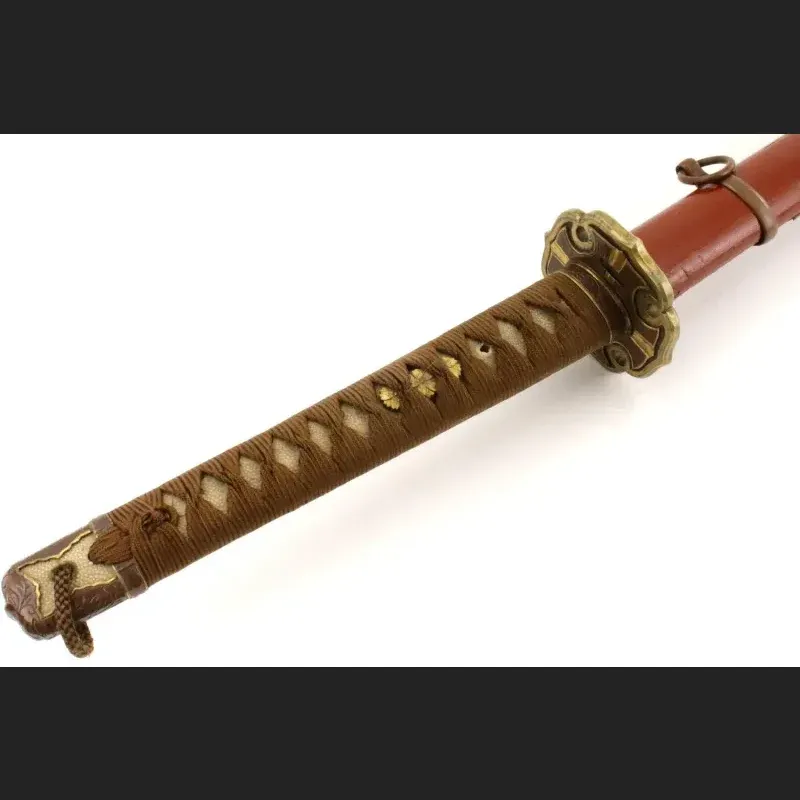
The complication of this era is the war, and it deserves one honest paragraph before a hand-off. Within the years to 1945, collectors separate the traditionally made gendaitō, of folded tamahagane, water-quenched, with genuine grain and an active hamon, from the shōwatō, the non-traditionally made wartime swords, frequently oil-quenched and made of mill steel, a distinctly lower grade of object13. Arsenal stamps are a guide: a Shō or Seki stamp generally marks a shōwatō, while a star stamp marks a Rikugun Jumei Tōshō army-approved smith working supplied tamahagane. But the line is a workmanship judgement, not a rule, since the same smith often made both, and each blade is judged on its merits13.
Shinsakutō: the postwar revival, 1953 to the present
The last chapter is a recovery. The Allied occupation banned sword-making and ordered surrenders, and the craft was suspended entirely. In 1953 Japan permitted it again under strict conditions, which is why the living tradition is conventionally dated from that year1728. The framework that governs it is the Firearm and Sword Possession Control Law of 1958, under which a newly made blade must be registered and made by a licensed smith to count as an art sword rather than a controlled weapon2127. The two dates are different events and worth keeping apart: 1953 is when making was permitted again, 1958 is the law that codified the regime.
Becoming a smith is deliberately hard. The candidate must apprentice under a licensed master for at least five years, then pass certification by the Agency for Cultural Affairs before working alone2728. Once licensed, output is capped.
For the collector, the shinsakutō is the one genuinely new nihontō you can buy. A blade from a living licensed smith comes with its registration papers, is wholly legal to own and to bring into the UK as an antique-method art sword, and can be commissioned to a chosen style. It is the accessible end of the tradition, and a fine one is a real sword, not a reproduction.
These living-smith blades are shinsakutō, “newly made swords”, best understood as the fully traditional subgroup of gendaitō. The work is technically superb and deliberately archaistic, with smiths choosing a kotō idiom, Bizen chōji, Sōshū, Yamato, and working it in water-quenched tamahagane to a very high standard. Standards are pushed upward by the annual competitions, above all the NBTHK’s Shinsaku Meitō exhibition, and by the designation of the very best smiths as Living National Treasures. The result is that the technical quality of the finest modern blades is, by many measures, the highest in centuries. Whether that should be measured against the Kamakura masterpieces it imitates, or judged as a distinct contemporary craft with its own standards, is a question collectors genuinely disagree on, and a fair guide leaves it open rather than ruling28.
Sugata evolution at a glance
If you remember nothing else, remember the shape, because it is the single most reliable period clue412. The straight blade of jōkotō gives way in the Heian to the slender, deeply koshizori tachi with its small point. Mid-Kamakura broadens the body and stubs the tip into the ikubi-kissaki. Nanbokuchō stretches everything into the long, wide, thin ōdachi with its great ō-kissaki. The Muromachi uchigatana shortens, narrows, and moves the curve up toward the tip as sakizori. Keichō-shintō briefly revives Nanbokuchō grandeur before Kanbun-shintō settles into its stiff, shallow, standard shape. Shinshintō then quotes the old shapes back deliberately, and the gendai and shinsakutō smiths continue that revival into the present. The montage below sets real blades side by side, scaled to their true length and read from right to left in the traditional direction, from the Heian tachi at the right to the modern work at the left, so the whole twelve-century drift shows in one sweep. Every boundary is conventional, and the smiths, as ever, worked straight across them.
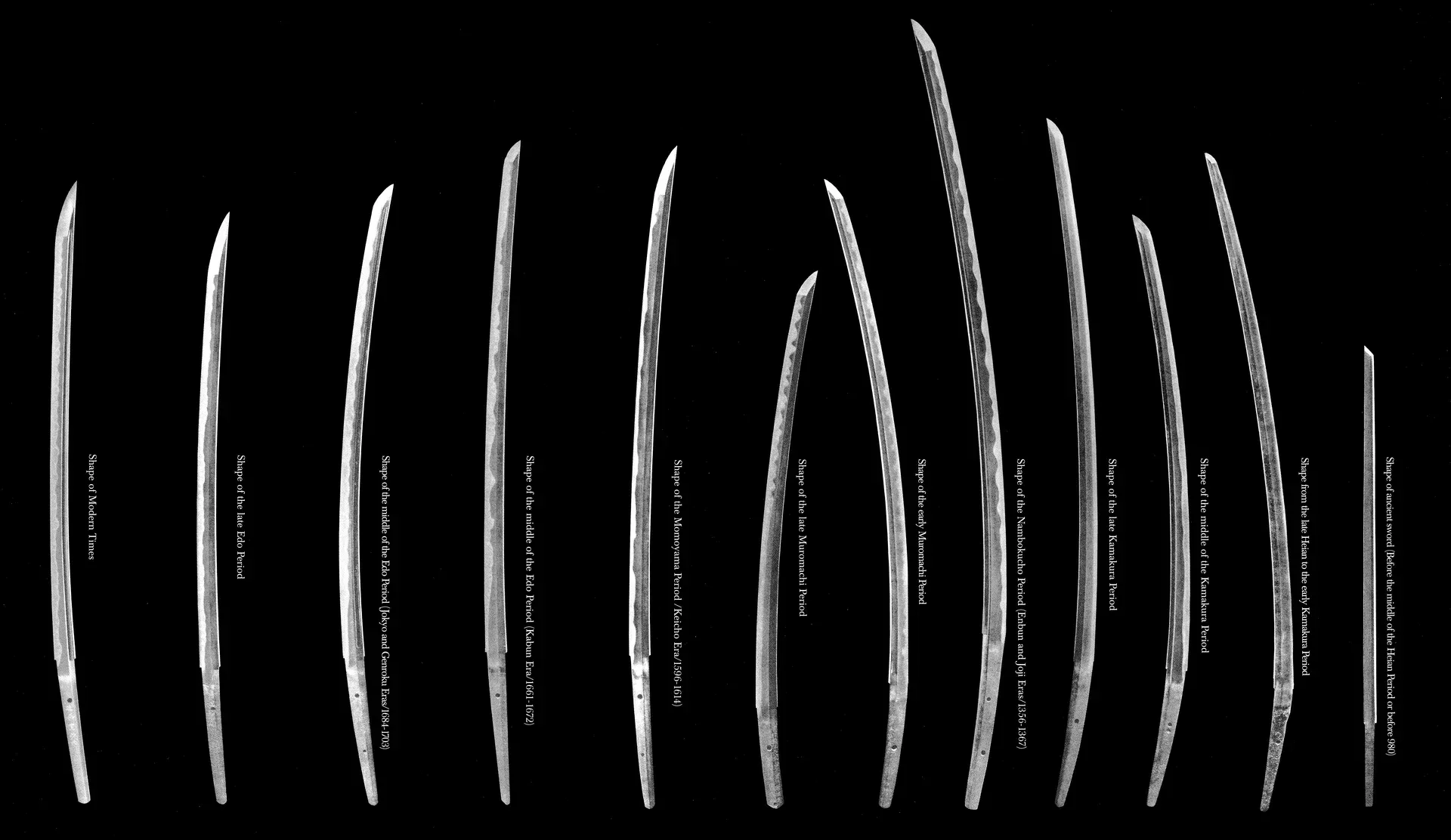
Figure 2. Real blades across the periods, scaled to their true length and read right to left in the traditional direction: the slender, deeply curved Heian and Kamakura tachi at the right; the long, wide Nanbokuchō ōdachi; the shorter Muromachi uchigatana; the stiffer shintō and shinshintō blades; and the modern work at the left. The Nanbokuchō reach and the late shallowing of the curve both show at a glance.
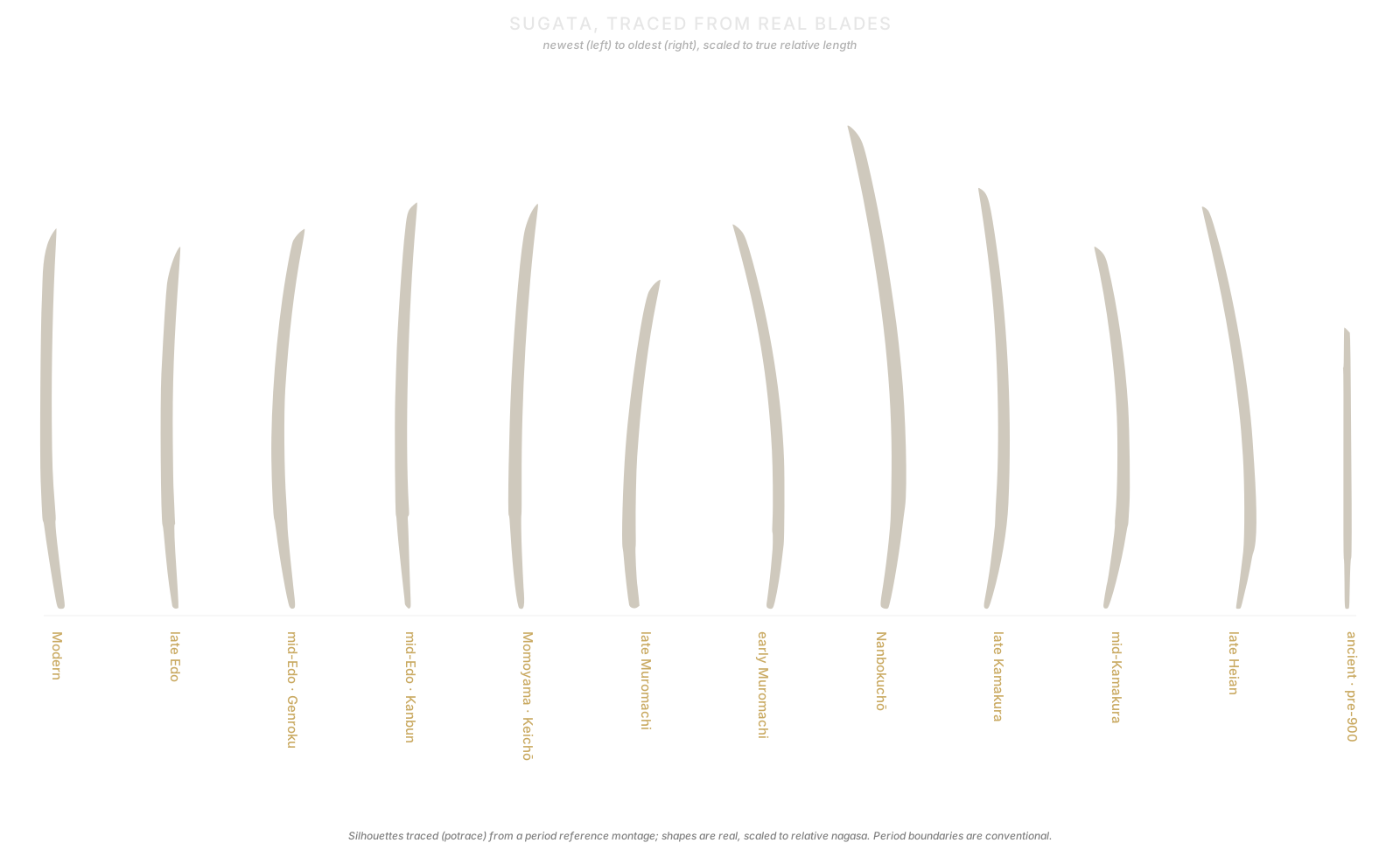
Figure 3. The same blades traced and labelled, so the period of each is legible. The silhouettes are real shapes lifted from the montage above, scaled to relative length, modern at the left to ancient at the right.
If you are trying to place a specific blade and want a second opinion before you buy or submit it, that is what our mei translation and polish and shinsa coordination services are for. And to turn a period guess into a reasoned attribution, the companion guide on kantei walks through how the reading is actually done.