陸軍受命刀匠 Programme
The Rikugun Jumei Tōshō, the Imperial Japanese Army Appointed Swordsmiths, was a formal wartime programme through which the Army identified, supervised, and stamped the output of smiths producing traditionally-forged blades for officer issue. One distinction matters above all others here. RJT blades are genuine nihonto, forged from tamahagane by trained smiths using traditional methods, then inspected and stamped by army metallurgists. They are not the mass-produced machine-stamped swords, the shōwatō, that collectors and researchers correctly treat as outside the nihonto tradition. The star stamp is what separates the two.
History and lineage
The programme emerged from a mid-war recognition that Japan’s officer class needed blades of genuine martial and spiritual character, not the pressed-steel munitions swords being produced in industrial quantities. The Army formalised the Rikugun Jumei Tōshō designation — literally “Army-commissioned swordsmith” — and recruited smiths who had trained within established nihonto traditions. Smiths admitted to the programme were required to work in the traditional manner: tatara-smelted tamahagane, hand-forging, clay-coating for differential hardening, water quenching. Their output was submitted for inspection by army metallurgists, and blades that passed were struck with the hoshi-jirushi (星刻印) — the army star stamp — which certified the blade as a genuine gendaitō rather than a substitute. The programme operated primarily from the late 1930s through 1945, with production peaking in the early 1940s. The number of admitted smiths fluctuated; estimates vary, but several hundred smiths held RJT designation at various points. After Japan’s defeat, the programme ceased and most surviving swordsmiths transitioned into peacetime craft production.
Identifying characteristics
The primary identifier of an RJT blade is the hoshi-jirushi: a small stamped star, typically found on the nakago, often near the munemachi (the notch at the blade’s base on the spine side). The stamp is die-struck and distinct from any hand-engraved decoration; under magnification it shows the clean edges of a mechanical impression. Some blades carry additional stamps indicating inspection date or inspecting officer. The blade itself should show the characteristics of traditional forging: a visible jihada (typically a tight ko-itame or itame reflecting the individual smith’s training), a hamon produced by differential hardening (notare, gunome, or suguha depending on the smith’s school background), and a nakago with hand-filed surface and an authentic hand-engraved mei. The mei on an RJT blade typically gives the smith’s name, often a date in the Japanese calendar (e.g., Shōwa 18 = 1943), and sometimes a location or dedication inscription. Shōwatō, by contrast, show no meaningful jihada, a machine-applied hamon-like pattern, and a mass-produced nakago — the differences are apparent to any experienced examiner.
Why this matters for collectors
RJT blades hold a clear position in the gendaitō market. They are genuine nihonto made under wartime conditions by trained smiths, documented by the army star stamp, and collectible both as military history and as examples of the traditional methods kept alive through extraordinary circumstances. The star stamp, when authentic, is a form of contemporary authentication: army metallurgists examined the blade in the year of its production and confirmed it met traditional standards. For a collector, the practical questions come down to a few. Is the star stamp genuine, die-struck rather than engraved or added later? Do the jihada and hamon read as traditional forging? Does the mei cohere with the stamp and the period? A blade that passes is a legitimate gendaitō with clear military provenance. The common pitfalls are shōwatō wearing fake star stamps, and RJT blades whose mei has been added or altered after the fact.
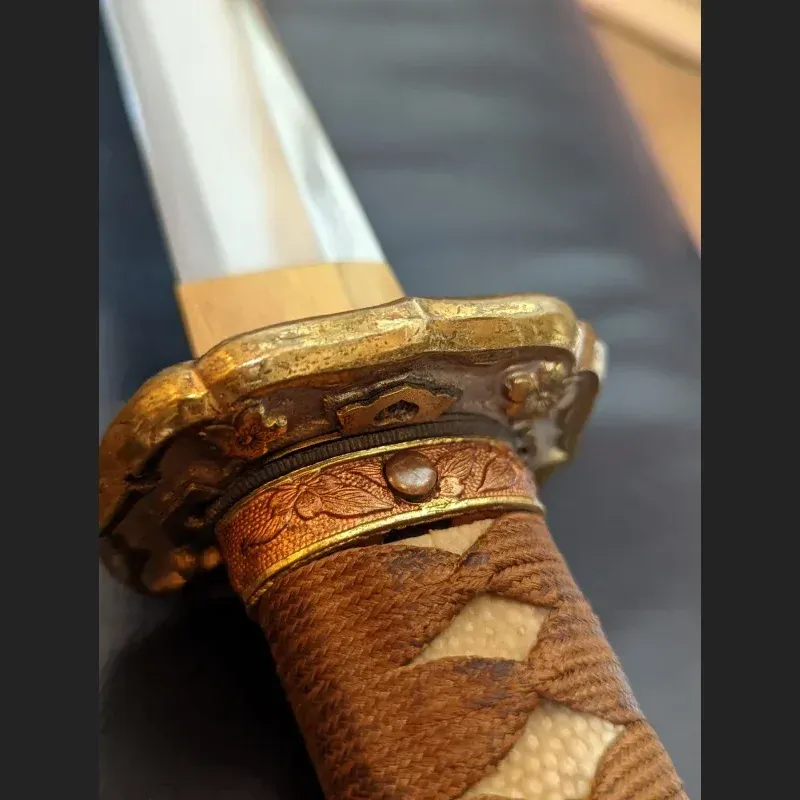
Our archive piece JB-1009, a 1943 blade signed Yoshiharu with army star stamp, offered and sold in near-mint guntō mounts, was a fair example of what the programme produced at its mid-war peak: a traditionally-forged katana with legible hamon, clear jihada, and a stamped and signed nakago that told its history plainly.
Related guides: WW2 Japanese sword buyer’s guide · Periodisation of the Japanese sword