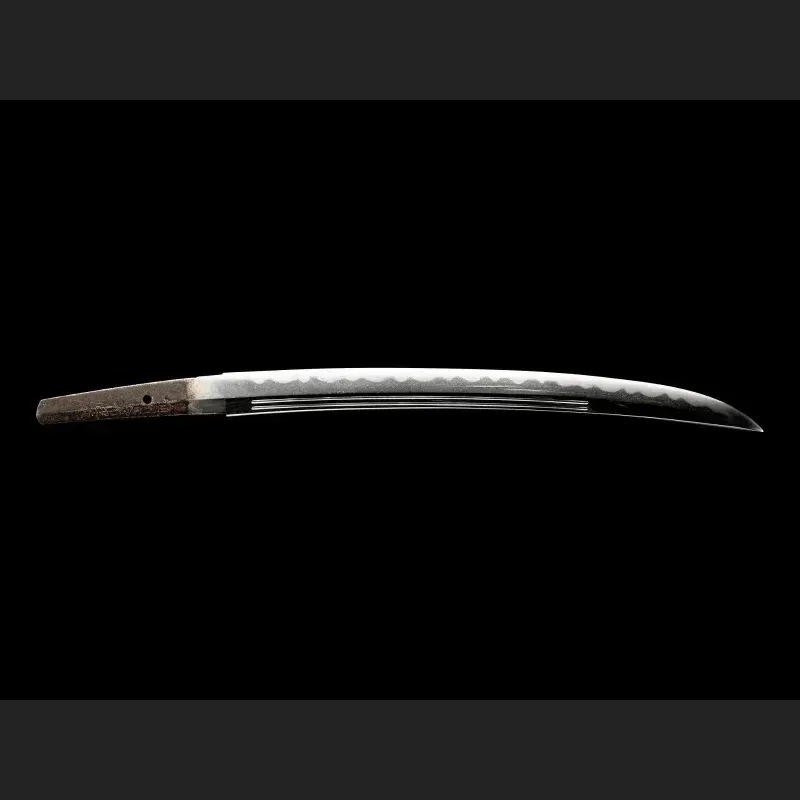
長船 School
Osafune is the mainline of the Bizen tradition through its golden age, the workshop centred on the Osafune locality that, across the mid-to-late Kamakura period, produced the succession of Mitsutada, Nagamitsu, Kagemitsu, and Kanemitsu. Think of it as the disciplined heart of Bizen: a nioi-based chōji and gunome hamon over standing midare-utsuri, worked with tighter control and a rounder gunome admixture than the wilder, purely nioi-based exuberance of the Ichimonji groups it grew up alongside.
History and lineage
The mainline begins with Mitsutada (光忠), working in the mid-Kamakura period in a flamboyant register — broad ō-chōji with conspicuous ji-nie. He is recorded as not having worked in suguha, which is itself a useful negative when reading attributions. From him the line passes to Nagamitsu (長光), the towering and exceptionally prolific master whose surviving body of work anchors the school’s reputation; the Daihannya Nagamitsu, a Kokuhō whose name derives from a valuation of six hundred kan, is the famous example, though it is one masterpiece among a large oeuvre and should not be made to stand for the whole. Nagamitsu is succeeded by Kagemitsu (景光), whose hallmark is the kataochi-gunome — a sawtooth, slanting gunome — with dated works running across roughly 1303 to 1335. The line continues to Kanemitsu (兼光), whom modern consensus, including Tanobe, treats as a single generation working in a dual style: a Bizen chōji-gunome manner and a later, Sōshū-influenced notare.
One genealogical question remains genuinely open. The “Sakon Shōgen Nagamitsu” signature of the 1290s and 1300s has prompted an unresolved debate over whether it reflects one unusually long career or two generations working under the name. The honest position is that this is not settled, and an attribution should not lean on a tidy resolution of it.
Identifying characteristics
The diagnostic feature of Osafune work is standing midare-utsuri — a clear, upright shadow of the hamon pattern in the ji — over a hamon that combines chōji with a rounder gunome than the Ichimonji groups favoured. Where Ichimonji chōji runs wild and purely nioi-based, Osafune reads as tighter and more controlled, the gunome admixture lending a steadier rhythm. A recognised aid to dating and attribution is the san-saku bōshi — the closely related bōshi forms shared by Nagamitsu, Kagemitsu, and Sanenaga. Kagemitsu’s kataochi-gunome is among the most reliable single signatures of hand in the whole tradition. The Nanbokuchō period brings the Sōden-Bizen development, in which smiths such as Chōgi and Nagayoshi fused Bizen with Sōshū methods — more nie, more sweeping notare — a distinct phase that should not be conflated with the mid-Kamakura mainline.
Mei on the nakago follow the individual smith rather than a house formula, and the prolific output of Nagamitsu in particular means signatures must be weighed against workmanship, not trusted in isolation.
Why this matters for collectors
Osafune sits at the summit of what Bizen achieved, and the names (Mitsutada, Nagamitsu, Kagemitsu, Kanemitsu) carry corresponding weight in the market. That prestige is also the principal hazard. Ambitious Bizen blades are sometimes optimistically catalogued to the mainline, and the san-saku bōshi or a convincing kataochi-gunome are features to confirm rather than to assume. The Kanemitsu dual-style question and the unresolved “Sakon Shōgen” debate both mean that a name alone settles little. NBTHK papers are strongly advisable for anything offered as named Osafune work, and the steel, utsuri, and hamon should cohere before the signature is given any weight.
If you’re hunting for an Osafune piece, we welcome enquiries. Many of the best examples never appear on public listings.
Related guides: Kantei: attributing a Japanese sword · Periodisation of the Japanese sword