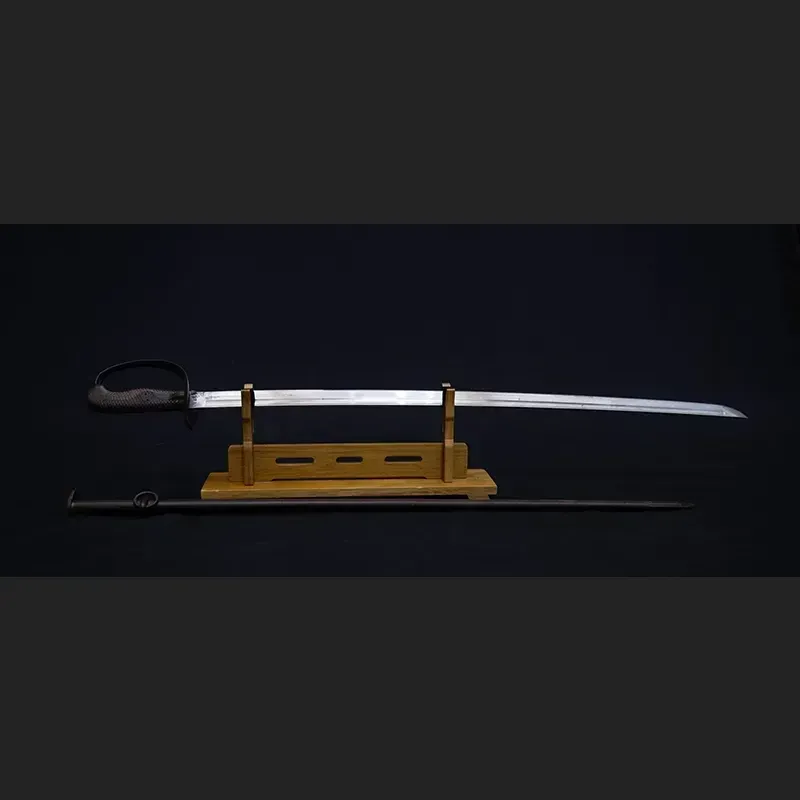
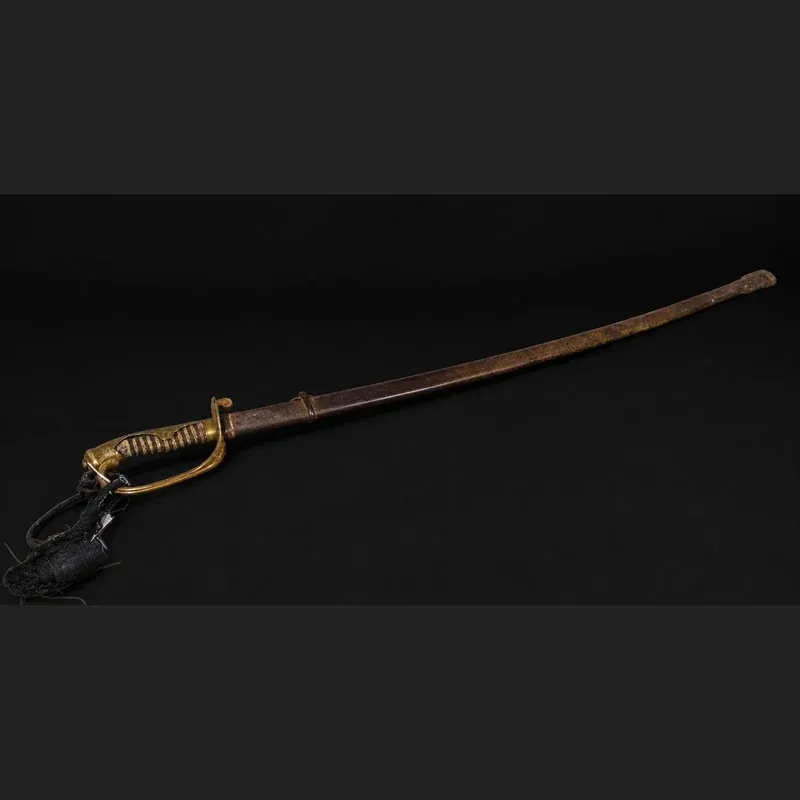
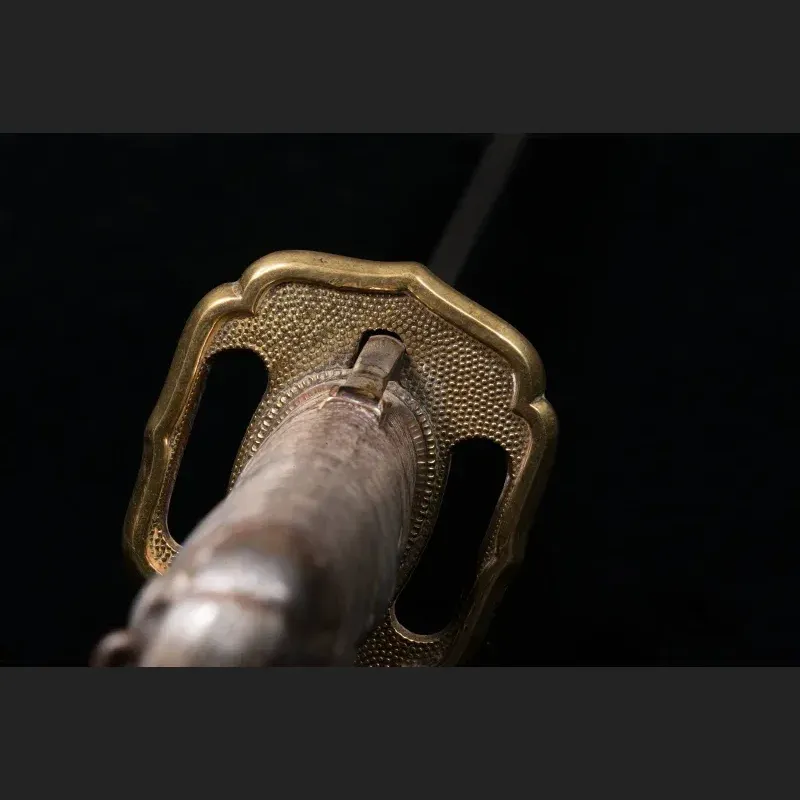
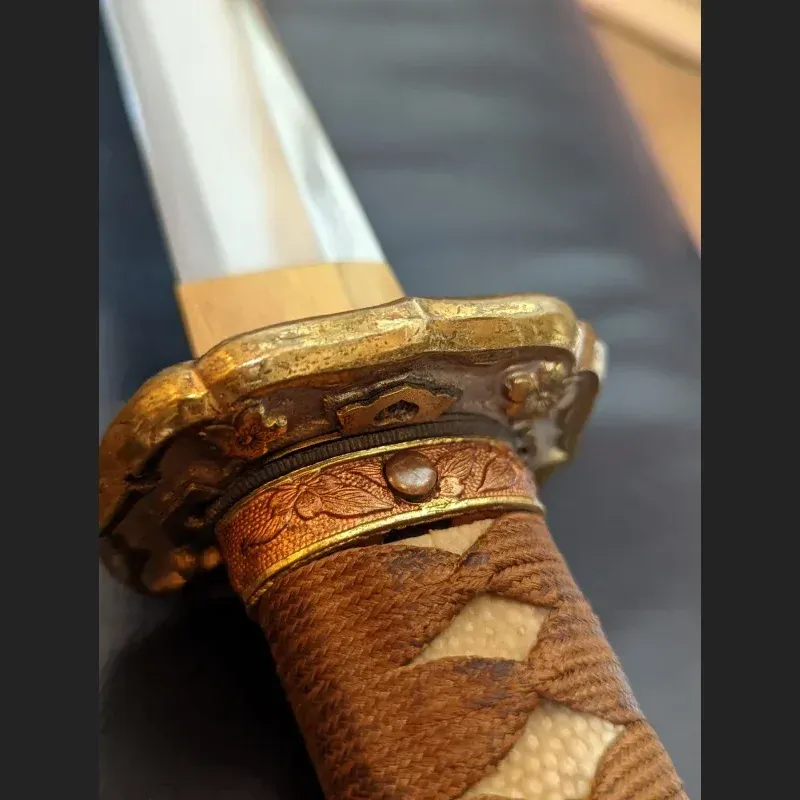
Most UK collectors who inherit, find, or buy a WW2 Japanese sword do not own what they think they own. The grandfather’s “samurai sword” brought home from Burma is, in the great majority of cases, not a samurai sword in any meaningful sense. It is an industrially produced officer’s blade in regulation mounts, made between 1934 and 1945 to wartime specification, and it sits in a particular legal, historical, and market category worth understanding before selling, polishing, or papering it.
This guide takes the plain position throughout. The romance of the bring-back blade is real, and the legal status under UK law is settled firmly in the collector’s favour. Institutional standing within the nihonto world and the technical character of the steel are separate questions, and they are the ones this guide answers. It is written for the reader who wants a clearer view of what a Type 98 actually is, how to read the nakago, and which star-stamped blades are worth submitting to NBTHK.
What you’re actually buying: nihontō, gendaitō, shōwatō
Three categories cover almost everything a UK collector will encounter from the 1933 to 1945 production period. The categories are commonly conflated, including in reputable dealer listings, and getting them straight from the start is the foundation for everything that follows. How the traditional features are actually read off a blade is the subject of our kantei guide.
A nihontō (日本刀) in strict usage is a blade forged by traditional methods: tamahagane steel smelted in a tatara furnace, folded and worked by hand, differentially hardened by clay coating and water quench3. This produces the visible characteristics collectors prize, the hada in the ji, the nie and nioi in the hamon, and a bōshi with its own activity5. The term applies to all periods from the Heian forward, traced era by era in our periodisation guide, including modern blades that meet the standard.
One exception is worth flagging early: Mantetsu (Kōa Isshin) blades are not traditionally forged and not classed as nihontō, but their controlled-temperature hardening can still produce genuine nie and nioi activity in the hamon16. A Mantetsu signature with visible nie does not promote a blade to gendaitō; Section 3 details the case.
A gendaitō (現代刀) is a nihontō made in the modern era, broadly post-Meiji. Applied to WW2 production, it identifies swords made by traditional methods using tamahagane or comparable quality steel, folded, hand-hammered, water-quenched. The Yasukuni shrine smiths, the Minatogawa shrine smiths, and the RJT-certified smiths in section three all produced gendaitō61. The NBTHK and the mainstream collector community accept these as genuine nihontō.
A shōwatō (昭和刀) in collector usage is any blade made by non-traditional methods during the Shōwa period. The diagnostic markers run together: machine-forged or semi-machine-forged steel, often mill steel rather than tamahagane; oil-quench tempering rather than water-quench; absence of visible hada; a flat hamon line or an etched imitation; an Arabic serial number on the nakago61. These are not considered nihontō in Japan. They are collectable as militaria but classified as military equipment, not art swords. The Type 95 NCO sword is the canonical shōwatō.
From the mid-1930s, non-traditionally made blades were increasingly marked with a manufacturer-chosen stamp. The arrangement is widely attributed to a 1937 law, though no contemporary Japanese gazette establishing such a law has been located; the practice was, at least in part, driven by a Seki Cutlery Manufacturers Association quality-control programme121. The intent was to mark shōwatō and so distinguish them from gendaitō. The arrangement produces a useful heuristic, an unstamped 1937 to 1945 blade is more likely a gendaitō; a Seki or Showa stamp leans toward shōwatō, though one critical stamp (the star) does the opposite job and identifies a gendaitō. The stamp is never the whole story.
The UK market is dominated by shōwatō in regulation army mounts, Type 95s at the lower end and Type 98 bodies above them, with a smaller seam of officer gendaitō in Type 94 or Type 98 koshirae. Genuine nihontō re-mounted into military fittings exist and complicate identification, particularly when an ancestral blade was shortened (suriage, 磨上げ, removing material from the base of the nakago) to fit a regulation scabbard25. To set expectations honestly: the inherited bring-back is far more often a shōwatō than a gendaitō, and far more often a gendaitō than a kotō survival in military koshirae.
UK legal status: Offensive Weapons / 2008 Order, antique exemption, the 1954 cutoff
Two statutes and one statutory instrument constitute the framework. Knowing which one carries the actual prohibition is the difference between a confident collector and an anxious one.
The Criminal Justice Act 1988, section 141 is the enabling power7. The section grants the Secretary of State authority to designate offensive weapons by statutory instrument; the section itself does not name swords. Everything relevant to curved blades flows from the 2008 Order made under it. The Offensive Weapons Act 1996 raised penalties for carrying offensive weapons and provides background context only9. Collector guides frequently conflate the 1996 Act with the curved-sword prohibition; they are distinct instruments.
The Criminal Justice Act 1988 (Offensive Weapons)(Amendment) Order 2008, in force from 6 April 2008, is the operative instrument8. The Order prohibits curved blades of 50 centimetres or over, measured as “the straight line distance from the top of the handle to the tip of the blade.” This catches effectively all full-length katana, tachi, and gunto blades.
The Japanese sword defence, paragraph 3 of the Order, reads in full:
“It is a defence to show that the weapon in question was made in Japan before 1954 or was made in Japan at any other time according to traditional methods of forging swords.”8
Two independent routes, then. The first is the 1954 cutoff: a blade made in Japan before 1954. This covers every genuine WW2-era piece, whether nihontō, gendaitō, or shōwatō, provided Japanese origin can be demonstrated. The cutoff is 1954, not 1945; a 1942 Type 95 shōwatō is exempt. The second route is traditional manufacture at any time, which covers post-1954 nihontō by contemporary smiths.
Two further points. Public carry is governed by the Prevention of Crime Act 1953 and public order law, not the 2008 Order; the curved-blade defence does not authorise anyone to walk around with a sword. The relevant antique threshold here is also the 1954 cutoff, not the conventional 100-year definition used for import or export of antiques generally. The two should not be confused.
Production landscape 1933 to 1945: arsenals, Mantetsu, RJT, regional smiths
Mass production of military swords was organised on three tracks running in parallel: government arsenals, the Mantetsu / Kōa Issin railway-steel programme in Manchuria, and the Rikugun Jumei Tōshō (RJT) civilian-smith system6. The collector encounters all three, and each writes its identity onto the nakago in a different hand.
Arsenals and commercial contractors
The principal sites of arsenal-grade shōwatō production:
- Tokyo Arsenal (Koishikawa). Large-scale output; nakago carries the Tokyo (Tō) stamp with serial numbers in Arabic numerals12.
- Nagoya Arsenal. Identified by the Nagoya (na) stamp12.
- Kokura Arsenal. Active in both blade and complete sword production; combination marks with Tokyo appear regularly.
- Seki (Gifu Prefecture). The major commercial production centre for military blades; the Seki stamp is common on shōwatō officer swords, with many independent contractors operating under the umbrella112. Two distinct Seki stamps appear: a 5 mm large stamp used by the Seki Cutlery Manufacturers Association from 1940, tapering off through 1943; and a smaller 3 mm stamp introduced in 1943 by the Seki Supervisory Unit of the Nagoya Army Arsenal, used through to war’s end. The larger stamp is a commercial mark; the smaller is a military inspection mark.
- Osaka Arsenal. Smaller military sword output, with characteristic stamps.
- Minatogawa Shrine smiths (navy-controlled forge). Occupy a contested zone between gendaitō and shōwatō; the kikusui (chrysanthemum-on-water) mon identifies their work612. The forge was navy-controlled from 1940 and produced good-quality hand-forged blades. The contest turns on materials: some Minatogawa runs used tamahagane, others a substitute steel, and NBTHK treatment varies by individual blade. Each kikusui-stamped piece warrants its own examination.
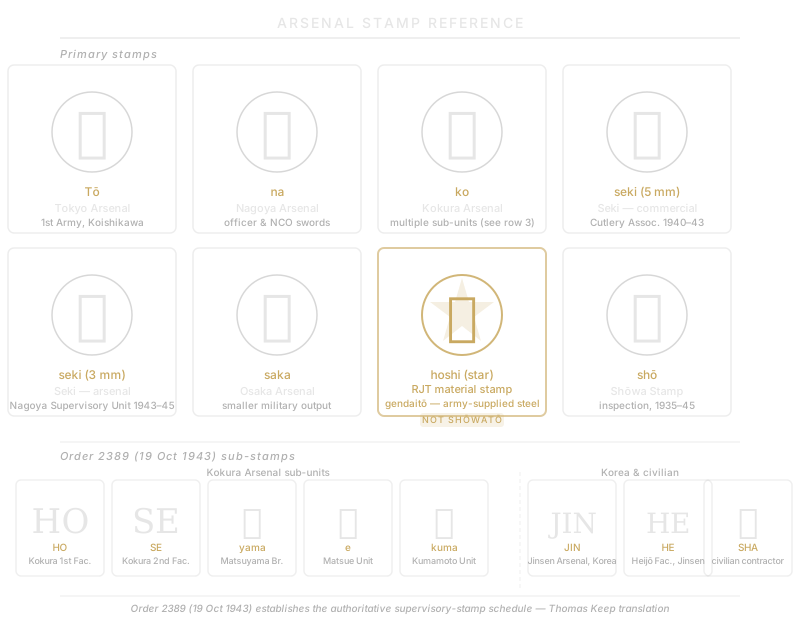
Arsenal-stamp reference chart. Each cell shows the stamp glyph, production source, and romanisation. The star stamp (highlighted in brass) is a gendaitō indicator, not a shōwatō warning.
Mantetsu (Kōa Isshin and Kōnan Essei)
The South Manchuria Railway Company (満鉄, Mantetsu) established a sword factory at its Dairen (Dalian) railway works under a Kantō Army contract. Steel development began September 1937; mass assembly-line production began December 193716146. The brand Kōa Isshin (興亜一心, “Asia, one heart”) was adopted in 1939 when the earlier Dairen Railway Factory mark was replaced. Output ran at roughly 400 blades per month from 1938, rising to about 500 per month in fiscal year 1944 against a documented Tokyo 1st Army Arsenal order of 6,000 blades16. Total production 1938 to 1945 is estimated at approximately 42,000 blades on the most recent calculation, with the older secondary-source figure of 50,000 still in circulation; both are estimates1614.
Mantetsu dating uses a three-element system. A complete Kōa Isshin blade carries an Arabic numeric serial (used from 1938, overlapping with kana from 1939); an iroha kana character identifying the year-group; and a sexagenary-cycle date, two zodiacal kanji following 昭和 with a season qualifier (e.g., 昭和辛巳春, “Shōwa kanoto-mi haru” = Spring 1941)16. The kana lets a specialist read the year; the zodiacal date is the form actually inscribed on the blade, not the ordinal year format used elsewhere. The kana series ran out in 1945, and the final 1945 production carries a new slogan, Kōnan Essei (興南一誠, “Sincerest Devotion to the Development of the South”), documented by Team Mantetsu in 2025 and not present in earlier reference literature16. Transitional Mantetsu mei (満鉄鍛造之) bridge 1943 to 1944 between the principal Kōa Isshin run and the Kōnan Essei finale.
Arsenal stamps on Mantetsu nakago are a 1942-onward phenomenon, not a late-1930s one. The Nan stamp (南) appears from 1942 when Nan-Man Arsenal began supervising SMR production; the Ren stamp (連) from 1944, when the arsenal created a dedicated Dairen unit; Army Ordnance General Order 2389 of 19 October 1943 documents the formal oversight regime16. Pre-1942 Mantetsu blades carry no arsenal stamp by design, and the absence is correct rather than suspicious. An inverted double-chevron mark (“M/W” in some references) appears on some 1942 to 1944 blades as a mid-production inspection stamp; it is not an arsenal mark.
Mantetsu blades are not nihontō. They were made from Manchurian railway steel on industrial equipment. The hada typically appears as ko-itame or nashiji-like, the hamon usually suguha, the finish careful614. Unlike most shōwatō, Mantetsu blades can display genuine nie and nioi (the 2025 study documents “a variety of nioi, nie and ko nie”), and a small number carry gunome rather than suguha; controlled-temperature hardening is the metallurgical explanation16. Nie on a Mantetsu signature does not promote it to gendaitō. Mantetsu blades appear in both Type 94 and Type 98 koshirae, and late-1945 mumei (unsigned but numbered) examples in MRS contingency fittings are documented; an unsigned Mantetsu with a serial number is not automatically irregular16. By category they remain shōwatō and are not papered by the NBTHK (no documented case is known to the author, although no formal institutional ruling on the category is known either). A documented UK example sits in the National Army Museum study collection (accession NAM. 1966-04-27-1): a Kōa Isshin inscribed Spring 1941 in zodiacal form, surrendered by Major-General Tamoto to Lieutenant-Colonel A.K. Crookshank of the Maratha Light Infantry on 20 September 1945 at Bentong, Pahang2016.
Production effectively ended with the Soviet invasion of Manchuria, which began 9 August 1945. Japan surrendered on 15 August 1945, and the Soviet occupation closed the Dairen factory shortly after6.
RJT: Rikugun Jumei Tōshō
The Rikugun Jumei Tōshō programme (陸軍受命刀匠, “army-commissioned swordsmiths”) designated individual civilian smiths as certified producers of officer-grade blades. The first names appear in the Rikugun Jumei Tōshō Meibo of 1933, and the programme was a deliberate attempt to sustain traditional production at war scale15.
Certification required the smith to submit two blades for examination. Acceptance brought regular tamahagane allocation, charcoal supply, draft deferment, and preferential food rations. In 1942 the 1st Tokyo Armoury solicited the Fukushima prefectural government directly to recruit additional smiths, including general blacksmiths with no prior sword experience, which materially diluted the pool15. The expansion is relevant to the quality debate.
The star stamp (hoshi) is an army material-inspection stamp certifying that army-supplied steel was used in the blade12. Under the RJT programme, the allocated steel was tamahagane, and the programme regulation independently required multi-fold forging. A star-stamped blade is therefore a gendaitō by virtue of both inputs and method, not of shōwatō15. The common assumption that any stamp means non-traditional manufacture is wrong here.
Approximately 130 smiths are documented with confirmed star-stamped blades, with a further 300-plus RJT smiths identified in literature sources such as the Nihontō Meikan and Tōshō Zenshū without confirmed star-stamped examples surviving15. Not all RJT blades carry the star, and the quality range across the programme is considerable.
Alongside the RJT system, two shrine-based programmes produced gendaitō at scale: the Yasukuni Jinja tōshō (active in their modern form from 1933) and the Minatogawa Jinja smiths. Both are recognised by the mainstream collector community as reliable producers of gendaitō1. Yasukuni blades in particular are sought after and command meaningful price premiums when correctly attributed.
Mount types: Type 94, 98, 95 NCO, kaiguntō
Type 94 (1934, army officers)
Introduced in 1934 as the first standardised shin-guntō, the Type 94 set the visual template the army carried through the war6:
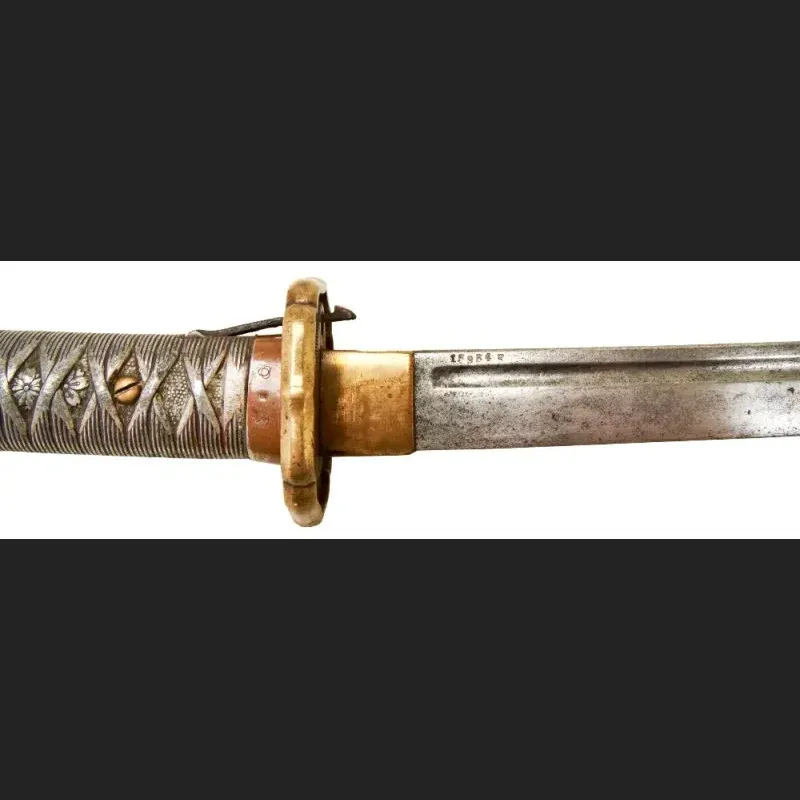
- Tsuka covered in samegawa and bound with silk ito in traditional lozenge pattern
- Tsuba of iron with cherry-blossom (sakura) motif
- Fuchi-kashira in decorated brass with matching sakura imagery
- Saya of lacquered wood with metal mounts and two suspension rings (the dual-hanging arrangement that distinguishes Type 94 from Type 98)
- Mounts in bronze and brass throughout, relatively heavy and well finished
Type 94 koshirae accepts both gendaitō and shōwatō blades. The fittings progressively simplified as the war economy bit; early (pre-1937) Type 94s carry higher-quality mounts, while later examples show aluminium substituted for brass and painted finishes replacing lacquer6.
Type 98 (1938, army officers)
The simplified successor to Type 94, externally similar in hilt style but distinguished principally by the single suspension ring on the scabbard, where Type 94 carries two6. Economy measures show progressively across the Type 98 production span: aluminium mounts replace brass; the metal scabbard gives way to a painted wooden scabbard by 1943 to 1945; cloth wrappings replace silk ito; iron fittings replace brass.
The Type 98 is by some distance the most common mount type on the UK market and accepts the same range of blades as Type 94. Late-war Type 98s, sometimes called “last-ditch” or desperation swords, present a wooden scabbard, painted metal tsuba, cloth wrap, and iron fittings; quality has collapsed visibly61. These are the cheapest gunto on the market and should be priced accordingly.
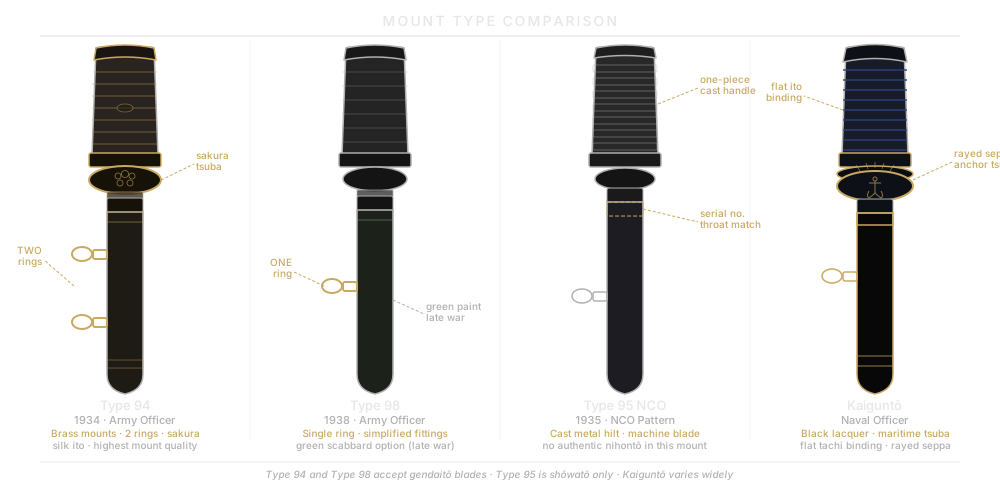
Mount-type comparison. The two suspension rings on the Type 94 scabbard are the quickest field distinction from the Type 98. The Type 95 one-piece cast handle is unmistakable. Kaiguntō navy blue ito and maritime tsuba imagery distinguish naval from army mounts.
Type 95 NCO (1935)
The Type 95 is the NCO pattern, authorised in 1935 and entering production in 1936; the first documented field allotment was the October 1937 order of 2,370 swords for the Kantō Army191. The design is machine-made throughout, intended for mass production:
- Hilt material moves through three phases: cast brass (Variation 1, 1936 to July 1938), commonly described as “copper” by collectors due to the low-zinc coppery-orange appearance, although official documentation specifies brass; cast aluminium alloy from a specification change dated 5 July 1938 (Variation 2 onwards); wooden hilts from approximately May 1944 (Variation 7 onwards), with integral moulded bosses in the menuki position rather than separately fitted menuki19. The hilt is painted across all three phases to simulate ito wrap. The material sequence brass → aluminium → wood is itself a primary dating indicator.
- Blade machine-made with a deep bo-hi (fuller), Arabic serial number stamped on the nakago.
- Matching numbers on blade and scabbard throat; mismatches indicate parts-mix and reduce value.
- Scabbards were metal across early and mid-war production and continued metal alongside the first wooden-hilt variants (from around May 1944). Wooden scabbards appear only in the final production variants. A wooden-hilt Type 95 with a metal scabbard is a normal mid-to-late-war pairing, not a parts-mix19.
On the sword knot: the Scoggin variations monograph treats this with appropriate caution. The original Type 95 sword knot was a leather knot, not a textile tassel. Brown and blue/brown textile tassels often found on surviving Type 95 swords are more typically associated with officer sword types and may be post-war replacements or mismatched fittings; the monograph declines to publish a rank-colour table for Type 95 tassels for that reason19. A tassel without independent provenance should not be used to date or rank-attribute a Type 95.
The claim that all Type 95 blades are machine-made shōwatō holds without qualification. There is no authentic nihontō in a Type 95 mount, and any listing that suggests otherwise should be treated with suspicion1.
Kaiguntō (naval officer)
The kaiguntō (海軍刀) is the naval officer’s pattern, codified by a 1937 regulation but with significant customisation in practice1718. Distinguishing features include:
- Ito in the standard regulation pattern is black or dark blue, applied in a flat tachi-style binding (tsukagashira kakemaki) rather than the lozenge ito-maki of army swords; the flat binding is itself a distinguishing feature of kaiguntō. Early regulation examples may carry brown flat ito, so the wrap colour alone does not separate naval from army mounts cleanly18
- Tsuba often with maritime motifs (anchors, waves) rather than cherry blossom, and frequently larger and more elaborate
- Scabbard in black or dark blue lacquer, sometimes rayskin-covered, with brass or lacquered-steel construction for marine corrosion resistance
- Suspension initially with two rings per the 1937 regulation. Single-ring variants appear informally throughout the war as simplified or economy koshirae; the formal requirement to reduce to one ring was Naval Directive 54 of 27 March 1945 (the rinji tokurei or “temporary exception” koshirae regulation), issued in the final months of the war. The same directive removed gilding, sarute, and the use of brass and copper fittings18
The principal dedicated naval workshop was Tenshozan Tanrenjo (天照山鍛錬場) at Kamakura, distributing largely through the Imperial Navy Officers Club (Suikōkai). Much of its output was stainless or anti-rust steel (taiseikō, 耐錆鋼; the Cox monographs use taiseikō-tō, 耐錆鋼刀), machine-produced from mill bar with a polished or etched hamon and not classed as nihontō or gendaitō17. The anchor-in-circle stamp (maru-ikari) common on kaiguntō is a general Imperial Navy acceptance mark; older English sources attributed it to Toyokawa Naval Arsenal, but Cox establishes that Toyokawa produced armaments, ammunition, and optics rather than swords, and the stamp traces to Tenshozan-finished blades carrying the general naval acceptance1718. Other naval production includes Takayama Tanrenjo (specialist early-war work), the Inaba forges (Seki / Mishima, Hattori-connected), the Kikusui forge at Minatogawa Shrine, and Sasebo Naval Arsenal17. Many naval-mounted swords carry Seki commercial blades finished and mounted elsewhere.
Blade quality therefore ranges widely: traditional gendaitō from Minatogawa or guest smiths at Tenshozan; commercial Seki blades in naval koshirae; and the large body of taiseikō stainless pieces. Kaiguntō are less common than army swords in the UK market and accordingly priced slightly higher for comparable condition.
Reading the nakago: mei, stamps, seasonal designations, production numbers
The nakago is the primary identification surface and rewards careful reading412. Begin with the basics, then layer the stamps and dates.
Mei
The mei (銘, “inscription”) on a signed blade sits on the omote, the cutting-edge-right side when the blade is held with the edge up. On a gendaitō the smith’s name and sometimes school or location is carved by hand in classical kanji style. On a shōwatō, no mei is typical, the blade is anonymous by production design. Ancestral blades in military mounts may carry classical pre-Meiji mei.
Stamps
Several distinct stamp types appear on WW2 nakago, and the type matters more than the presence:
- Arsenal stamps identify production source. Army Ordnance General Order 2389 (19 October 1943) is the authoritative schedule of supervisory marks: Tō for Tokyo 1st Army Arsenal, na for Nagoya, seki for the Seki Supervisory Unit, saka for Osaka, ko for Kokura with sub-stamps (HO, SE, yama, e, kuma for its various branch units), JIN and HE for the Jinsen (Korea) arsenals, and SHA for civilian contractor factories12. Each mark designates inspector jurisdiction and often distinguishes officer (Type 1) from NCO/enlisted (Type 2) swords.
- The Showa stamp (昭) appears from 1935, concentrated on 1940 to 1945 blades. It marks military inspection or acceptance and is not in itself a mark of shōwatō status. Most Showa-stamped blades are non-traditional, though the evidence is not closed: Ohmura’s 1939 inspection survey suggests traditionally made blades were sometimes excluded from the inspection regime entirely, and a stamped blade is not automatic proof of non-traditional manufacture126.
- The star stamp (hoshi) designates RJT manufacture with army-supplied tamahagane and is a gendaitō indicator1512.
- The Minatogawa kikusui mon (chrysanthemum-on-water) identifies Minatogawa Shrine smiths and sits in the contested zone between full gendaitō and shōwatō6.
Serial numbers
Arabic numerals on the nakago appear on shōwatō and Type 95 blades. Arsenal attribution is made through the stamp identity (Tō for Tokyo 1st Army Arsenal, na for Nagoya, ko for Kokura, and so on per Order 2389) rather than reading orientation12. The serial number itself, if matched to the scabbard throat, confirms the blade and mount have not been separated. Mismatched numbers always reduce value and frequently indicate a parts-mix marriage.
Seasonal date designations
Gendaitō blades commonly carry traditional Japanese dates rather than Arabic numerals, using the ordinal year form:
- Era name and year, e.g., 昭和十七年 (Shōwa jūshichi-nen, 1942)
- Season qualifier: 春 (haru, spring), 夏 (natsu, summer), 秋 (aki, autumn), 冬 (fuyu, winter)
A complete inscription reads, for example, “Shōwa jūshichi-nen haru” (Spring 1942). This is the standard gendaitō dating form, and its presence on the nakago strongly suggests traditional manufacture. Arsenal shōwatō use Arabic serial numbers, not this form41.
Mantetsu kana and zodiacal dating
Mantetsu dates work differently from the ordinal gendaitō form. Kōa Isshin blades carry an iroha kana identifying the year-group, an Arabic serial, and a sexagenary-cycle inscription (two zodiacal kanji following 昭和, then a season). The National Army Museum’s Tamoto Mantetsu (NAM. 1966-04-27-1) reads 昭和辛巳春 (“Shōwa kanoto-mi haru”, Spring 1941), the zodiac pair 辛巳 standing in for the year number1620. The Kōnan Essei slogan (興南一誠) dates a blade to early 1945; transitional Mantetsu mei (満鉄鍛造之) bridge 1943 to 1944.
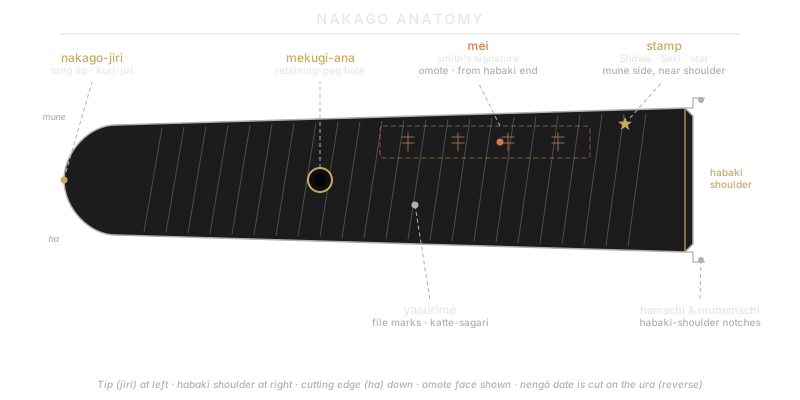
Nakago anatomy reference. The mei is cut on the omote face and read from the habaki end; the nengō date sits opposite, on the ura. The mekugi-ana is the retaining-peg hole. Arsenal stamps (the Showa, Seki, or star mark) sit high on the mune side, above the mekugi-ana and toward the habaki shoulder, not down by the jiri.
What the nakago cannot tell you
Nakago rust does indicate age, but rust can be artificially induced and an expert will recognise both genuine and forced patinas. Nakago shape and the hi-ending position relative to the habaki are structural age indicators a specialist reads in person, not from photographs5. For the buyer who is not yet that specialist, the safer policy is to send good photographs of the nakago to the Nihontō Message Board or the Token Society of Great Britain before committing.
The six-point authenticity check
The check below follows the established kantei method, adapted for WW2 production. It is not a substitute for an expert in front of the blade, but it will catch most misattribution and most outright fakes.
Check 1 — Nakago examination
File marks (yasurime), rust colour and distribution, stamp presence and type, mei style (hand-carved versus machine), serial number if present. The nakago is the single most diagnostic surface54. A handful of specifics to read:
- Yasurime should be regular, period-appropriate, and consistent across the nakago.
- Rust should be uniform in colour and texture; freshly induced rust looks orange, blotchy, and lacks the deep brown-black of decades.
- A hand-cut mei shows variation in stroke depth and character spacing. A machine-stamped or etched mei is mechanically regular.
Check 2 — Hamon character
A water-quenched gendaitō shows nie (bright, crystalline activity) along the yakiba35. Oil-quenched or machine-hardened shōwatō shows a flat, uniform line, sometimes absent altogether. A false hamon is etched into the surface and has the mechanical repetition of a printed pattern, no depth, no activity at the boundary. Etched lines tend to be visible on first inspection under raking light.
Check 3 — Jihada examination
Folded tamahagane produces visible hada in the ji: itame, mokume, masame, or variations of these3. An oil-tempered or machine-made blade typically shows no hada or a faint, undifferentiated grain. Mill-steel blades will be grain-free under polish.
Check 4 — Koshirae dating consistency
Does the mount type match the blade? A nihontō blade in a Type 95 NCO mount should raise immediate questions, the combination did not occur in regulation use. An ancestral blade shortened for military mounting is period-authentic but is not a “military blade” by manufacture. Cross-check stamp dates against koshirae type. Late-war painted-wood scabbards do not pair with early high-quality fittings61.
Check 5 — Physical integrity
Matching serial numbers on Type 95 and late-war arsenal swords; habaki fit; scabbard lining condition; metal-versus-wood scabbard appropriate to period. A loose habaki may indicate a blade-mount marriage rather than an original pairing. A blade rattling in its saya has either lost its habaki or been mounted into a scabbard it was never made for.
Check 6 — Provenance chain
Documentation (surrender tags, capture papers, bring-back letters) adds value and historical interest but does not authenticate the blade itself1. A blade with excellent provenance but no hamon is still a shōwatō; a gendaitō without papers is still a gendaitō. Provenance affects price, not nature, and an honest seller will keep that distinction clear.
Worth noting: the most common issue in this market is not outright fakes but misattribution, a shōwatō sold as a gendaitō or an ancestral blade represented as an RJT piece. Outright modern fakes of WW2 mounts do exist but are generally detectable by specialist examination, and the NBTHK shinsa process catches them4.
Provenance: bring-back papers, GHQ tags, surrender registers, family histories
Documentation falls into five rough tiers, in declining order of value to the buyer.
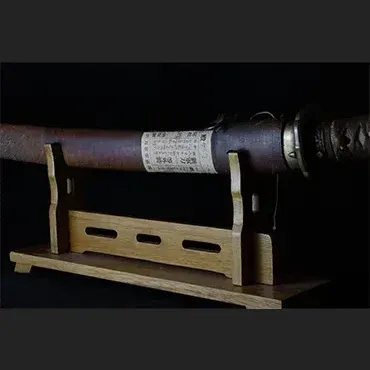
Surrender tags
The most common physical documentation, attached to the scabbard at the ring or throat. Format is usually a small silk-cloth strip, sometimes paper, written in Japanese brush characters with the owner’s name, address, unit, and rank, often added with English notes by US forces2. The “CADET” annotation appears on some examples. Tags were issued informally at police stations and unit collection points, never centrally standardised, and survive in great variety. A silk-cloth tag in brush-written Japanese with a family name and a military rank is the classic form. UV examination can reveal characters that have faded under sunlight.
The tag evidences the surrender or confiscation chain. It does not authenticate the blade.
Unit-level capture papers
Written receipts or registers kept at company or battalion level recording swords collected from specific Japanese officers or units. Format varies enormously by capturing nation. US forces were generally the most systematic; British forces in India Command, Burma, and the Pacific less so. A typed or handwritten document on military letterhead identifying the sword by description, the date and place of capture, the capturing unit and officer’s name, and the Japanese owner’s name is the strongest form of bring-back documentation a UK collector typically encounters.
The strongest end of this tier looks like NAM. 1966-04-27-1 at the National Army Museum: a 1941-dated Kōa Isshin Mantetsu surrendered by Major-General Tamoto to Lieutenant-Colonel A.K. Crookshank OBE of the Maratha Light Infantry on 20 September 1945 at Bentong, Pahang20. A privately held bring-back will rarely carry a Major-General’s name, but the structure to look for in the paperwork is the same: who surrendered, to whom, when, where.
ATIS tags
The Allied Translator and Interpreter Section, established 19 September 1942, processed captured Japanese documents and materials. ATIS tags occasionally appear on swords taken from Japanese command positions and represent a higher tier of documentation than unit-level tags, though the ATIS link runs primarily to intelligence rather than weapons processing13.
GHQ collection tags and SCAPIN-12
During the 1945 to 1952 occupation, GHQ organised mass collection of weapons across Japan. Tags from GHQ processing facilities survive on some swords and are post-surrender rather than battle-capture documents. The framework is generally cited as SCAPIN-12 (September 1945), permitting retention of swords “if household treasures; swords issued by Japanese Government to be turned in with other weapons of war,” followed by Emperor’s Decree No. 300 of 1 June 1946 exempting “swords and valuable items as art.” Both items are widely repeated in NBTHK institutional history and collector literature; primary text confirmation requires NARA or NDL archive access, and the dates and numbers here follow the established secondary citation chain. Together they let gendaitō and ancestral nihontō remain in Japanese collections through the occupation, and the NBTHK’s founding in February 1948 was a direct institutional response10.
Family provenance letters
Post-war family documentation, letters from the capturing service member to family members, obituaries, estate records. Useful for narrative value and insurance documentation; not independently authenticating. The weakest tier, and the most common.
Value impact
Fully documented swords (surrender tag, unit capture paper, clear ownership chain) sell at a meaningful premium over undocumented comparables, somewhat tighter in the UK than in the US but still significant. A clean Type 98 with matching numbers and a documented Burma-capture letter trades materially above the same blade with no story attached.
What to avoid, and where to find help
What to avoid
- eBay and unspecialised online auction without prior specialist knowledge. Photos of the nakago stamps, the hamon, and the jihada are the minimum due diligence; sellers who provide only handle-and-saya photos should be passed over.
- “Katana” listings that do not specify Type or show nakago photographs. The category usually conceals martial-arts practice swords (modern, often Chinese-manufactured) that conflate with genuine period pieces and carry no provenance.
- Sellers who cannot confirm country of manufacture. Under the 2008 Order the burden of proving Japanese origin rests with the possessor, and a sword without that chain of evidence is hard to defend at customs or in court.
- Etched false hamon. The acid-etched line has the mechanical regularity of a printed pattern, no nie, no nioi, no depth at the boundary. Visual identification is straightforward: a genuine hamon has a living boundary with scattered nie crystals, ashi running into the temper line, and visible depth; an etched line has none of these.
- Separated mounts. A blade without its habaki is difficult to store, display, or insure safely; a mount without its blade is an ornamental item, not a sword. Pay accordingly.
The Token Society of Great Britain
The primary UK nihontō organisation, founded 1964, publishing Token Magazine and maintaining a member archive that includes back issues of the Nihontō journal11. Members include specialist dealers and serious collectors, and study days and the annual meeting are by far the best entry point for any UK buyer who intends to learn before committing capital. The community offers the same kind of vetting and education that takes years to assemble from books alone.
Nihontō Message Board
The Nihontō Message Board is the primary online collector community, and a reliable place to get identification help before committing to a purchase. Posting photographs of a nakago lets experienced members identify arsenal stamps, flag fakes, and call out misattribution. The community knowledge runs deep, and the arsenal-stamps thread is a working reference updated continually.
After purchase: care, papering, insurance
Basic care
Japanese swords require minimal but consistent maintenance. The two risks that damage most blades in private hands are moisture ingress and contact corrosion from finger oils. Handle with clean dry hands or cotton gloves and store in a dry environment.
Chōji oil is the traditional preparation: roughly 99 percent mineral oil with a small fraction of clove oil for fragrance. Applied thinly with a clean cloth to the entire blade, a light coat every two months is sufficient for a WW2 shōwatō stored properly (horizontal in saya, blade upward, dry environment).
Uchiko, a silk-wrapped ball of fine polishing-stone powder, removes residual old oil before re-application. Tap lightly along the blade to distribute powder, wipe clean, re-oil. For WW2 military blades with original polish, use uchiko sparingly. The polish on many guntō was not high quality and repeated uchiko can dull rather than maintain.
Storage is horizontal, blade upward (edge up by tradition), in the original saya. Leather sheaths hold moisture and are unsuitable for long-term storage; if the saya is damaged, a wooden shirasaya (plain wooden storage mount) is the proper housing.
NBTHK papering
Eligibility runs as follows. Gendaitō WW2 blades can receive NBTHK papers10. Shōwatō blades made on industrial equipment are not considered nihontō and are generally not papered; Mantetsu blades fall into this group, and no documented instance of a Mantetsu receiving NBTHK papers is known to the author. The entry tier, Hozon, requires the blade to be deemed “worthy of preservation,” and a well-made RJT gendaitō with nie in the hamon can pass at this level.
All-in cost from the UK is meaningful: the submission fee itself, plus agent handling, plus insured shipping both directions. Tokubetsu Hozon costs more again, and Jūyō Token more again. The submission fee is not refunded if the blade fails. Overseas collectors cannot submit directly; a licensed Japanese agent or NBTHK member dealer is required. Sessions run four to five times a year, and the timeline runs two to four months per cycle.
Value impact is genuine when the underlying blade carries the work. Hozon on a credible gendaitō with a recognised smith makes the exercise rational; on a routine shōwatō, papering is neither applicable nor economic.
Insurance
UK specialist insurance for antique arms and militaria is available through specialist brokers (Hiscox, Endsleigh specialist policies, Lloyd’s syndicates). The insurer will require a written valuation for higher-value pieces; a UK-based nihontō specialist can provide this.
Customs and declaration
Importing a genuine pre-1954 Japanese sword into the UK is legal under the 2008 Order exemption8. The item should be declared at customs as “antique sword, Japan, pre-1954” to establish the exemption record. Keep copies of any export permit from Japan, which is required for registered cultural property; a typical WW2 guntō does not carry that designation and an export permit is not normally required, but a Hozon-papered gendaitō may.
The wider point closes here. A WW2 Japanese sword is, in UK law and in collector practice, an accessible category. An honest reading of the nakago, attention to the hamon and the hada, the patience to ask the Nihontō Message Board and the Token Society before committing capital, turns what looks like an opaque corner of the antiques market into something a careful buyer can handle well. The romance of the bring-back blade survives that scrutiny. The price one pays for the romance, once the categories are clear, is the price one chooses, not the price one is told.