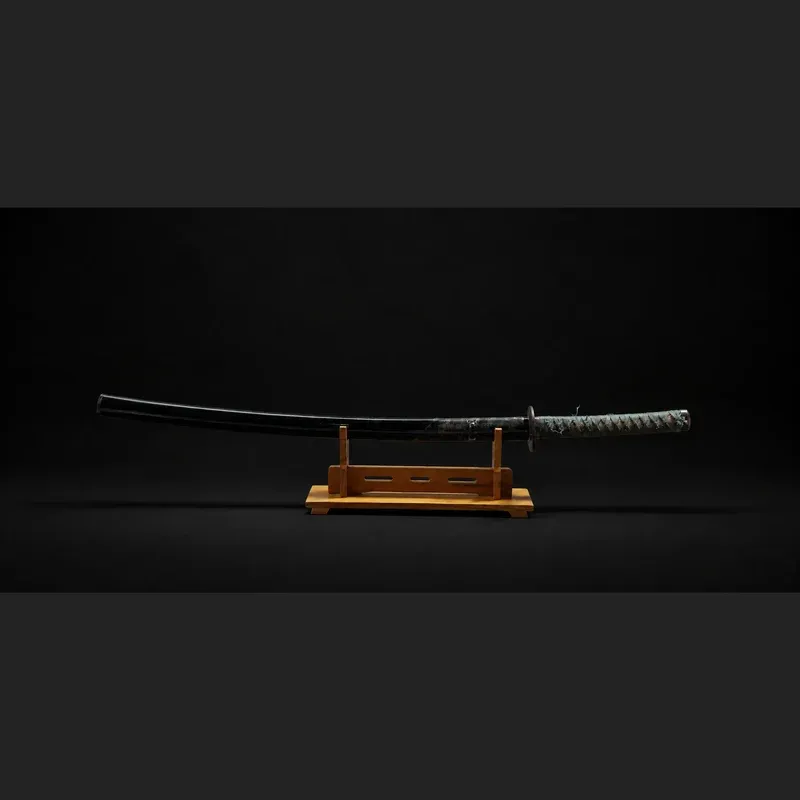
石堂 School
The Ishidō school holds an unusual position in nihonto history: a group of Shintō-period smiths who turned away from the prevailing fashions of their own age to revive, deliberately and with conspicuous skill, the flamboyant chōji-midare hamon of Kamakura-period Bizen. Ishidō work is, in essence, a Shintō tradition wearing a Kotō face: Bizen-style chōji in nie rather than the nioi-based original. Recognising this gap between the model and the execution is the heart of attributing it correctly.
History and lineage
The school takes its name from the Ishidō locality and traces its sense of identity to the Ko-Ichimonji and Fukuoka Ichimonji traditions of Bizen, whose extravagant chōji it consciously took as a model. Its smiths flourished across the seventeenth century, the early decades of the Shintō period, and dispersed into several regional branches rather than remaining a single workshop. The most celebrated is the Korekazu (是一) line of Edo, whose smiths signed with the honorific title Musashi Daijō (and later Musashi no Kami) Fujiwara Korekazu; an Ōsaka branch worked under names such as Tameyasu and Mitsuhira; a Kii (Kishū) branch served the Tokugawa cadet house in that province; and a Fukuoka branch in Chikuzen, sometimes called Fukuoka Ishidō, returned the tradition close to its Bizen geographic roots. These branches share an aesthetic programme more than a single bloodline, which is why kantei of Ishidō work proceeds by reading the hamon and steel rather than by trusting the name alone.
The Edo Korekazu line proved the most enduring. The Musashi Daijō Fujiwara Korekazu title passed down through successive generations of smiths who kept the Ishidō chōji alive long after the broader school had faded — through the Shinshintō period and beyond the Haitōrei edict of 1876 that ended the wearing of swords. The line continued into the modern era and closed with Musashi Ishidō Teruhide (石堂輝秀, 1900–1982), recorded as the tenth and last generation of the Edo and Tokyo Korekazu line and a descendant of Musashi Daijō Fujiwara Korekazu. Teruhide worked through the Shōwa period — he was ranked in the wartime swordsmith assessments and produced gendaitō judged worthy of NBTHK preservation papers — and with his death the long Ishidō Korekazu succession came to its end.
Identifying characteristics
The defining feature of Ishidō work is a tall, vigorous chōji-midare hamon modelled on Fukuoka Ichimonji — clove-shaped heads rising in busy, irregular sequences, often with conspicuous ashi and yō. The decisive point of difference from the Kamakura Bizen original lies in the texture: where genuine Bizen chōji lives in a misty nioi-guchi, Ishidō chōji is typically rendered in bright nie, a Shintō-period characteristic the smiths did not — and arguably could not — fully suppress. Many Ishidō blades also show a form of utsuri-like shadow in the ji; scholars debate how far this is true Bizen-style utsuri and how far it is an artefact of the Shintō steel and polish, and the question remains genuinely unsettled. The hada is usually a tight ko-itame, at times approaching the nearly grainless muji surface common to Shintō work, cleaner and stiller than the active grain of Kamakura Bizen. Sugata follows Shintō katana conventions — a healthy, well-proportioned form with a chu-kissaki — rather than the koshi-zori tachi shape of the blades being emulated.
Mei conventions vary by branch and generation. Edo Korekazu smiths signed with the Musashi Daijō or Musashi no Kami Fujiwara Korekazu titles; the Ōsaka and Fukuoka smiths signed their own names. The modern Teruhide is recorded signing in more than one manner — a long mei, a simple “Ishidō saku,” and a compact two-character niji-mei reading 輝秀 — so the nakago must be read against the specific generation rather than against the school name in the abstract.
Why this matters for collectors
Ishidō offers something distinctive: technically accomplished Shintō work that openly courts comparison with the most admired hamon of the classical age. A sound Ishidō blade with vivid chōji is an instructive piece to own precisely because it sits at the boundary between Kotō model and Shintō execution, and it rewards the kind of close looking that kantei demands. The pitfalls are twofold. First, the deliberate Bizen resemblance means Ishidō blades are sometimes optimistically catalogued as Bizen itself; the nie-based texture and Shintō sugata are the correctives. Second, the prestige of the Korekazu name invites over-attribution across the line’s many generations. As with the other traditions here, NBTHK papers are the clearest resolution, and an attribution resting on a signature alone should be weighed against what the steel and hamon actually show.
If you’re hunting for an Ishidō piece, we welcome enquiries. Many of the best examples never appear on public listings.