青江 School
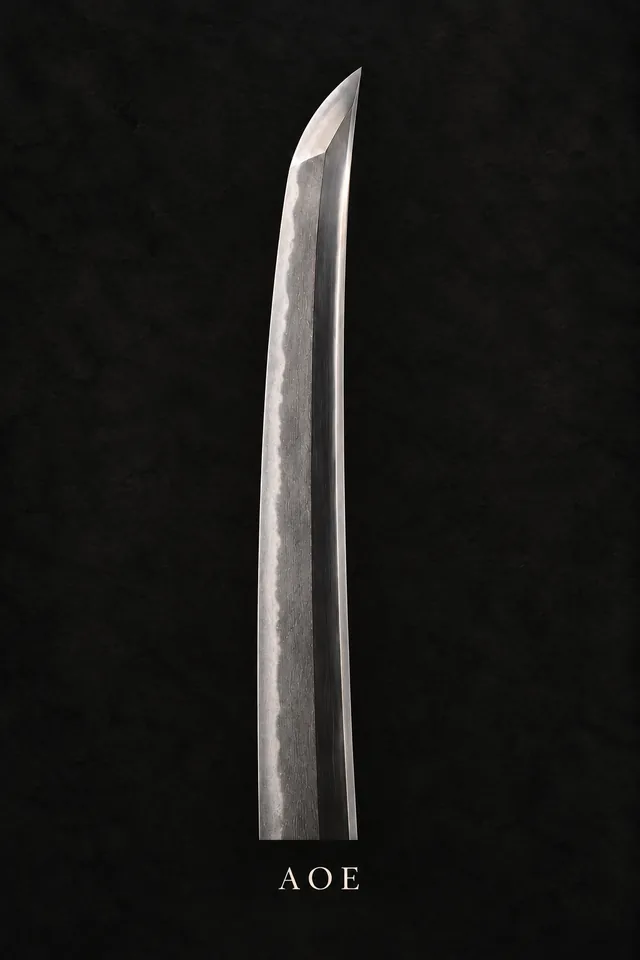
The Aoe school of Bitchū province (modern western Okayama Prefecture) worked along the Takahashi river, and its steel tends to announce itself. The skin is a fine, tight chirimen-hada, the “crepe-silk” grain, frequently carrying dark, carbon-rich patches called sumigane (or sumihada) and a banded midare-utsuri known as dan-utsuri (段映り, “stepped” utsuri). No single one of these is decisive. Together they point firmly toward Bitchū rather than its more famous neighbour, Bizen.
History and lineage
Aoe activity divides into three broad phases. Ko-Aoe (“old Aoe”) spans the late Heian and early Kamakura periods, the work clustering around early figures such as Noritaka and Moritsugu; these are among the most refined and sought-after Aoe blades. Chū-Aoe (“middle Aoe”) runs from the mid-Kamakura through the Nanbokuchō period, carried by smiths including Tsunetsugu, Tsuguie, and Sadatsugu, and represents the school’s broad maturity. Sue-Aoe (“late Aoe”) denotes the Muromachi-period continuation, generally regarded as a decline from the earlier heights. The divisions are conventional scholarly groupings rather than sharp lines, and individual smiths are sometimes placed at the boundaries differently by different authorities.
One frequently cited tendency is worth noting carefully: Aoe smiths are often described as favouring ura-mei — signing on the reverse (outward) face of the nakago rather than the omote. Treat this as a tendency to corroborate per smith and generation, not an absolute rule; it is a supporting observation, never a sole basis for attribution.
Identifying characteristics
The jihada is the school’s signature: a notably fine and tight chirimen-hada, an itame/mokume so closely worked it resembles crepe silk, often laced with bright chikei. Within the steel appear sumigane — dark, carbon-rich patches — and the banded dan-utsuri, which together are near-diagnostic for Aoe when found in combination. The hamon ranges from a calm chū-suguha and ko-midare to a livelier ko-chōji-midare. Critically, Aoe preserved the backward-slanting saka-chōji and saka-ashi (ashi leaning toward the base) well after other Bizen-area schools had abandoned the older slant — a genuinely useful tell. The sugata tends to koshizori with generous niku and a high shinogi, a robust construction that itself helps separate Aoe from Bizen work.
How this differs from Bizen repays study, since the two are easily confused: Aoe’s chirimen-hada is finer and tighter than the typical Bizen itame, and the combination of dan-utsuri, sumigane, and the slanting hamon points to Bitchū. The high shinogi and abundant niku owe something to neighbouring Yamato sensibilities as well, though the steel remains distinctly Aoe.
Why this matters for collectors
Aoe is one of the great Kotō schools, yet it lives somewhat in Bizen’s shadow, and that can work to a discerning collector’s advantage. A sound Ko-Aoe or Chū-Aoe blade offers steel of a refinement few traditions match, often at a more approachable level than comparable Bizen work. The principal pitfall is misattribution. A nioi-based midare hamon with some utsuri readily attracts a Bizen label, and the corrective is exactly the cluster described above: chirimen-hada, sumigane, dan-utsuri, and any surviving slant in the hamon. As ever, NBTHK papers are the soundest resolution. An attribution resting on a signature alone, particularly given the ura-mei question, should be weighed against what the steel itself shows.
If you’re hunting for an Aoe piece, we welcome enquiries. Many of the best examples never appear on public listings.
