正廣 Smith
Masahiro is the second great name of the Hizen school. Where Tadayoshi was the founder and his descendants the main line, the Masahiro smiths were the closest branch of the same Hashimoto family, working in the same Saga forges for the same Nabeshima lords, and signing with the same care. Four generations used the name across roughly a century, and because two of them held the same court title, Kawachi Daijō, a blade signed that way needs its generation settled before anything else is said about it.
History and lineage
The first Masahiro (1607 to 1665) was born Hashimoto Sadenjirō, later Yashichibei, the son of Hashimoto Yoshinobu, who had married into Tadayoshi’s family. Japanese sources call him Tadayoshi’s grandson; Western writers sometimes say nephew. The closeness is not in doubt, only the exact degree. He trained under Tadayoshi and his father, signed Masanaga at first, and took the name Masahiro in 1625, the “hiro” said to have been granted by the Nabeshima lord Katsushige, whose favoured smith he became. He received the honorary court title Kawachi Daijō in 1628 and used it in his signatures from about 1639. Fujishiro rates him jō-saku, and his blades are ranked wazamono for cutting. The first Masahiro is generally counted the finest of the branch smiths of Hizen.
His son, the second Masahiro, died in 1699 at seventy-three. He went by different titles: Musashi Daijō in 1660, Musashi no Kami the following year, and after his father’s death Kawachi no Kami in 1665. So a signature reading Kawachi no Kami Masahiro is the second generation, never the first or the fourth. He is also rated jō-saku, and worked in suguha as well as a notare with small gunome and ashi.
The third generation signed Masanaga throughout and never used the Masahiro name. He worked around the Jōkyō era of the 1680s and the record of him is thin.
The fourth Masahiro was Hashimoto Tomonoshin. He signed Takemasa as a young man, and on the same day in 1708 received the title Kawachi Daijō and took the name Masahiro. He signed that way for twenty-five years and died in 1733 at sixty-one. Fujishiro rates him chūjō-saku, a step below the first two generations, and records his hamon as notare mixed with gunome and ashi, or suguha. Among his recorded signature forms is one that shortens Fujiwara to 藤氏, “of the Tō clan”, and that abbreviation is a useful tell for his hand.
Identifying characteristics
The Masahiro smiths worked squarely in the Hizen manner, so the school page is the right frame. The jigane is the tight, fine ko-itame called konuka-hada, still and even under good light. The hamon is either a quiet suguha or a gunome-midare riding on a gentle notare, with small ashi dropping from the peaks and a bright, crisp habuchi in ko-nie. The bōshi is usually a small round turnback, sometimes with the midare carrying on into the point. Sugata follows the period: a well proportioned katana with moderate curve and a chū-kissaki.
The mei is cut in a single orderly column of even characters down the nakago, and the title in it does most of the work of dating. Kawachi Daijō belongs to the first generation from 1639 to 1665 and to the fourth from 1708 to 1733; Kawachi no Kami belongs to the second. The first generation’s title was held so long that his blades are far more numerous than the fourth’s, which is one reason a fourth-generation Kawachi Daijō blade with papers is not often seen. Between the two Kawachi Daijō smiths, the abbreviated 藤氏 form points to the fourth, but the NBTHK paper, which brackets the generation after the signature, is the thing to rely on.
Why this matters for collectors
The generation is the value. A first-generation Masahiro with Tokubetsu Hozon papers sits in the same bracket as good mainline Tadayoshi work; a fourth-generation blade with the same paper is a respectable mid-rank Hizen sword at a fraction of that. Both carry the same title on the tang, and dealers and cataloguers do not always say which they mean. Read the paper, not the title, and if a listing calls a Kawachi Daijō blade “Masahiro” without a generation, ask.
What the fourth generation offers is the Hizen manner, fine steel and a disciplined hamon from a smith of the Tadayoshi family, at a price that the founders’ work has long since left behind. For a collector who wants a papered Hizen katana from the family itself, without paying for the first generation’s name, it is a sensible place to look.
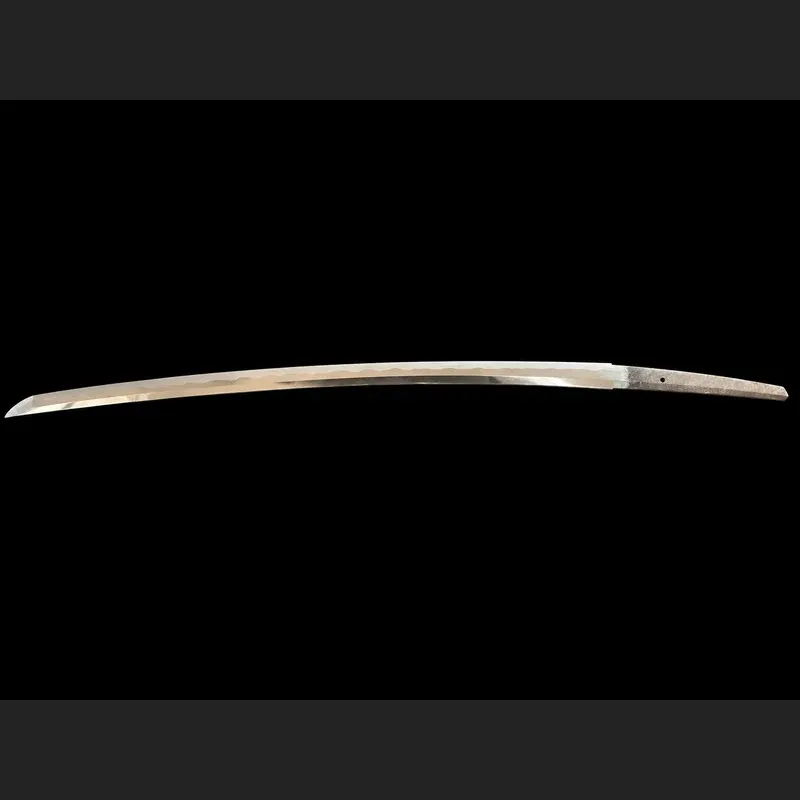
We presently have a fourth-generation Kawachi Daijō Masahiro katana with Tokubetsu Hozon papers naming the generation, in a period koshirae. For the tradition behind him see the Hizen school, and for how the Shintō period fits the wider story see the periodisation guide.
If you are weighing a blade signed Masahiro, we welcome enquiries, and would counsel papers that name the generation before any commitment.