Katana
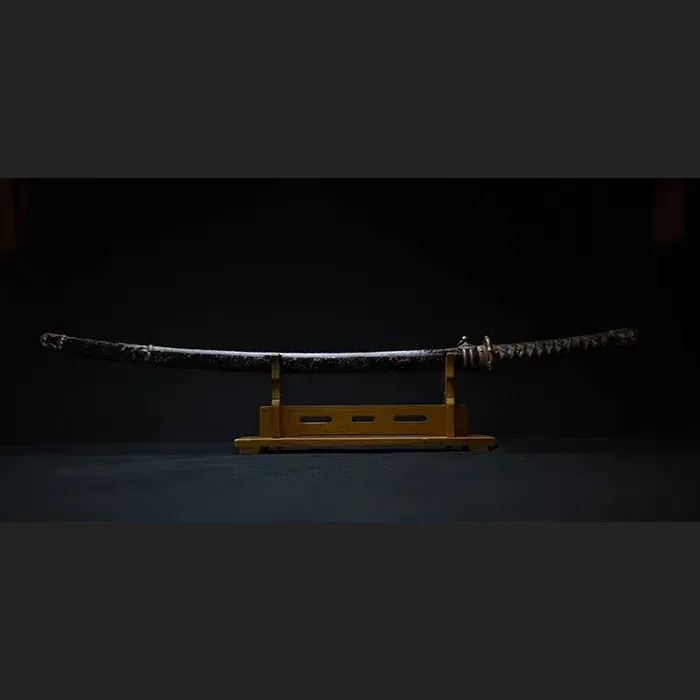
JB-1012 Katana
Koa Isshin Mantetsu
Spring 1943 Koa Isshin Mantetsu (serial HI 624) — among the last of the recorded 1943 Mantetsu blades, with the muji-hada and suguha hamon that define the type.
Katana
JB-1037
£7,500
A signed katana by the fourth-generation Hizen Masahiro, Kawachi Daijō, made between 1708 and 1733, in fresh polish with NBTHK Tokubetsu Hozon papers and a period koshirae with dragon tsuba and lobster fittings.
肥前國河内大掾藤氏正廣
Hizen no kuni Kawachi Daijō Tōshi Masahiro
Masahiro of the Fujiwara clan, holder of the honorary court title Kawachi Daijō, of Hizen province
This is a signed Hizen katana with papers that name its maker and his place in the line. The nakago carries an eleven-character mei reading Hizen no kuni Kawachi Daijō Tōshi Masahiro, and the NBTHK has examined the blade and issued a Tokubetsu Hozon certificate that attributes the signature to the fourth generation of the name.
The Masahiro line belongs to the Hashimoto family of Saga, the family of Tadayoshi himself. The first Masahiro (1607 to 1665) was Tadayoshi’s grandson by marriage, trained in his workshop, and became the favoured smith of the Nabeshima lord Katsushige, who granted him the honorary court title Kawachi Daijō. His son took a different title, Kawachi no Kami, and the third generation signed Masanaga, so the title Kawachi Daijō sat unused until the fourth generation, Hashimoto Tomonoshin, received it afresh in 1708 and took the name Masahiro at the same time. He signed that way for twenty-five years and died in 1733 at the age of sixty-one. A blade signed Kawachi Daijō Masahiro is therefore either the first generation or the fourth, and the NBTHK paper puts this one with the fourth. We price it as a fourth-generation blade. Fujishiro rates the fourth generation chūjō-saku, a step below the jō-saku given to the first two, and describes his work as notare mixed with gunome and ashi, which is what this blade shows.
The blade is shinogi-zukuri with an iori-mune, a moderate torii curve and a chū-kissaki, the proportions of a mid-Edo katana. The paper records the nagasa as 2 shaku 3 sun 5 bu, which is 71.2 cm, and we will confirm the figure with a rule. It has had a full Japanese polish and the steel is bright. The hamon is a gunome-midare riding on a gentle notare, the rounded peaks in a fairly even rhythm with small ashi dropping from them, and the habuchi is crisp and bright in the way of nie rather than soft nioi. In the point the midare carries on into the boshi and settles into a small round turnback. Studio light on a black ground does not show the hada, so we make no claim for the fine konuka-hada the Hizen smiths are known for until it can be seen in hand.
The tang is ubu, with a single mekugi-ana and the signature cut in one orderly column of even characters, the Hizen habit. The eighth and ninth characters are 藤氏, “of the Tō clan”, a shortened way of writing Fujiwara that is recorded for this generation. One small point is worth knowing before a buyer raises it: the NBTHK scribe wrote the final character as 弘 where the tang has 廣. Both are read hiro and the substitution is a common one in brush transcription, and the paper carries its own photograph of this tang, so there is no doubt which blade it belongs to. The patina is an even dark brown.
The paper is a Tokubetsu Hozon Tōken certificate, number 154813, issued on 12 August 2010 in the foundation-era format the NBTHK used before its 2012 reorganisation. It comes with the blade.
The koshirae is a period mounting of the kind Hizen blades wore at home. The tsuba is iron, carved in shallow relief with a dragon among clouds and finished with a gilt fukurin around the rim, in the Nagasaki manner. One hitsu-ana is plugged and the other has lost its plug, and the fukurin is worn through in places. The fuchi and kashira carry spiny lobsters in high relief in copper with gold detail, one curled around the fuchi and the other laid across the kashira, and the menuki under the wrap are a rat in shakudō and gold. The fuchi is signed Teruhide with a kao. Its previous cataloguing gave this as Ōmori Teruhide, the Edo master of that school, but we have not yet photographed or read the signature ourselves, and his is among the most copied names in sword fittings, so we offer it as a signed fuchi-kashira and no more. The tsuka keeps its original black silk wrap over rayskin that has aged to the colour of honey. The saya is lacquered a deep green flecked with gold and green, with a band of plain red lacquer at the waist and a shaped metal kojiri, and it carries a brown braided sageo. A plain wood shirasaya comes with it, so the blade can rest in storage wood rather than in the lacquered saya.
Age-verified delivery · UK / EU / international · Insured to declared value.
Spring 1943 Koa Isshin Mantetsu (serial HI 624) — among the last of the recorded 1943 Mantetsu blades, with the muji-hada and suguha hamon that define the type.
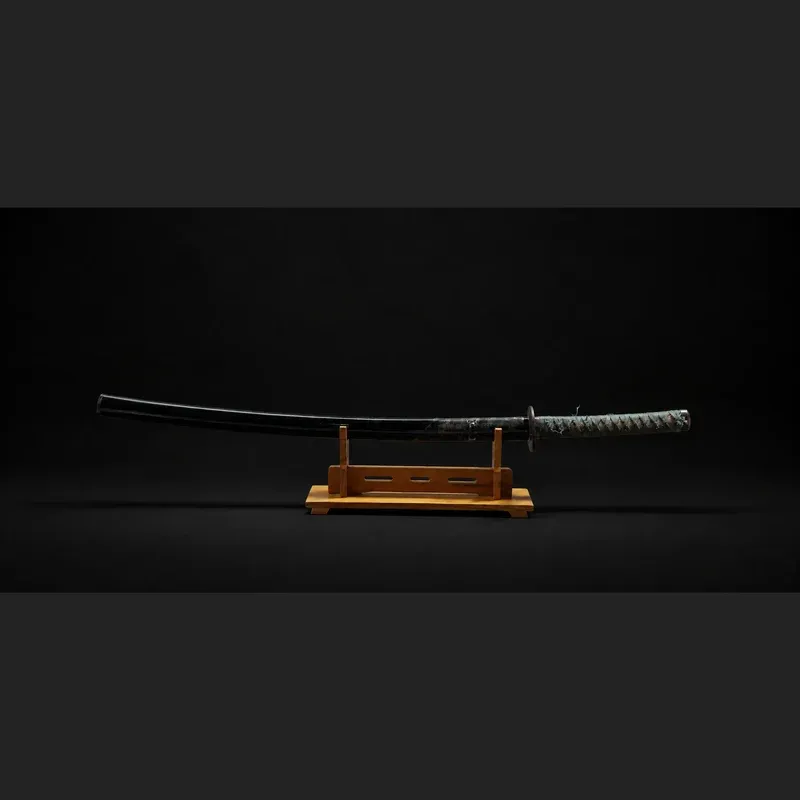
A katana signed 輝秀 (Teruhide) — the niji-mei of Musashi Ishidō Teruhide, last of the Ishidō Korekazu line — in characterful civilian koshirae bearing a manji family crest.
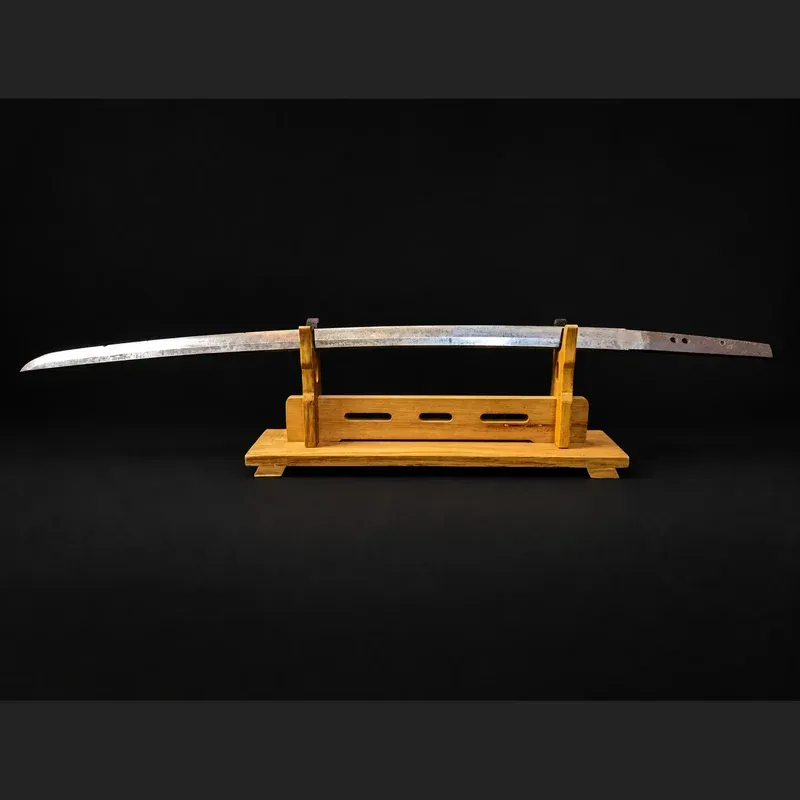
Mumei kotō-period blade with a clean gunome hamon, remounted at least three times across centuries of use. Now a bare blade with a slight bend, noted in the listing.
